France and Japan to jointly study MOX fuel recycling options
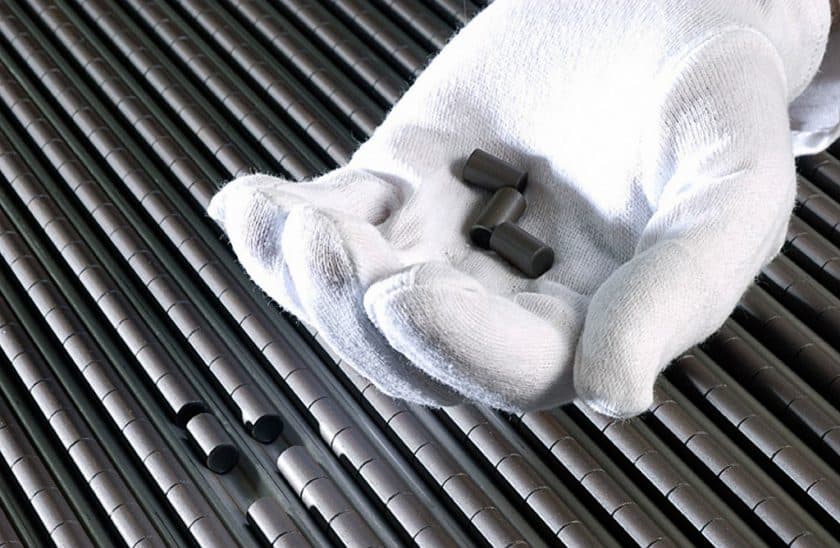
The Federation of Electric Power Companies of Japan (FEPC) has announced cooperation with French company Orano on demonstration research and development of technologies for reprocessing mixed-oxide (MOX) fuel. This fuel is already produced from reprocessed spent uranium fuel.
To continue using nuclear energy, countries need to process and store spent fuel safely and sustainably. This process also includes recycling MOX nuclear fuel discharged from Japanese reactors that have used this type of fuel in the past.
So far, operators in Japan have loaded MOX fuel into only four reactors. However, electric utilities expect to load MOX fuel into at least 12 reactors by the end of 2030.
Japan has recognised since the 1950s that, as a country poor in energy resources, it must recycle uranium and plutonium from spent nuclear fuel. Until 1998, Japan sent most of its spent nuclear fuel to France and the United Kingdom for reprocessing and the manufacture of MOX fuel.
Since 1999, the country has opted to store all spent fuel while awaiting the completion of a full-scale reprocessing plant and a MOX fuel fabrication plant.
Rokkasho facility
Construction of the reprocessing plant at Rokkasho began in 1993, and it was originally expected to begin operating in 1997. The facility uses the same technology as the French plant at La Hague. Construction and commissioning of both facilities—the reprocessing plant and the fabrication plant—have faced several delays, and the plant has still not entered operation.
According to information from January this year, commercial operation is expected to begin in 2024. The facility will enable the recycling of up to 800 tonnes of spent nuclear fuel per year. Construction of the fabrication plant, with a capacity of 130 tonnes of MOX fuel per year, began at the end of 2010.
“We must establish the technology for recycling MOX fuel as soon as possible. The reprocessing of MOX fuel has been technically assessed not only by scientists in Japan, but also in other countries. Until this technology is deployed commercially, technological processes based on the characteristics of MOX fuel need to be developed,” FEPC said.
According to FEPC’s sixth Strategic Energy Plan, the technology is intended to be deployed in the second half of this decade. The Japanese government approved the plan in October 2021.
“The demonstration research in cooperation with Orano aims to characterise the properties of spent MOX fuel. These properties affect reprocessing. By acquiring important technical knowledge for the practical application of MOX fuel reprocessing, we will demonstrate that MOX fuel can be reprocessed at commercial facilities,” the federation added.
Partner company Orano was selected following three meetings in May between Japan’s Ministry of Economy, Trade and Industry and France’s Ministry of Energy. During the meetings, the two sides signed a joint statement on nuclear energy and cooperation. The statement also included an agreement to support a policy of nuclear fuel reprocessing, which minimises not only the consumption of natural uranium but also the volume of waste and the required storage period.
MOX in Japan
Following the events of March 2011, when the Fukushima Daiichi nuclear power plant suffered an accident, four Japanese reactors were restarted using MOX fuel. These were Genkai 3, Ikata 3, and units 3 and 4 at the Takahama power plant.
Japan expects to use its own MOX fuel after 2026.
FEPC comprises 11 energy companies, including Okinawa Electric Power, Japan Atomic Power Company and Electric Power Development Company. Together, they hope to have at least 12 reactors operating with MOX fuel by the end of 2030. The companies have also agreed to support the use of weapons-grade plutonium and reduce stockpiles. Japan and other countries are to reduce their plutonium stocks through various forms of cooperation and agreements.
Translation disclaimer
This article is a machine translation of the Czech original and has not yet been fully reviewed. In case of any doubt, please refer to the Czech version.




