3 November 2026, 06:14
Loading...
Further delay announced in construction of ITER fusion reactor

Jiří Puchnar
28 October 2023, 12:30
ITER Director-General Pietro Barabaschi outlined the progress made on the International Thermonuclear Experimental Reactor project. He highlighted its most significant achievements, but also mentioned the problems engineers have faced so far.
At the 29th IAEA Fusion Energy Conference, Barabaschi said that a new construction schedule for ITER, located in Cadarache in southern France, would be submitted to the committee for approval during the coming year.
The pandemic and problems with weld joints between vacuum vessel sectors, as well as corrosion cracks in the thermal shield piping, mean the schedule will have to be significantly extended. Barabaschi said there was no chance of achieving first plasma in 2025, as set out in the schedule established in 2016, adding that this had already been clear three years ago.
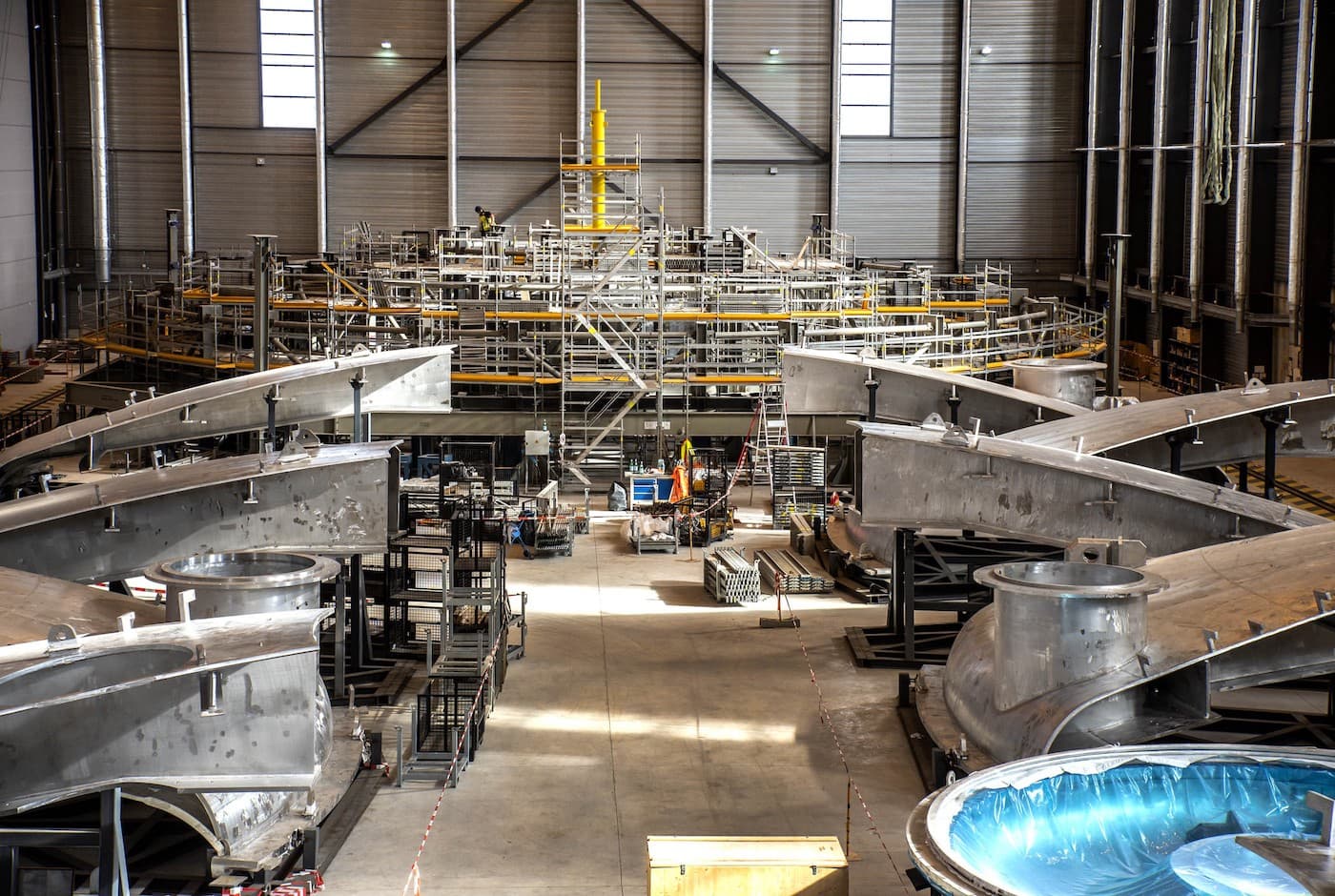
International Thermonuclear Experimental Reactor. Source: ITER
Barabaschi also said there had been a “change of culture”. “We are now ready to face the problems the project is facing instead of sweeping them under the carpet. We are now on the right track. The foundations for a new plan are being prepared. It will not be good news, but we are moving forward and we will succeed. I am very confident of that.”
Progress so far…
In his update after his first year in the role, Barabaschi said that considerable progress had been made. For example, the power supply system had been completed and most of the equipment for the pulsed electrical system had been installed, while overall construction work was now 80% complete.
Barabaschi added that all 19 toroidal field coils had been manufactured and 17 were in place, while the last two were now in transit. Of the six poloidal field coils, the largest of which has a diameter of 24 metres and weighs 400 tonnes, two have been installed and one is already on site. The last one is due to be completed by the end of the year. The cooling water system has been commissioned and is operational. Installation of the cryogenic plant equipment is complete and it has entered the pre-operational testing phase.
… and setbacks
As expected, however, complications arose with first-of-a-kind components. The unique, complete vacuum vessel module, which was lowered into the tokamak pit in May 2022, later had to be removed because “the welds connecting the individual vessel sectors are too challenging to make on site, as the project team concluded after identifying geometric mismatches in the joints.” Leaks were also found in the thermal shield cooling pipes due to chloride-induced stress corrosion. New contracts have been put out to tender to repair these defects.
Problems caused by knowledge loss
One of the biggest challenges we face in achieving fusion is the loss of much of the knowledge accumulated during ITER’s construction. For example, information is lacking on what is needed to integrate the equipment and on ITER’s design from the outset.
“I think we need to rebuild our knowledge system. The knowledge is available somewhere, but it has not been consolidated,” Barabaschi said.
When recording information and knowledge, technical staff were not as meticulous as fusion scientists.
“Scientists publish much more than engineers,” Barabaschi said.
The unsystematic approach to storing information posed a very serious problem, and according to Barabaschi, the culture of recording knowledge needs to change. Experts who have already retired may even have to be called back to recover some of this knowledge.
The most expensive project in human history
ITER is a prestigious international project focused on building a tokamak fusion facility. Its aim is to demonstrate the feasibility of fusion as a large-scale, carbon-free energy source.
The project aims to achieve an output of 500 MW (for at least 400 seconds continuously) with an input power of 50 MW to heat the plasma. During operation, additional electricity input of up to 300 MW may be required.
ITER is not designed to be a power plant that supplies a stable flow of electricity to the grid.
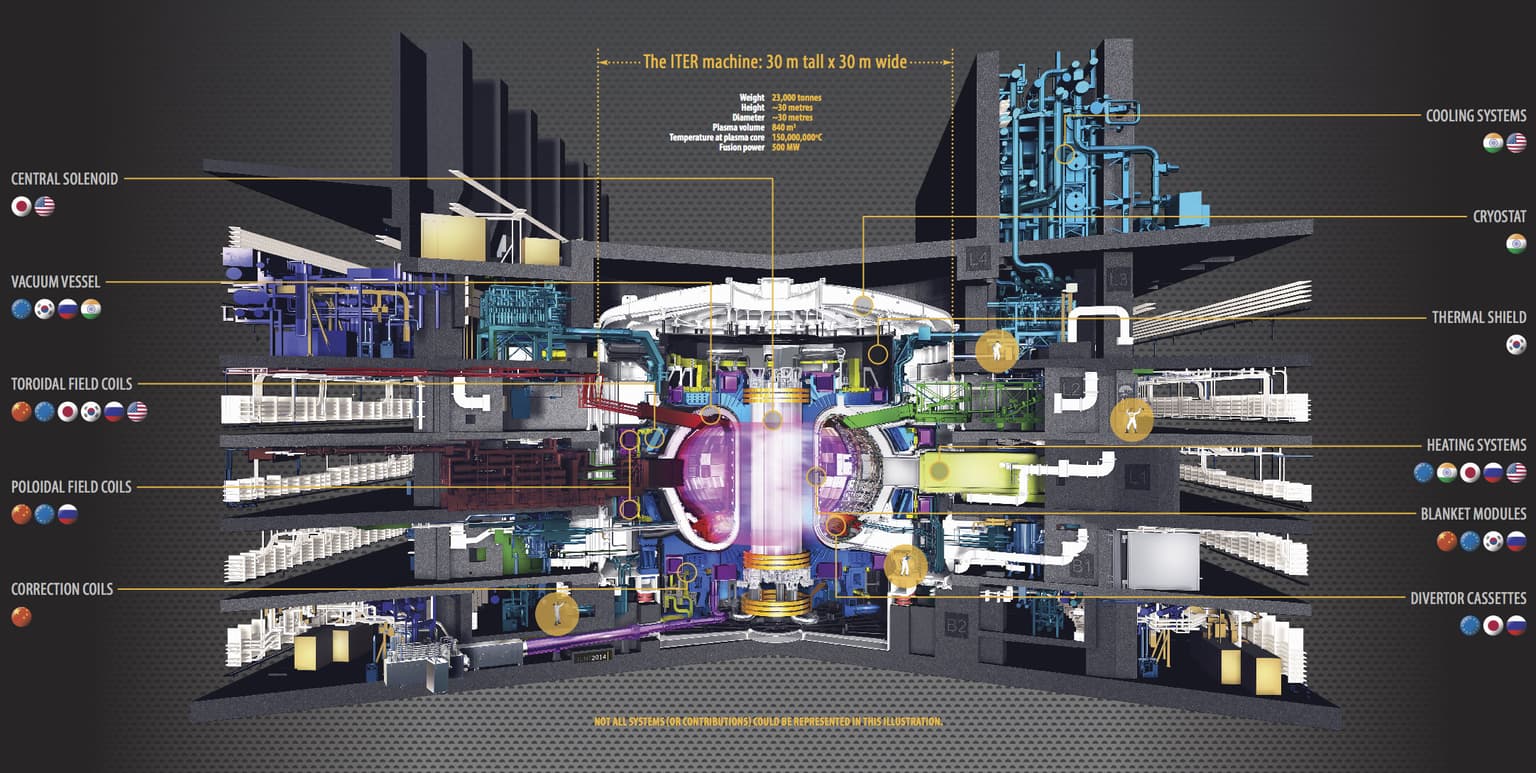
Countries contributing to the different parts of ITER. Source: ITER
Thirty-five countries are involved in ITER’s construction. The European Union (plus Switzerland) contributes almost half of the construction costs, while the other six members (China, India, Japan, South Korea, Russia and the USA) share the remaining half equally.
Construction began in 2010 and, with current estimated costs exceeding 22 billion euros (the original estimate was 6 billion euros), the project is considered the most expensive in history. Some estimates already suggest that as much as 65 billion euros may be needed.
The IAEA’s newly published World Fusion Outlook 2023 summarizes the current state of fusion reactor technologies and projects.
Translation disclaimer
This article is a machine translation of the Czech original and has not yet been fully reviewed. In case of any doubt, please refer to the Czech version.
Sdílejte článek prostřednictvím:
You might also like
2 November 2026, 14:47
2 November 2026, 10:52