Innovative material for building nuclear power plant containments passes tests

An American research team led by GE Hitachi Nuclear has successfully tested an innovative construction block designed for use in nuclear power plant construction. Engineers want to use the steel-and-concrete composite for a nuclear unit’s containment, reducing both construction costs and the time required to build it. The team expects to license the technology for practical use, starting with BWRX-300 modular reactors in Canada.
The U.S. Department of Energy announced a significant achievement by one of the advanced construction technology projects it funds. As part of research into ways to reduce the cost of building nuclear units, a research team led by GE Hitachi Nuclear developed a modular system for building a nuclear unit’s containment. A containment is the protective enclosure around a nuclear reactor and its primary circuit, which must withstand events such as an earthquake or an aircraft crash.
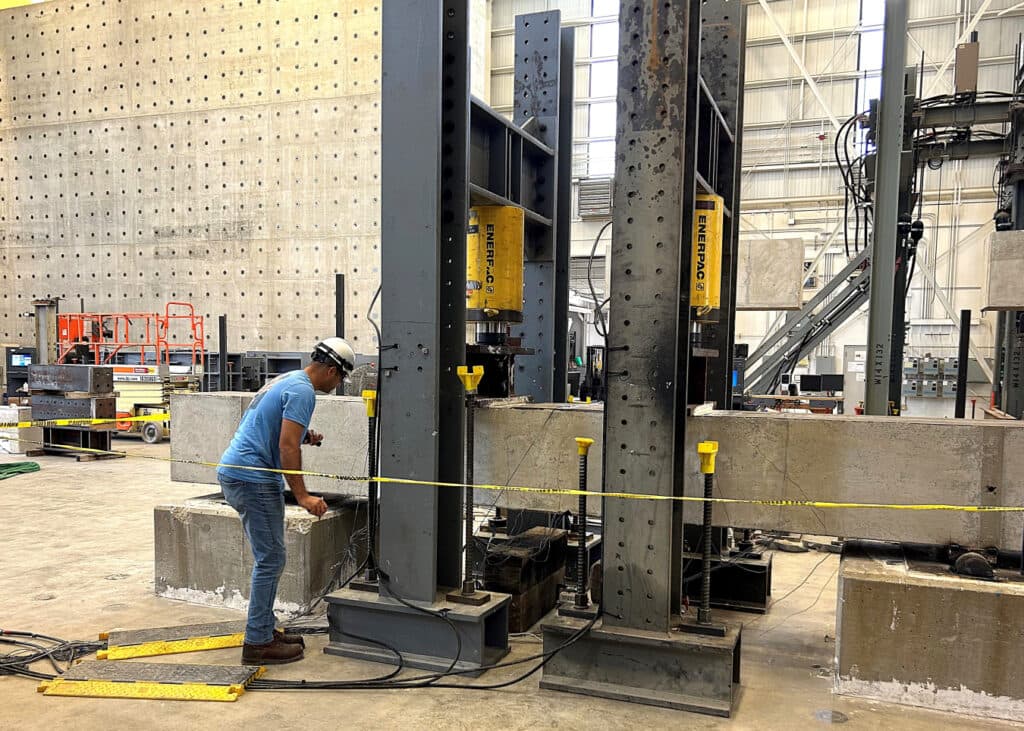
The new system, called DPSC (Diaphragm Plate Steel Composite), consists of two steel plates joined by steel “ribs” and then filled with concrete. The modular system allows walls, floors and other structural elements to be built in a range of configurations. The first samples, designed to offer greater strength and flexibility, were successfully tested in a laboratory at Purdue University in Indiana, USA.
“Testing the DPSC system at Purdue exceeded our expectations. We are very excited about using this construction technology, which will help save time and money when building new nuclear reactors,” said Luke Voss, program manager at Idaho National Laboratory.
Practical use? Coming soon
GE Hitachi Nuclear plans to use DPSC for its four planned small modular reactors, the BWRX-300, in Ontario, Canada. The project has already received a construction licence, and the company plans to bring the reactors online in the mid-2030s.
The new design is expected to save costs primarily because the modules can be manufactured off site and then transported to the construction site. According to the team, assembly and concrete pouring are also faster than with the technologies used today, saving both time and money.
“The successful design, manufacture and testing of DPSC modules demonstrates the potential of this advanced technology to reduce costs and shorten project schedules in the development of small modular reactors,” added Sean Sexstone, executive vice president of Advanced Nuclear at GE Hitachi.
The team will use data gathered during the smaller-scale tests to support licensing of the DPSC modules. It also plans to conduct further tests on a larger scale.
Translation disclaimer
This article is a machine translation of the Czech original and has not yet been fully reviewed. In case of any doubt, please refer to the Czech version.