
23 October 2026, 14:38
Loading...
What does the taxonomy say about Czech nuclear power, recycling and repositories?
Vladimír Wagner
24 March 2022, 10:57
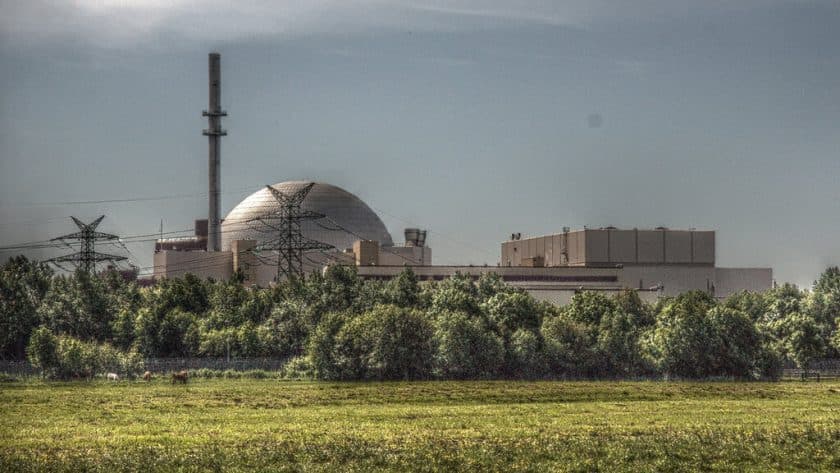
Current events in Ukraine have further highlighted the European Union's need for independence from fossil fuels and for the development of nuclear power. In response to this winter, nuclear power was approved for inclusion in the taxonomy of sustainable sources. It is therefore interesting to look at what the taxonomy actually means and what it focuses on.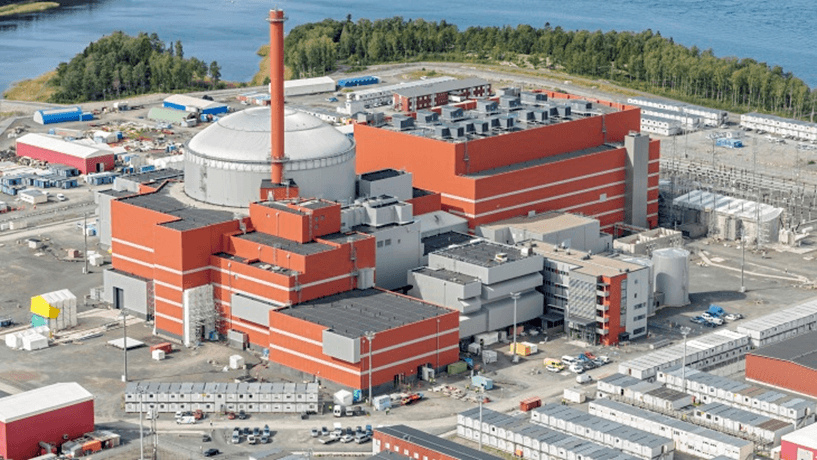
Even before the start of Russia's invasion of Ukraine, nuclear power was included in the taxonomy of sustainable sources. This was a consequence of the course of this winter, which clearly showed that the European Union's energy sector cannot do without nuclear sources. At present, amid dramatic events that are also having fatal impacts on the energy sector, the taxonomy is rarely discussed. Nevertheless, it is important to examine what it could mean.
Above all, it is a step away from ideology towards a rational perspective. Nuclear power is genuinely a low-carbon energy source which, in terms of sustainability and environmental impact, is comparable to—and in a number of parameters better than—renewable sources. Its inclusion in the taxonomy therefore establishes that nuclear sources, if they meet certain conditions, will be considered sustainable sources consistent with the European Union's environmental objectives.
Our knowledge is developing and becoming more precise. At the same time, technologies, including nuclear technologies, are improving. The conditions that need to be met for inclusion in the taxonomy may therefore change in the future. To give investors certainty about the stability of their investments, deadlines have been set until which the current conditions will apply. They therefore know that changes will only take place after those dates.
A deadline in the taxonomy does not at all mean that construction of Generation III units could not be supported under the taxonomy after 2045. The EPR unit at the Olkiluoto power plant started supplying electricity (source: TVO).
Let us recall that one such deadline is 2040, until which, under the taxonomy, modernisation of existing Generation II units can be financed. This does not necessarily mean that these units could not be supported after that date. They would merely need to meet some additional requirements. For example, given the emphasis on recycling spent nuclear fuel, there could be a requirement for a certain share of the core to be loaded with recycled MOX or REMIX fuel. However, support for Generation II units may also continue after 2040 under the current conditions.
The same applies to the 2045 deadline, by which, under the current taxonomy, a construction permit must be obtained for building Generation III units. These are the units planned for new Dukovany units and the completion of Temelín. Their status after 2045 will become clear before that date, when the taxonomy conditions for the next period are determined. It does not at all mean that no further Generation III reactors will be licensed with taxonomy support after that year and that only Generation IV reactors will be built. Depending on knowledge and technological development, the conditions may remain the same, but new ones may also emerge. For example, new Generation III reactors might have to operate entirely on recycled fuel and, together with Generation IV reactors, create an effective mix with a largely closed fuel cycle.
At the core of the taxonomy's approach to nuclear power is an effort to achieve the highest level of safety, as well as pressure to reduce the volume of nuclear waste and achieve a closed fuel cycle, meaning the highest possible level of recycling.
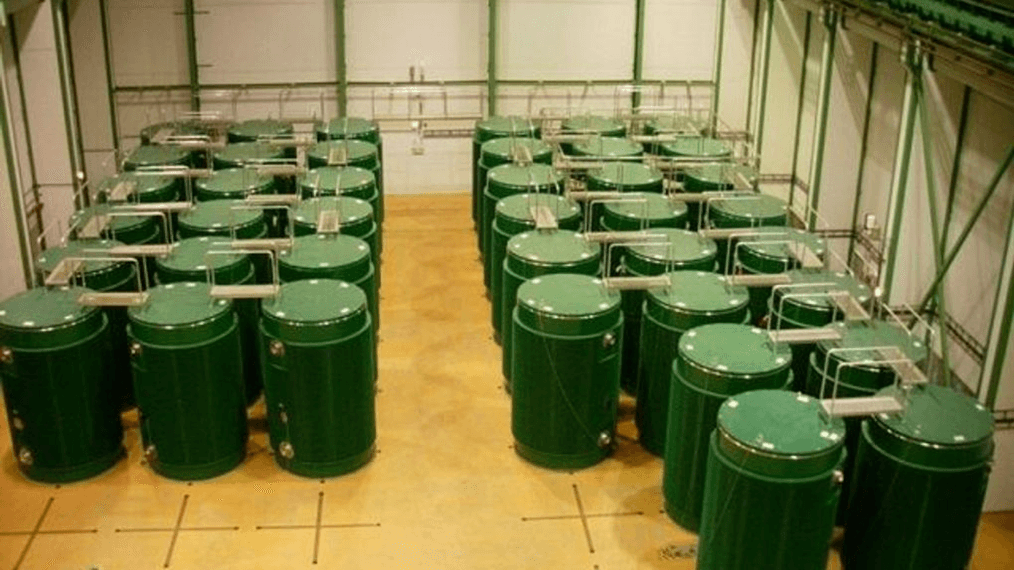
Interim storage facility at the Temelín nuclear power plant (source: ČEZ).
Permanent repository
One of the conditions in the taxonomy concerns the construction of a permanent nuclear waste repository. However, different requirements in the taxonomy contradict one another here. The taxonomy requires the early construction of a permanent underground repository, which should be available by 2050. As mentioned, the taxonomy focuses on maximally reducing the volume of nuclear waste per unit of energy, and thus also puts pressure on spent-fuel recycling. However, recycling delays by decades the date at which this material can be placed in a permanent underground repository.
It should be noted that, in reality, spent fuel presents a minimal problem, as its volume is very small. Operating a 1 GWe unit consumes roughly 25 to 30 tonnes of nuclear fuel annually. Such a quantity is no problem to secure and monitor very effectively. Interim storage of all spent fuel produced over the entire lifetime of a plant can therefore be carried out in a storage facility on the power plant site, which is very carefully guarded. It is thus more of a psychological and sociological issue.
Spent fuel removed from the core must cool for several years in a pool and then for decades in dry interim storage before it can be placed in a permanent geological repository. It is also economical to dispose of it when a sufficient volume of cooled spent fuel has accumulated. This is also why the opening of such a facility in the Czech Republic had so far been expected only in 2065.
If spent fuel also begins to be recycled in Czechia, the date when a permanent repository is needed will shift even further into the future. Moreover, its volume per unit of electricity produced will fall dramatically. Spent fuel still contains around 94 % uranium-238, just under 1 % uranium-235 and almost 1 % plutonium. All of this can be used in preparing recycled fuel, making spent fuel in fact a very valuable raw material, as described in more detail in an article for Vesmír magazine.
It can be used to prepare MOX fuel, in which plutonium recovered from spent fuel is added to depleted uranium. Its share depends on whether the fuel assembly is for a conventional light-water or heavy-water reactor. It is highest for a fast reactor, which can be very effective at burning plutonium. The second type of recycled fuel is REMIX, which uses not only plutonium from spent fuel but also uranium, which has a higher uranium-235 content than natural uranium. In conventional reactors, however, only a limited number of recycling cycles can be carried out, because an increasing share of heavier plutonium isotopes gradually accumulates. Even so, the volume of waste that must go into a permanent repository can be significantly reduced. More effective burning of transuranics, and thus a greater reduction in waste volume, could be achieved through advanced nuclear technologies such as Generation IV fast reactors or accelerator-driven transmuters.
The size of the required repository could therefore be significantly reduced. Or fewer repositories would suffice. If European Union countries could reach an agreement in this area, permanent repositories would not have to be built in every country that uses nuclear power.
At present, it made sense to build only one such facility, which would demonstrate that it works and that we can implement the closure of the fuel cycle. Such a facility already exists in Finland. At the Onkalo geological repository, excavation of the first disposal tunnel began last year after the basic structure was completed. At the same time, the encapsulation plant should be completed this year. This stage was described in more detail in a recent article. A similar repository is being prepared in Sweden, and the same methodology will be used in Czechia. It should be stressed that there is no urgency even in Finland and that the repository is not currently needed. It is mainly about demonstrating that it will work. There is really no point in rushing the others; they will not be needed for many decades.
Conclusion
The inclusion of nuclear power plants in the taxonomy of sustainable energy sources is a step towards rationality. Recent events have clearly demonstrated the necessity of using nuclear sources if we want to reduce dependence on fossil fuels. However, irrational aspects remain in the current taxonomy. One of them is pressure for the rapid implementation of a permanent spent-fuel repository. Especially if spent-fuel recycling is increasingly carried out, the need for such a facility will instead shift ever further into the future. Let us hope that the taxonomy will come even closer to reality and rationality in the future, and that the requirement for the rapid construction of a deep geological repository will disappear from it.
I presented an overview of the taxonomy from the perspective of the closed fuel cycle and repositories at a seminar organised by STUŽ. A more detailed and longer analysis is available here.
Translation disclaimer
This article is a machine translation of the Czech original and has not yet been fully reviewed. In case of any doubt, please refer to the Czech version.
Sdílejte článek prostřednictvím:
You might also like
23 October 2026, 11:01

23 October 2026, 06:34