23 October 2026, 14:38
Loading...
2020 – another turning point in the deployment of Generation III reactors
Vladimír Wagner
7 September 2020, 14:03
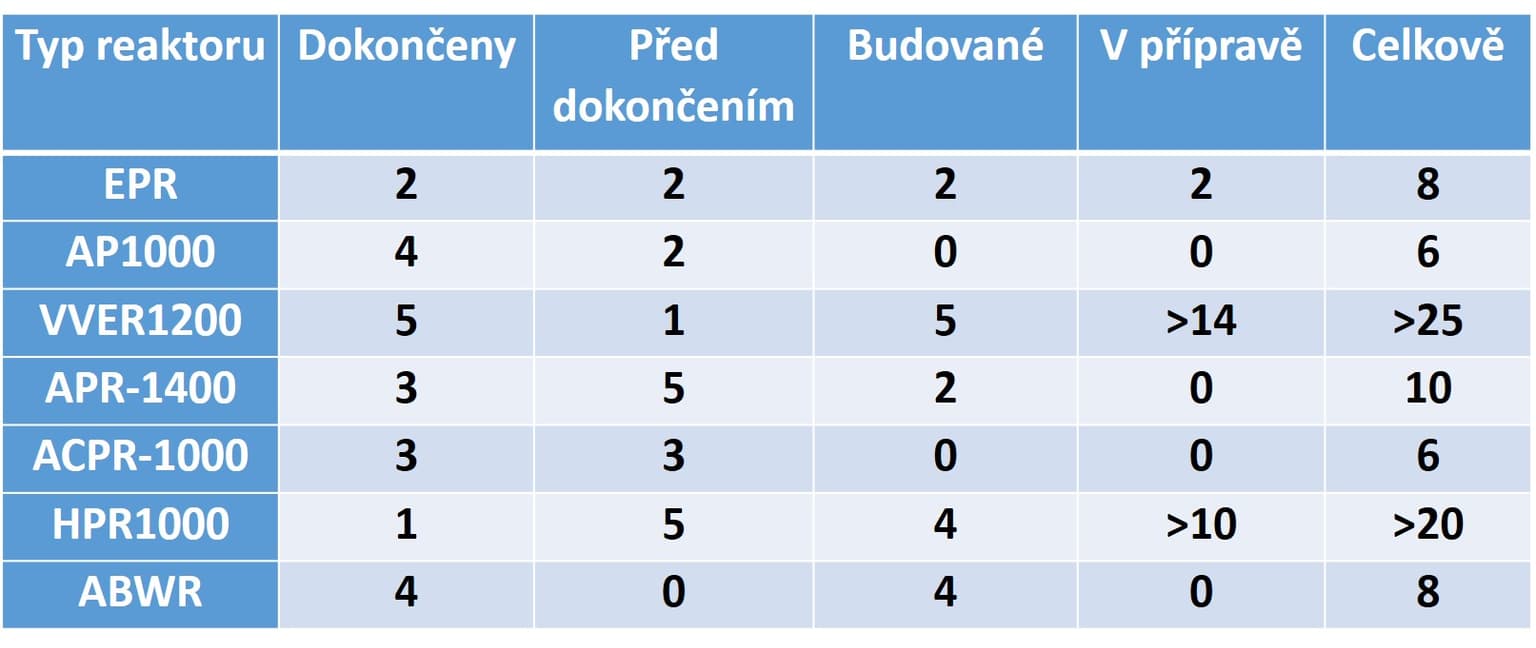
This year, the rollout of Generation III reactors is accelerating further. Two Russian VVER1200 reactors are being commissioned: the first at Russia’s Leningrad nuclear power plant and the second at the new Belarusian Ostrovets plant. The first APR1400 unit is starting up at the Barakah plant in the United Arab Emirates. China has commissioned an ACPR1000 unit, while fuel is being loaded into the first Hualong One reactor at the Fuqing plant. Operating Generation III units are delivering ever better performance, and construction of new ones is also progressing successfully.
Fuel loading has now begun at the first Hualong One (HPR1000) unit. This is already the seventh type of Generation III reactor to enter operation. Experience has already been gained with six pressurised-water reactor designs and one boiling-water design. The pressurised-water designs are Westinghouse’s AP1000, the French EPR, Russia’s VVER1200, South Korea’s APR1400, China’s ACPR1000 and now also the Hualong One. The only Generation III boiling-water reactor design is Japan’s ABWR. However, the four completed units in Japan have remained out of operation since the Fukushima I accident. The units at the Kashiwazaki-Kariwa plant are expected to be closest to restarting. This year marks another leap forward in the transition to these reactors.
Chinese ACPR1000 and HPR1000 nuclear units
The first reactor commissioned this year was an ACPR1000 at China’s Tianwan nuclear power plant. It is the plant’s fifth unit and was completed in five years. The sixth unit of the same type is expected to enter operation next year, again five years after construction began. Two such reactors are already operating as units 5 and 6 at the Yangjiang plant, entering operation in 2018 and 2019 respectively. They too took around five years to build. Unit 5 thus completed its first full year of operation in 2019 with an annual capacity factor of 76.5 %. Two further reactors of this type, units 5 and 6 at the Hongyanhe plant, are nearing commissioning. Their fission chain reactions should begin in 2021 and 2022. There has been some delay there, meaning they will be completed six years after construction started. In total, six of these predecessors to the Hualong One reactor will then be in operation.
As noted, fuel loading has begun at the first Hualong One reactor at the Fuqing plant. Fuqing unit 5 will enter operation five years after construction began. The Fuqing 6 unit of the same type will start operating next year. In 2022, two reactors of this type are expected to be commissioned as units 3 and 4 at the Fangchenggang plant. Delays there mean they will take six and seven years respectively. In recent days, concrete pouring has begun for the second unit of this type at the Zhangzhou plant; it began for the first unit a year ago. Concrete work should likewise begin shortly on the second unit at the Taipingling plant. Construction of these units has also been approved at the ChangJiang plant, where they will be units 3 and 4. Construction of two such units has also now been approved at the entirely new San’ao nuclear power plant. Construction is also being prepared for a pair of these reactors at Fangchenggang (units 5 and 6), Ningde (units 5 and 6) and Zhangzhou (units 3 and 4). The first two of these reactors abroad should be completed next year and the year after. These are Karachi 2 and 3 in Pakistan. Licensing of this reactor design for the United Kingdom is also progressing successfully. They are planned for the Bradwell B plant there. As can be seen, China is able to build Generation III nuclear units as standard within five years from the start of concrete pouring. The Hualong One is becoming its flagship design, with more than ten reactors of this type expected to be completed in the coming years. More will follow.
South Korean APR1400 reactors
The commissioning of the first South Korean APR1400 unit abroad is a major success. At the Barakah plant in the United Arab Emirates, the first unit recently began supplying electricity to the grid. The second unit has already been completed, while the third and fourth units are close to completion. It should be noted that the first unit itself was completed more than a year ago. It was necessary to wait for staff training to be completed and for the required, especially personnel-related, infrastructure for operating nuclear power to be established in the country. The country was starting from scratch in this respect. Eight years therefore elapsed from the start of construction of the first unit to its grid connection. In South Korea itself, two reactors of this type are already operating as Shin Kori units 3 and 4. The first of them recorded an annual capacity factor of 88.2 % in 2019. Two units at the Shin Hanul plant are just before completion. The first could start up around the turn of the year and the second a year later. Work is also progressing intensively on Shin Kori units 5 and 6. For these units in South Korea as well, the period from the start of construction to the beginning of operation is around eight years. This too can be described as a successful rollout of this reactor. Its only disadvantage is that South Korea’s political leadership has decided to halt further development of nuclear energy in the country. The consequence of this decision is that no further units of this type are being prepared either domestically or abroad. A detailed description of South Korean nuclear energy is available in an earlier article.
Russian VVER1200 reactors
Russia is currently commissioning the second VVER1200 reactor in the second phase of the Leningrad nuclear power plant. This will be the fourth unit of this type in operation. One unit is already operating at this plant and achieved an annual capacity factor of 74 % in its first full year of operation. Its start-up made it possible to shut down the first RBMK1000 unit at the plant. All four units of this type there will gradually be replaced. Two VVER1200 reactors are operating in the second phase of the Novovoronezh nuclear power plant. The first achieved annual capacity factors of 60.9 %, 79.4 % and 74.6 % in 2017, 2018 and 2019 respectively. Construction of these units took between 8 and 10 years. Two units are at an advanced stage of construction in the second phase of the Kursk plant. They will also replace RBMK1000 units. The refined VVER1200-TOI variant is being built and should become a mainstay of nuclear energy development in Russia and of exports abroad. The third and fourth units of the Leningrad plant and two units in the second phase of the Smolensk plant, where RBMK1000 units are also operating, are at an advanced stage of preparation. Replacements are also planned for the remaining RBMK units at the plants already mentioned, to be carried out gradually as these reactors reach the end of their operating lives. Further units at entirely new sites are also planned, to be built as needed.
The first reactor of this type at the Ostrovets nuclear power plant in Belarus should enter operation shortly. It will be the first foreign deployment of this unit. The second at the plant should start up next year. Their construction required seven years. As with the reactors at Kursk, it is clear that experience is being used successfully to shorten construction times. It is also worth noting that Rosatom has by far the largest number of plants under construction, in preparation and planned abroad. Projects for four units at Turkey’s Akkuyu plant are at a very advanced stage. Concrete pouring for the second unit began in June this year. Preparations to begin construction of the third are at a very advanced stage, and the construction site for the fourth unit is ready. The first reactor should start up in 2023. Two VVER1200 reactors are also being built at the Rooppur plant in Bangladesh. The first should be completed in 2023 to 2024. At both plants, the required components are also being manufactured and transported to the sites on an ongoing basis. The coronavirus epidemic does not appear to have significantly affected these projects.
Preparations of the site for four units at Egypt’s El Dabaa plant are also nearing completion, and a permit to begin construction of the first unit is expected in 2021. The same applies to two pairs of reactors being prepared in China: Tianwan units 7 and 8 and Xudabao units 3 and 4. Concrete pouring for the reactor foundations should take place progressively between 2020 and 2022. Construction of two units is also being prepared in Uzbekistan near Lake Aydarkul. Construction of the reactors there could begin in 2022. It should be recalled that two VVER1000 units are being built at Iran’s Bushehr plant and two at India’s Kudankulam plant. Their characteristics also match those of Generation III reactors.
For us, the most interesting development is the preparation of VVER1200 reactor construction in the European Union. The project for two units in the second phase of Hungary’s Paks plant was recently submitted to the local nuclear safety authority. If everything is in order, it should receive a permit in 2021 and construction could begin. For now, site preparation and the development of supply chains are continuing. At Finland’s Hanhikivi nuclear power plant, receipt of a construction licence from the local nuclear safety authority is likewise now targeted for 2021. Preparation of the site and supply chains is reaching a stage at which construction of the units can begin immediately after the licence is received. These projects will show whether Rosatom is capable of delivering construction not only under the strict oversight of the European Union near its borders, but also of building units in EU member states.
Russia is a country that continuously builds reactors at home and abroad and has established supply chains and teams of experts able to transfer experience from one project to another. This will make it possible to use the growing experience to improve the efficiency of construction and operation of VVER1200 units.
Westinghouse AP1000 reactor
Four reactors of this type are operating at the Chinese Sanmen and Haiyang plants. Each of these units required nine years to build. Apart from Sanmen 2, where technical issues were addressed, they recorded very good annual capacity factors in 2019. Sanmen 1 achieved 88.7 %, Haiyang 1 reached 92.3 % and Haiyang 2 recorded 97.4 %. Construction of two such units at the US Vogtle plant is now continuing smoothly. Construction of the first has been completed and testing before start-up is beginning. It could enter operation in 2021. Following the cancellation of construction of another pair at the US VC Summer plant and the replacement of these units with Hualong One reactors in China’s plans, no units of this type are realistically being prepared. Following an agreement between the owners of the unfinished reactors at the VC Summer plant, the sale of components that had already been prepared there is being arranged. There is some possibility that these designs could be deployed in Poland or India. However, how realistic this is remains a very open question.
EPR reactor
Two such reactors are operating in China at the Taishan plant. The first unit at this plant had an annual capacity factor of 82.2 % in 2019, which is a very good result. Both units were completed in nine years. The situation is far worse for reactors being built in Europe. Work has been under way on Olkiluoto 3 for fifteen years. Its start-up was recently postponed again, to 2021. Although measures against the COVID-19 pandemic were cited as the reason, it is more likely the result of the enormous extension of construction and the need for equipment replacement and modifications arising from it. Construction of Flamanville 3 has likewise been extended to an unacceptable degree, and it will not start up before 2022. The fate of this reactor type depends very heavily on how the experience gained is reflected in construction of the Hinkley Point C units. So far, construction appears to be progressing smoothly. Another key factor will be whether the Sizewell C project, with two reactors of this type, can be successfully launched using previous experience. The main and critical question, however, is what approach France itself will take to nuclear power and how it will proceed with replacing its ageing nuclear units.
Conclusion
At least five Generation III reactors will start up this year. Hualong One (HPR1000) will already be the seventh reactor type of this generation. Nearly twenty units of this generation will therefore be operating next year, and a number of others will begin operation over the following few years. This also shows that they are becoming a key component of nuclear energy development. Annual capacity factors ranging between 70 and 90 % indicate good performance so far. These are, of course, the first years of operation of the first units, where prototype shortcomings can be expected to require resolution.
China and Russia are demonstrating their ability to build these reactors continuously and efficiently at home and abroad. Russia has additionally shown that it can replace its older units with new ones and ensure the efficient, sustainable development of its nuclear sector. Both countries are preparing projects in the European Union that will show whether they are capable of delivering them there as well. In China, units are routinely built in five years, while Russia’s Rosatom is gradually reducing construction times. In their cases, work is under way on a sufficient number of reactors for the experience gained to be used to make construction more efficient and less expensive.
The main problem for nuclear power in South Korea and for the prospects of deploying APR1400 reactors abroad is the political and ideological stance of its political leadership. If the situation in which no new construction is being prepared is not changed in time, this design will face problems. Westinghouse’s AP1000 unit is in a similar position. For the EPR, the critical challenge is finding a financial model for the Sizewell C plant and using previous experience to improve the quality of construction of new units in the United Kingdom. However, the development of France’s approach to nuclear energy is crucial.
The beginning of the rollout of Generation III reactors and their good performance are also helping increase total electricity production from nuclear sources. Total generation in 2019 was 2657 TWh, only 4 TWh less than output in the record year of 2006. Nuclear energy development in the past year is described in detail in an article from the regular series. In addition to the Generation III reactors mentioned, India started up its domestic PHWR-700 heavy-water reactor in 2020, which is one component of its path towards using thorium reserves. This too should help ensure a path to low-emission energy. China and Russia are intensively developing all components of the low-emission mix, namely renewable sources as well as nuclear energy. Nuclear power is currently a key component of the low-emission mix in the European Union and the United States. However, their nuclear fleets are ageing. Whether they can overcome the ideological approach to technical issues that unfortunately prevails there will be a key factor in the development of their low-emission energy sectors. Given its geographical conditions, the use of nuclear energy is essential for the Czech Republic. This year is therefore a very encouraging sign that Generation III nuclear units will be available and that there will be sufficient information to select a suitable candidate for construction in Czechia.
Written for the Oenergetice and Osel websites.
Lead photograph: The first Hualong One reactor into which fuel loading has begun is Fuqing 5 (source: CNNC).
Translation disclaimer
This article is a machine translation of the Czech original and has not yet been fully reviewed. In case of any doubt, please refer to the Czech version.
Sdílejte článek prostřednictvím:
You might also like
23 October 2026, 11:01
23 October 2026, 06:34