23 October 2026, 14:38
Loading...
Czech green activists’ energy plans: not just in light of this winter
Vladimír Wagner
30 October 2021, 13:31
Green organisations have published their energy plan. Unlike previous ones, it envisages using nuclear capacity that has been built and preserved despite their intensive campaign against it. Even so, they cannot ensure a transition to low-emission energy without building new nuclear units. This is true even assuming extremely intensive use of wind turbines, and above all biomass plants, which would probably have highly dramatic environmental impacts. It is therefore worth examining their ideas in greater detail and comparing them with reality.
Greenpeace and Hnutí Duha jointly presented their energy plan. It reflects a very dramatic shift in their stance on nuclear energy, particularly at Greenpeace. However, these organisations still lack sufficient self-reflection, and the energy plan they advocate remains detached from reality. Above all, its implementation threatens to cause fundamental environmental damage and would have dramatic effects on the social conditions and standard of living of Czech citizens.
Before looking at the current energy plan, let us turn to the previous ones, and above all to the actual activities of these organisations in the energy sector. Since Greenpeace arrived in the Czech Republic and Hnutí Duha was founded in 1989, their main activity and the dominant goal of their direct action has been fighting nuclear power and preventing the construction of nuclear units at Temelín, as well as campaigning for the Dukovany nuclear power plant to be shut down no later than after thirty years of operation.
Hnutí Duha founders Jan Beránek and Jakub Patočka, as well as Greenpeace representatives at the time, both in the past and today, regard their failure to prevent the construction of the two nuclear units at Temelín as their greatest mistake (see, for example, here). Conversely, they regard the period of campaigning against Temelín and Dukovany as a golden era, including the fact that construction at Temelín was nearly halted altogether and, in any case, that the construction of the four units originally planned was prevented. Even after the two Temelín units were commissioned in 2000, they continued for years to seek their closure, including through legal challenges. Greenpeace's energy plan, which remained in force until now, still envisaged the rapid shutdown of Dukovany.
In this respect, the new plan is progress. It envisages the operation of the Temelín nuclear power plant beyond 2050, while Dukovany is expected to operate for at least fifty years, and more likely even until the mid-2040s. By supporting the continued operation of existing nuclear units, Czech Greenpeace differs significantly from its international leadership. Yet even though the green activists have accepted nuclear power at least to this extent, their new energy plan clearly shows that a path to a low-emission mix is not possible in Czechia without new nuclear capacity. To get closer to such a mix, they must resort to the massive deployment of energy-use biomass, which threatens dramatic environmental impacts. They must likewise believe in a dramatic breakthrough in storage technologies, such as the large-scale use of hydrogen, and in the possibility of importing significant volumes of electricity from abroad. The inability to transition fully to a low-emission mix even if existing nuclear units are used for as long as possible clearly shows the catastrophic position Czechia would be in on emissions reductions had Greenpeace and Hnutí Duha succeeded in eliminating nuclear power in the country altogether, as they intensively sought to do.
The new energy plan of Greenpeace and Hnutí Duha
The green organisations' new energy plan is called the Energy Revolution. Its basic pillars are an extremely rapid expansion of renewable sources—wind, solar photovoltaic, and above all biomass use. The authors of the plan acknowledge that the potential for new hydropower sources in Czechia is already minimal. The plan assumes electrification of transport and industry, while heating is also to be partly electrified through the expected use of heat pumps and thermal energy storage. It relies heavily on storage, including seasonal storage in hydrogen.
Strengthening cross-border transmission lines is also crucial, so that electricity can be exported during periods of excess generation and imported during periods of shortfall. However, there is a major snag in this area. The vast majority of European countries envisage massive construction of wind and solar photovoltaic plants. Conversely, stable nuclear and coal-fired units are to be shut down. This applies particularly to neighbouring Germany. It is therefore highly likely that when wind and sunshine are abundant, everyone will want to export electricity, while when there is no wind and the sun is not shining, everyone will face a shortage of electricity. High interconnection will ultimately help no one.
Let us look in more detail at several key problems with the proposed energy plan, which its authors themselves acknowledge. Installed wind turbine capacity is expected to increase from today's 0,318 GWp to 2,3 to 4,8 GWp in 2030 and even 8,8 to 16 GWp in 2050. The lower figures are associated with a less ambitious scenario that still assumes very intensive use of gas-fired power plants. The higher figures are associated with a very ambitious scenario. Let us recall that the largest turbines in Czechia have a capacity of 3 MWp, and larger ones will be difficult to build for geographical and transport reasons. The ambitious scenario thus assumes the installation of around 1600 turbines by 2030 and even around 5300 by 2050. This represents a truly dramatic intervention in the landscape. Even the Institute of Atmospheric Physics of the Czech Academy of Sciences does not consider such a massive number of installations likely to be accepted by the public living near where the turbines would be installed. Another enormous problem is that selecting sites, obtaining construction permits, assessing the environmental impact of construction, and ultimately carrying out the projects would take a very long time with such a large number of turbines. Let us recall that construction sites for nuclear units are already prepared and a number of permits have already been obtained.
Installed solar photovoltaic capacity should rise from the current 2,2 GWp to 7 to 10 GWp by 2030 and then to 23 to 33 GWp in 2050. Unlike wind farms, photovoltaic plants can be built relatively quickly, as the boom in Czechia at the end of the first decade of this century showed. The problem, however, is that in summer months around noon, generation would exceed required capacity many times over. Conversely, in winter, even with such capacity, photovoltaic plants would supply only a minimum of demand. Such massive deployment of these plants simultaneously assumes very extensive storage use, including seasonal storage. If photovoltaics can be confined to roofs, brownfields or possibly agrivoltaics even at such large scale, the installations themselves need not be an environmental problem. However, the need for raw materials—not only for the panels and the necessary electronics, but especially for the equipment needed for storage—would have far greater environmental impacts.
By far the greatest environmental impacts of this energy plan would result from the assumed massive use of biomass. Installed capacity is expected to rise from the current 0,8 GW to 2,2 to 3 GW in 2030 and 4,0 to 4,4 GW in 2050. At its maximum, the envisaged more than fivefold increase in biomass plant capacity means a very extensive expansion in the use of the landscape for energy. The authors of this energy plan themselves point out that very intensive use of the landscape for energy biomass production cannot be achieved without restricting food production and expanding land for energy crops. They assume this could be achieved by changing society's dietary habits, involving a significant reduction in meat consumption and in crops requiring large areas of land. Imports of energy biomass or the aforementioned foodstuffs are also assumed. Such imports and the burning of wood for energy production are now being pursued extensively in Denmark, the Netherlands and the United Kingdom, which import pellets from America and Russia. In my view, and not only mine, this is an environmental crime.
The storage capacity required by this plan is very large. The problem with potentially using pumped-storage plants is the environmental impact of hydropower projects. Their upper reservoirs would have to be built in ecologically valuable mountain areas. Batteries are highly raw-material intensive. However, pumped-storage plants and large battery storage facilities provide only short-term storage. They cannot shift surpluses from the summer period, when photovoltaic generation is high, to winter. Nor can they shift surpluses from several days of wind to a longer period of winter inversion. This would require the large-scale deployment of P2G methods and hydrogen production. It should be recalled that these technologies are currently at the prototype and small pilot-scale testing stage. When they can be deployed on a massive scale remains an open question. The economic costs associated with the need for extensive storage use could be dramatic.
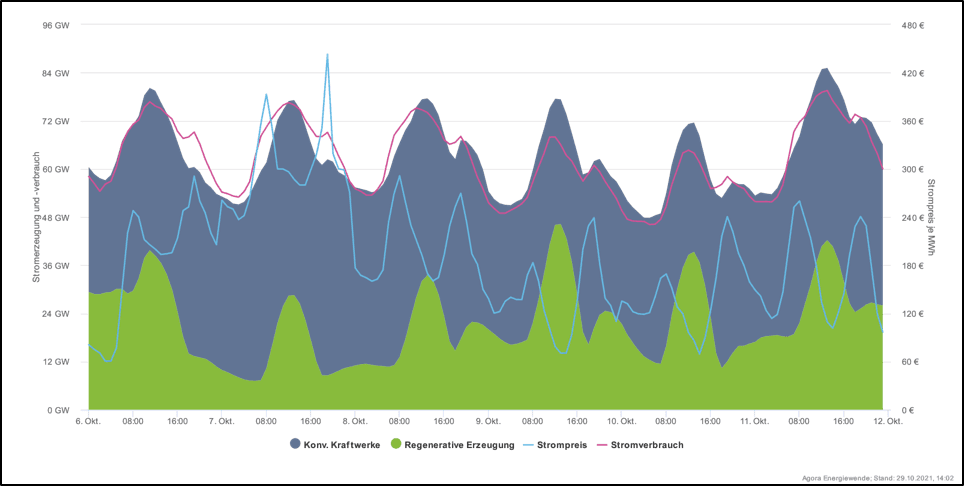
Electricity in Germany at a time when there was almost no sunshine. The electricity price at that time exceeded 400 EUR/MWh. (Source: Agorameter).
Implementing the Energy Revolution plan threatens highly dramatic environmental impacts, which could be far greater than the beneficial effect of the resulting reduction in greenhouse gas emissions. The impact on our economy, security and social conditions of shutting down coal-fired capacity before a replacement is secured that ensures not only overall generation but also its balancing function could be devastating. It should also be recalled that replacing coal units with gas-fired ones need not be any victory from the perspective of greenhouse gas emissions. Once methane leaks during gas extraction and transport are included, gas-fired power plants are not much better. Shutting down coal-fired capacity as quickly as possible regardless of the progress of its replacement is therefore one of the most dangerous aspects of this plan.
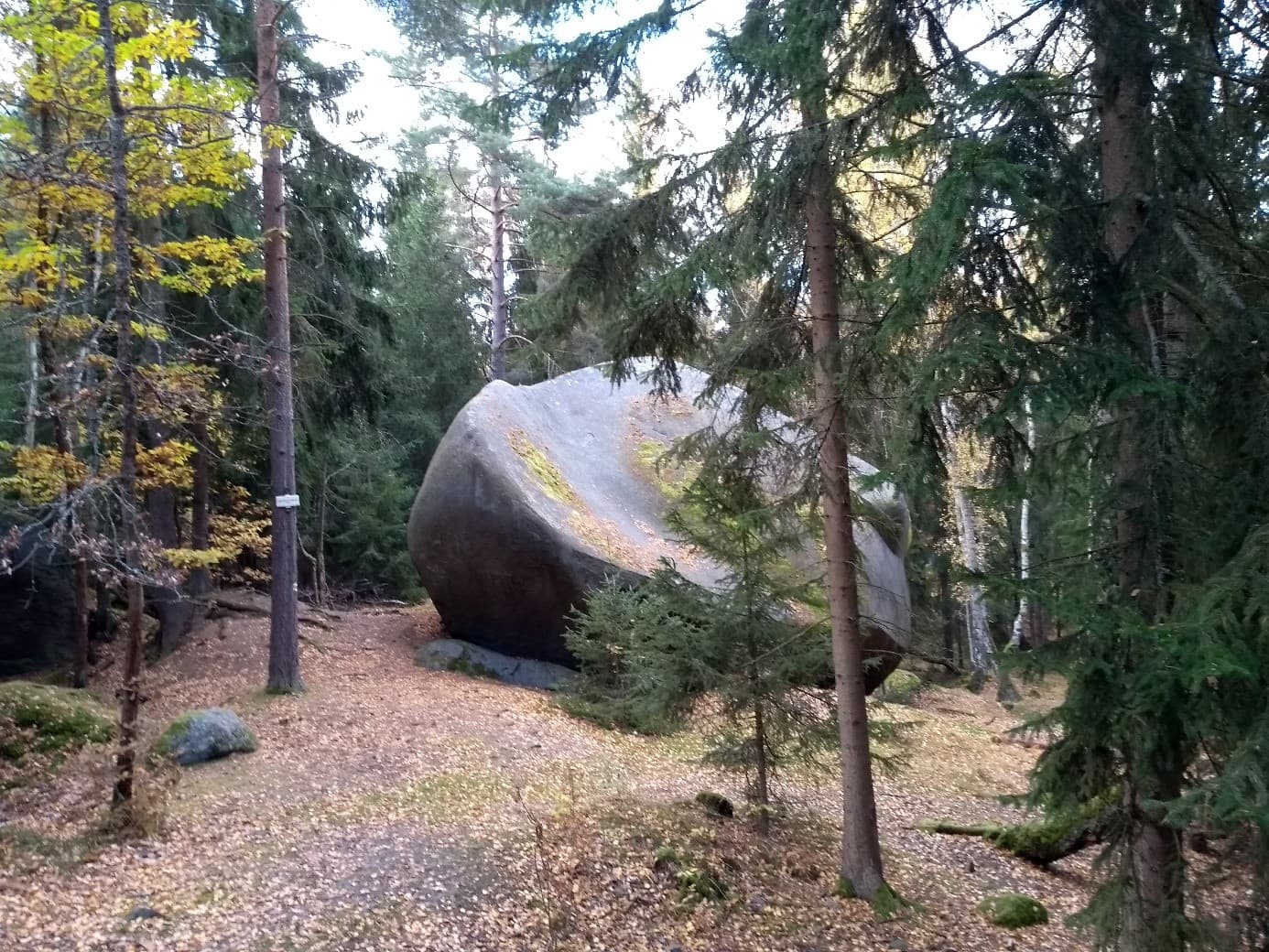
The energy plan of Greenpeace and Hnutí Duha, especially its major demands for biomass use, would place extreme pressure on agricultural and forest landscapes and our environment. Forests near Žihle (photo by Vladimír Wagner).
An effective path to low emissions in Czechia
I have written several times about what, in my view, the path to a low-emission mix in Czechia should be. It should involve a gradual transition to a combination of nuclear and renewable sources. Coal-fired capacity should only be shut down once replacement capacity has been built for both generation and balancing. In the nuclear sector, two large units should gradually be built at Dukovany and two more at Temelín. By 2050, available nuclear capacity could thus be around 7 GWe. If small modular reactors become commercially available, they could gradually begin to be used in more decentralised energy systems. In line with the previous plan, I also do not envisage a significant increase in hydropower use. Some opportunities are offered, for example, by new projects linked to flooding exhausted coal mines, but they are limited.
Solar photovoltaics are ideal for covering daily peaks in consumption. Ideally, installed capacity would cover this peak at maximum generation during summer months. This is currently around 5 GWp. Depending on changes in electricity consumption, storage options and the distribution of photovoltaic plant orientations to broaden the generation peak, the ideal effective installed capacity could be correspondingly higher. For wind, there is little point in Czechia in exceeding installed capacity of 1 GWp by much. It must be taken into account that during windy periods, Germany in particular will produce enormous surpluses of wind power and will need to sell them somewhere. Photovoltaics and wind turbines should be developed predominantly in decentralised form and preferably in conjunction with storage.
Biomass plants should be built only in line with regional opportunities and the availability of biomass from agricultural and forestry waste. They should be decentralised sources with limited collection distances. The landscape should be used predominantly for food production and environmental functions. There should be no intensive production of energy crops. This is especially important at a time when the sustainability of the landscape, its water regime and its ecological quality need support.
It is clear that the plan will evolve in the future. Overall consumption will depend on the progress of electrification and efficiency improvements, as well as on achieved savings. If it proves that we can build large Generation III nuclear units efficiently, the construction of another large nuclear power plant can be considered in the future. Potential sites exist. If development in storage advances faster, it will be possible to increase installed solar photovoltaic or wind capacity, or import renewable energy from our neighbours. Given that electricity shortages in Europe are highly likely during windless winter periods, the Czech Republic should have a mix capable of ensuring the necessary capacity at all times. It is therefore necessary to consider sufficient strengthening of the stability and flexibility of the energy mix used.
What does the current situation show?
The current situation of gas and electricity shortages and their high prices should be a sufficient warning for us to approach energy security responsibly and strategically. Today's energy crisis has several causes, and there is a danger that some of them will worsen in the future. The key fact is that nuclear and coal-fired power plants are being closed not only in Europe, while gas is being relied on to replace them. As I wrote long ago, such a trend leads to strong competition between demand from heat and electricity generation, and thus pressure to increase both gas consumption and prices. Moreover, the constant disparagement of fossil sources has led to a decline in investment in gas extraction as well.
Increasing the share of solar, and especially wind, sources means that we are becoming ever more dependent on the weather. And this year, wind turbine output in Europe has been low compared with other years. Their generation had to be replaced by gas, and gas consumption therefore rose. These factors may become significantly more pronounced in future years. Europe is not alone in wanting to continue closing coal and nuclear units. It will rely ever more heavily on wind and solar sources. Another factor contributing to increased gas consumption was the economic recovery following the slowdown during the Covid pandemic.
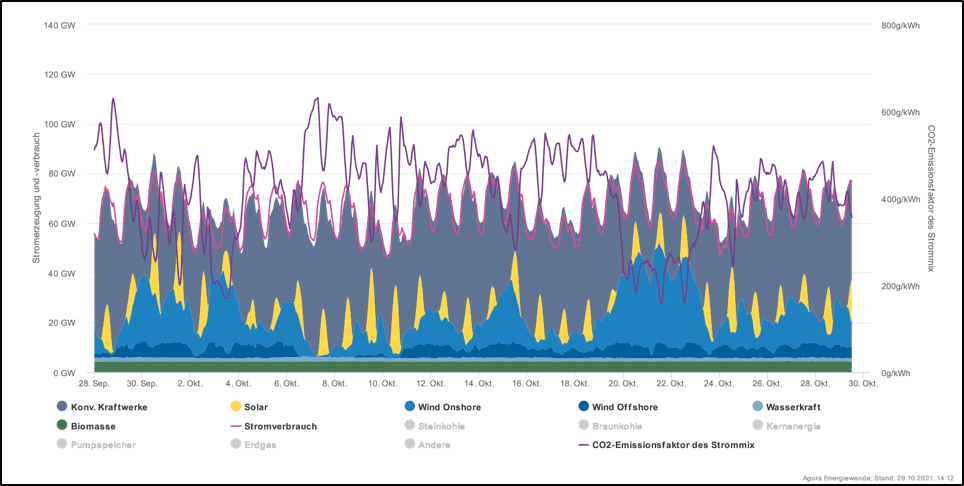
Electricity generation over the past month. It is clear that even in Germany, which has installed more than 50 GWp of solar photovoltaic and wind capacity—a figure close to instantaneous demand—conventional sources remain the dominant suppliers. And CO2/MWh emissions are always several times higher than in France. (Source: Agorameter).
Electricity prices in Europe have also been affected by rising emissions allowance prices. Their effect consisted not only in the direct impact of their rising prices on electricity prices, but also in their contribution to the shift from coal-fired to gas-fired capacity. Gas consumption and pressure on its price thus also increased. The current extreme volatility of the European gas market, which also affects electricity prices, is primarily driven by European Union pressure to shift from long-term contracts to spot purchases on commodity exchanges. It was assumed that competition from liquefied gas from the US and the Middle East, as well as European production, would bring down the price of gas supplied from Russia. And in periods when gas production was in relative surplus and consumption was lower, this did indeed work. At present, when production is insufficient to meet high demand, the situation we are observing can occur. The US and the Middle East prefer to send their liquefied gas to Asia, which offers higher prices, while production outages have occurred in Europe. Russia's Gazprom reliably fulfils its obligations under signed contracts, but prefers to use additional gas to fill domestic storage ahead of the harsh Russian winter or, where possible, sell it to Asia at a higher price. The European Union's emphasis on seeking the lowest possible spot price at the expense of longer-term stability and security has thus led to the current crisis.
Presentations by senior European Union representatives proclaim that a recurrence of the current price crisis can be prevented through further intensive construction of wind and solar sources. In reality, however, the current situation clearly shows that this is not true. If electricity prices in Czechia were set without the influence of our German neighbour, they would be determined by the price of coal-fired electricity, and there certainly would not be a capacity shortage pushing prices up. We still have sufficient sources, including a large share of nuclear and coal-fired capacity. Higher installed wind or solar photovoltaic capacity would not have changed the situation in Czechia this winter. Germany is among the countries with the largest installed capacity of both wind and solar photovoltaic sources. Yet it is precisely this country that has the greatest problems with sufficient capacity on relatively frequent windless days, and its gas-fired power plants are the marginal units that dramatically raise gas prices in Czechia as well. The problem is that when there is no wind and no sun, the contribution of wind and solar sources is negligible. No further increase in their capacity will change that. Conversely, when the wind blows strongly, much of the newly installed capacity would have to be curtailed. Overall, installing large new renewable capacities will increase the system's chaos and volatility, while not significantly reducing gas consumption under current weather conditions.
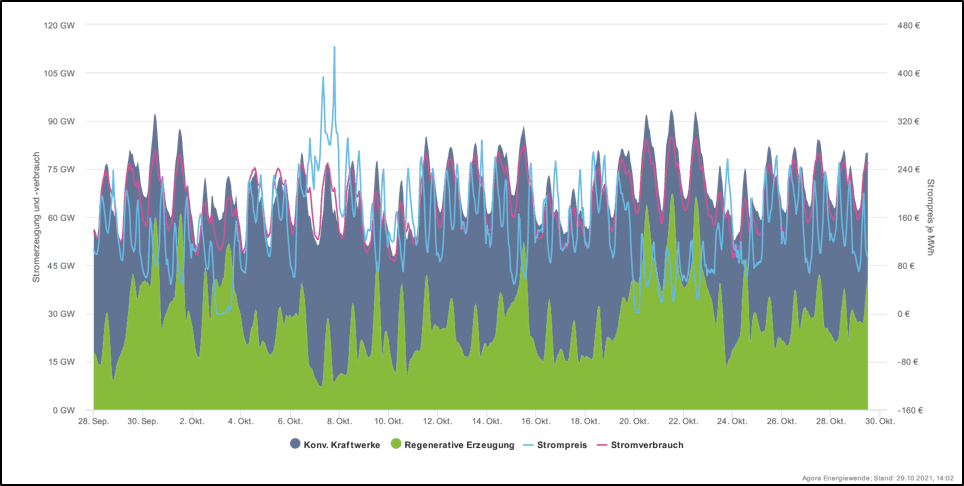
Electricity generation, consumption and price in Germany over the past month. It is clear that there are windy days when the spot-market price falls as low as zero, but for the dominant part of the month renewable sources supply only a smaller share of electricity. (Source: Agorameter).
Conclusion
The preceding overview shows that most of the causes behind the current high prices and volatility of gas and electricity are not short-term or temporary. A number of them are also linked to the current policy of uncritical adoration of renewable sources and disparagement of nuclear sources. These are precisely the factors also contained in the energy plan proposed by Greenpeace and Hnutí Duha. Unfortunately, the European Union's current energy policy is based more on ideology than on rational facts and knowledge. The green activists' energy plan is marked by this as well. For precisely this reason, its implementation would lead to fundamental environmental damage, would fail to achieve emissions reductions, and would also threaten dramatic security risks and social impacts. I have already written about the risks of the massive biomass use adopted by some European countries. I believe that once the effects of massive wind turbine construction in the landscape and the appropriation of valuable agricultural and forest land for intensive energy-crop cultivation begin to manifest themselves, every environmentally conscious person will oppose this plan. This includes Greenpeace and Hnutí Duha members and supporters. I assume that a number of authors calling for the rapid shutdown of coal-fired capacity and construction of renewables alone will also change their views (here, here and here). Their main error is that they do not address the question of balancing and assume a rapid, dramatic technological breakthrough in storage.
The Energy Revolution presentation emphasises that nuclear sources are expensive compared with renewables. However, this claim is untrue. The cost of building a source with equivalent electricity output is comparable. Moreover, if we take into account the more than twice-as-long lifetime of nuclear sources, they fare even better. The problem is that this is a large, one-off, long-term investment, and it can be decisively affected by the cost of capital. This is strongly influenced by the chosen financing model. If construction is carried out as a strategic state investment to ensure secure and cheap energy, the price of nuclear electricity is fully competitive with electricity from wind and photovoltaic sources. If the costs of storage and backup for these renewable sources are also included, the price of their electricity may be several times that from nuclear sources.
If we genuinely want to achieve a transition to a low-emission mix efficiently, with minimal negative environmental and social impacts and risks, then the path proposed by Greenpeace and Hnutí Duha in their Energy Revolution is not the right one—quite the opposite.
The author's discussion of the topic with Milan Smrž of the Eurosolar association:
https://www.youtube.com/watch?v=S5P_2_Z5mCU
Translation disclaimer
This article is a machine translation of the Czech original and has not yet been fully reviewed. In case of any doubt, please refer to the Czech version.
Sdílejte článek prostřednictvím:
Topics:Opinion
You might also like
23 October 2026, 11:01
23 October 2026, 06:34