Czechia's dependence on oil and electromobility
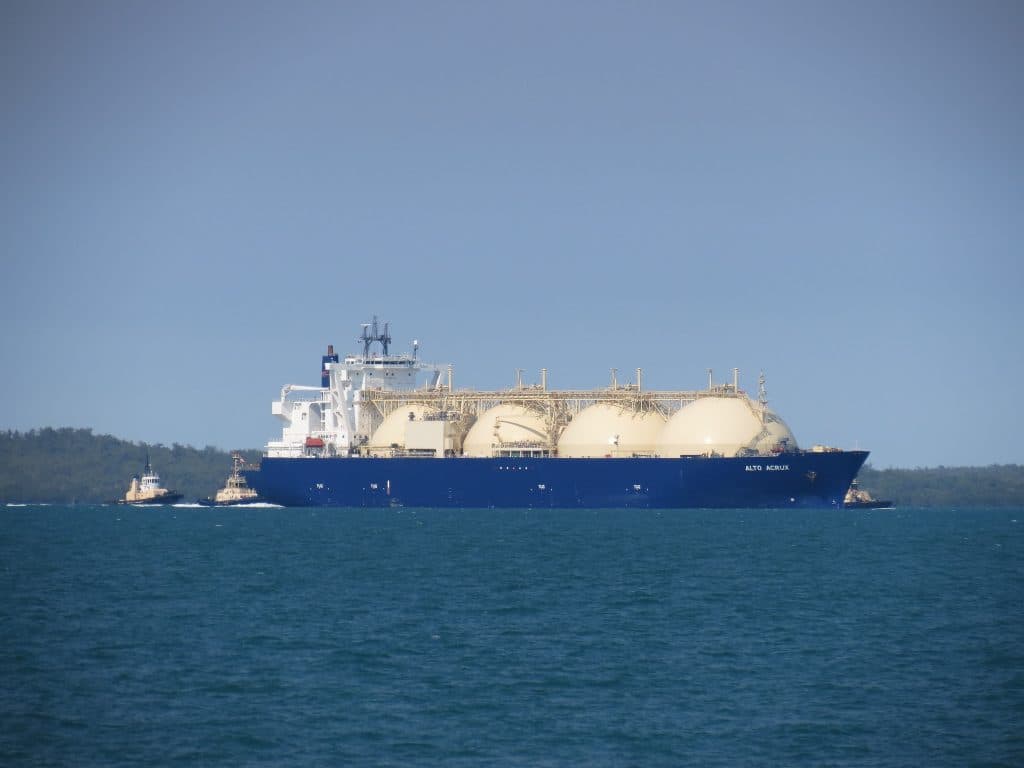
In previous articles, I discussed my own experience with electromobility. However, the entire transition to this “new” type of propulsion needs to be placed in a broader context, one aspect of which is the dependence of Czechia, or rather Europe, on oil imports. Europe as a continent does not have large oil reserves and therefore has to import the vast majority of this commodity. EU countries import 99 % of the oil and petroleum fuels they consume. Unfortunately, this is often from regions where, for understandable reasons, we would not want to send money. Yet we continue to send substantial amounts there.
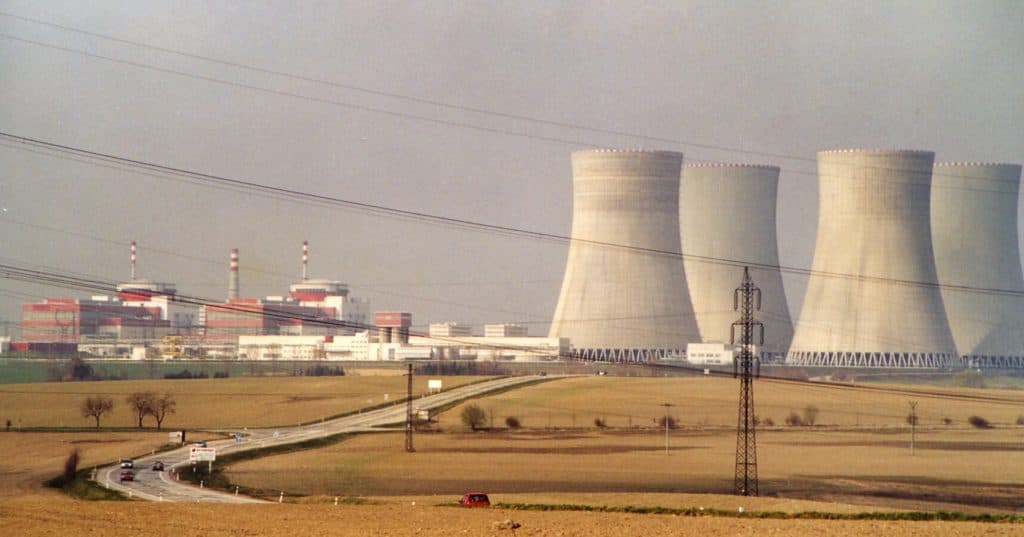
In 2022, Czechia imported a total of 7 424,8 thousand tonnes of oil, an increase of 8,5 % compared to 2021. Of this amount, 56 % of oil was imported from Russia. According to the Czech Ministry of Industry and Trade’s aggregate energy balance, transport in Czechia consumed 73 TWh of petroleum fuels in 2021 (the 2022 data have not yet been statistically processed). By comparison, total electricity consumption in 2022 was roughly 60TWh. Petroleum fuel consumption in transport thus exceeds final electricity consumption, equivalent to the output of nine new Dukovany nuclear power plants (around 8 TWh/year).
At a price of around 80$/barrel, we therefore import approximately CZK 103 billion worth of oil annually, with nearly CZK 60 billion going to Russia, which could purchase around 200 modern tanks for that amount.
These costs must also include the relatively energy-intensive refining of fuel. Precise data on refinery consumption are fairly difficult to find, and studies vary considerably in their figures. Various studies indicate that global refinery consumption is around 6-8% of total electricity consumption. In Czechia’s case, a rough estimate would put electricity used for fuel refining at around 4TWh. For the sake of simplicity, I do not take gas consumption in refineries into account.
This must be supplemented by biofuels, with a 5 % share. Rapeseed and other crops for energy use in transport in Czechia are grown on roughly 100 000 ha of land. Biofuels from this area can therefore provide fuel for just 5 % of vehicles. At the same time, PV installations with an approximate capacity of 1,2 MWp can be installed on 1 ha. PV installations spread across the area sown with energy crops would produce around 120 TWh of electricity per year, enough to cover all of Czechia’s consumption, including powering all vehicles, with some left over. I am certainly not proposing covering fertile land with panels; this merely shows how desperately inefficient growing rapeseed for energy is as a means of converting solar radiation into propulsion energy.
As stated in the previous article, when internal combustion engines are replaced by electric propulsion, energy consumption for passenger cars in predominantly urban operation is roughly one-third, thanks to substantial energy savings from regenerative braking. In long-distance transport, especially freight, the share of energy recovered is lower. When seeking a long range, large battery packs reduce vehicle utility, and electricity consumption is somewhat higher, particularly during high-power fast charging, approaching half the energy consumption of diesel (which is additionally favourably affected by the higher efficiency of larger diesel engines in trucks and buses). Total electricity consumption to replace petroleum fuels for all vehicles would therefore be around 30 TWh, with potential for reduction if part of individual transport were shifted to public transport, especially rail.
Statistics on using a car with PV show that around 50 % of mileage can be covered by PV generation (private, community and corporate installations, and carports above public car parks). Domestic photovoltaic sources in Czechia could therefore, purely theoretically, cover roughly half, i.e. 15 TWh. Even if we had to import the remaining half of the electricity at the current price of 100€/MWh, we would pay roughly CZK 37 billion for it, which is one-third of what we spend annually on petroleum fuels.
Although photovoltaics are currently the cheapest energy source of all, they are nevertheless a volatile energy source that needs to be supplemented with suitable storage and backup.
Alongside peaking plants, pumped-storage hydropower plants and battery storage, an interesting option is to use electric vehicles themselves to stabilise the grid – so-called flexibility management. Whether it involves charging from own sources at home, at companies, or with flexible tariffs on the streets, vehicles provide the grid with fairly large energy storage capacity. The existing 20 000 vehicles in Czechia alone theoretically provide 1 GWh of energy, equivalent to just under one-third of the Dlouhé Stráně pumped-storage plant (3,6 GWh), while 6 million passenger vehicles represent the theoretical capacity of 100 Dlouhé Stráně plants (360 GWh). At average winter consumption of around 10 GW, vehicle battery capacity could theoretically cover all of Czechia’s consumption for 36 hours. If, in reality, roughly one-third of this capacity were used for grid flexibility management, it would still be a huge figure that would otherwise be very difficult to build in Czechia. Of course, the idea is not to power the entire energy system from car batteries; automotive battery lifetimes are not designed for frequent charging and discharging, but managed charging during periods of peak output can be effectively used to optimise distribution grid loads.
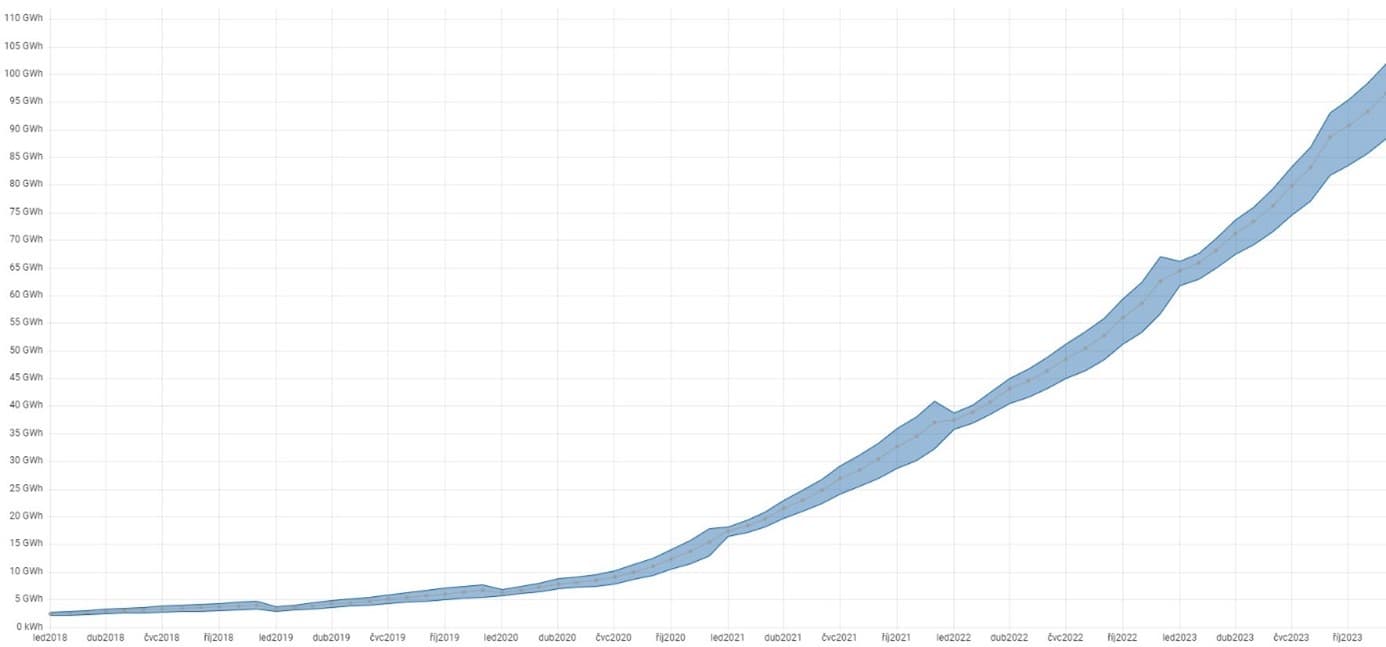
The Technical University of Aachen provides interesting statistics, estimating the total capacity of vehicle batteries in Germany at around 90 GWh. In other words, from 2018 to the present, Germany has “built” 25 pumped-storage plants with the capacity of Dlouhé Stráně through vehicle batteries. The pace of capacity growth is also interesting, at around 3,5 GWh per month.
However, storage alone is not sufficient, especially in winter, and an energy source for the cold part of the year must also be addressed. In many countries, wind power plants are used for this purpose, as they generate primarily in winter and suitably complement photovoltaic sources. Although Czechia also has suitable locations for wind energy development, let us first look at the possibility of supplementing PV with a natural gas combined-cycle plant. It is still a fossil-fuel source, but it is necessary to view it also from the perspective of efficiency of up to 55-60 %. This is because a combined-cycle power plant uses two operating cycles and has two electricity generators. In the first cycle, electricity is supplied by a generator driven by a gas combustion turbine, while in the second cycle electricity is supplied by a generator driven by a steam turbine that uses steam produced from the hot exhaust gases of the gas combustion turbine. Compared with coal, natural gas (methane, CH4) has a more favourable hydrogen-to-carbon ratio in its structure, which, together with the higher efficiency of the combined cycle, results in roughly three times lower specific emissions from electricity generation (around 0,33 kg CO2/kWh versus 1 kg CO2/kWh). Combined-cycle power plants also have the advantage of fast start-up, which is needed to operationally complement volatile sources. At the same time, their waste heat can be used effectively, for example in the district heating systems that are widespread in Czechia. These sources operate most efficiently in winter, when heat consumption is highest, and thus again suitably complement PV sources. Their advantage is the ability to easily regulate output according to the needs of the distribution grid. They are therefore so-called peaking sources, generating only when other sources are insufficient. The energy sector will always need such sources, and their future advantage is also the possibility of operating on hydrogen, biomethane or gas produced from waste.
From the import perspective, it looks as follows. If we were to import all electricity for vehicle operation purely theoretically, total costs would amount to two-thirds of current liquid fuel imports. Even if all vehicle operation had to be covered by combined-cycle gas sources and the gas imported, import costs would be approximately 50% compared with operation on liquid fuels. If half of operation were covered by local PV and gas were imported for combined-cycle generation during the other half of the year, the need for fuel imports would amount to only one-quarter of what we pay for importing and producing liquid fuels. And that does not include the use of waste heat for heating, as is the case with the new combined-cycle source in Mělník supplying heat to the capital. Converting coal-fired power plants to combined-cycle plants is relatively simple and economical, as a number of components from the original coal plant, including its connection to the transmission system, can be used.
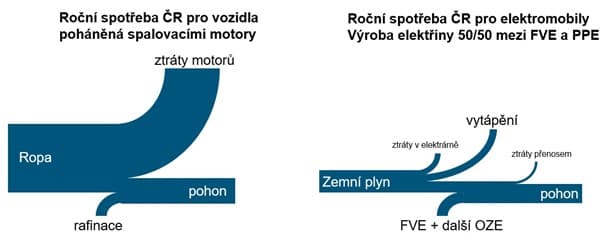
The energy balance for powering all vehicles in Czechia is shown in the following graphic. For clarity, the entire process is considerably simplified. For internal combustion engine propulsion, imported oil and the energy needed to refine it enter the process. Extraction, transport and other fuel logistics are neglected here. The illustration makes it immediately apparent that the largest component of expensive imported and refined fuel is waste heat released into the atmosphere.
The second scenario considers electric vehicle propulsion and electricity generation with an equal share of PV and natural gas combined-cycle generation, with efficiency of 55 % and the use of part of the waste heat for heating. Losses in the power plant and distribution grid are also included in the entire process. Despite the major simplification of the whole process, the substantially lower amount of energy needed for electric vehicles is immediately apparent, primarily due to their high efficiency. Even in the case of partial gas imports for generation during winter, the amounts paid for necessary imports are several times lower. The calculations assume an electricity price of 100 €/MWh and a gas price of 40 €/MWh.

If further sources were built in the region, such as a new Dukovany nuclear power plant unit, wind power plants, biogas plants and biomass heating plants, the need for energy imports during winter would decline significantly further, and imports overall would account for only a small fraction of what we currently spend on importing liquid fuels.
Conclusion
What more is there to add? Czechia will certainly not become an oil emirate, but we are able to produce a large part of the far smaller required amount of electricity ourselves. Even if we had to temporarily replace liquid fuels with electricity generated from gas, the amounts involved would be several times lower than the cost of importing and producing fuels from oil.
The transition to electromobility presents many challenges for industry and the energy sector, but these are technically manageable. At the very least, these challenges are more feasible than finding a sufficiently large oil field in Czechia.
Translation disclaimer
This article is a machine translation of the Czech original and has not yet been fully reviewed. In case of any doubt, please refer to the Czech version.