23 October 2026, 14:38
Loading...
German dawn 2: Is German energy’s bet on Russian gas paying off?
Michal Šnobr
2 October 2018, 07:55
I recently wrote an essay entitled “German dawn”, in which I sought to outline and explain my vision of where the power sector across our region is heading. I make no secret of the fact that the text was based on a successful investment story that had already materialised more than a year ago.
I also admit that, above all due to the unexpectedly rapid sequence of recent events – the rapid rise in the CO2 allowance price on the reformed EU ETS market, progress in the construction of the new Nord Stream 2 pipeline (hereinafter “NS2”), the weak interim results of the German government commission seeking agreement on a faster coal phase-out scenario in Germany, or the worsening outlook for Germany’s energy balance after all German nuclear power plants are shut down by the end of 2022 – I decided to publish everything on this forum.
What lies behind the German dawn? Although this is already Germany’s several-th major policy reversal in energy over the past decade, the scale and pace of the current changes, driven by German national priorities and underpinned by Germany’s foreign-policy orientation towards Russia, have once again come as a surprise.
Nord Stream 2 as a German-Russian pact
Germany’s eastern neighbours, as well as Brussels itself, are once again surprised. In the past, some criticised the Germans for their individual approach to energy policy, while others did not take their concept seriously and assumed that they would reconsider their stance in the future. This did not happen and, on the contrary, the so-called European Energy Union, which according to original Polish ideas was meant to protect Eastern Europe from Russian influence in energy and which Brussels endorsed, has, at least in our region, quietly but very rapidly “degenerated” into a German Energy Union with strong ties to Russia, thanks to the prioritisation of German interests.
The NS2 pipeline, as a purely bilateral pact between Germany and Russia whose implementation recently began, has become not only a symbol of these changes but also a strong foreign-policy move. Its importance to the Germans is confirmed by their willingness in this respect to risk not only good relations with the US but also the EU’s internal cohesion.
In the current situation, NS2 is an acceptable national solution for Germany, but despite all Brussels’ promises it may threaten the transit of Russian gas to Eastern Europe via Ukraine, thereby rewriting the long-term arrangements across the entire region. Many are only now, to their surprise, gradually beginning to discover just how far removed from its ideals the EU can be in the crucial energy sector.
Everyone will simply have to adapt to Germany’s appetite for Russian gas, whether voluntarily or not. Eastern Europe will soon also understand that Germany’s approach to energy policy, its geographical influence, economic strength and the market integration of energy markets within the EU will eventually definitively erase even the assurances previously promised to eastern countries regarding their own national energy mixes. Unfortunately for Czechia, a country geographically wedged into Germany, this applies doubly, and Czech politicians have so far understood very little of it.

Germany in a dead end – German dawn as a realistic way forward
Of course, I was surprised by the response this text provoked immediately after publication, including among experts. When comments followed that built on or drew from my text, or at least from the theses I described in it, I decided to write a follow-up – German dawn, part two.
None of the responses or arguments raised convinced me; on the contrary, they reinforced my view that the German dawn I described is a realistic path for the entire region and will come to fruition in the coming years, because Germany has no other path left. Only one thing could change everything: the fall of Chancellor Merkel and her current government, followed by profound political change in Germany. However, I currently consider this less likely than the German path for the energy sector across the entire region.
The biggest discussion below my text concerned the extent to which the dawn I described – in short, a bet on a high CO2 allowance price plus a stronger role for gas at coal’s expense – is an actual German plan or a forced scenario. I must admit, however, that I consider this part of the debate entirely unnecessary and insignificant.
The pressure to complete Nord Stream 2 quickly despite all obstacles, as well as Germany’s clear position/U-turn on EU ETS reform at EU level last year, are irrefutable proof that Germany has consciously turned the wheel.
That the Germans had no other choice is simply a fact that I clearly described in the original text: “In the recent past, Germany consciously and entirely independently within the EU (often contrary to EU policy) decided to make several fundamental interventions in its energy sector. From a Czech perspective, we may consider them irrational or ideological, good or bad, but on the other hand, for the Germans these decisions appear to be desired, final and immutable. We are talking here about the decision to shut down all nuclear power plants in Germany by 2022, bet on rapid renewables expansion and at the same time place itself at the forefront of the fight against climate change.”
This is the starting point. Germany’s capacity to fulfil all its wishes in energy policy (now significantly influenced by politics) is, thanks to its economic dominance and influence in the EU, incomparably different from what disunited and fragmented Eastern Europe would like or be able to achieve.

On the other side of the border, Germany mainly faces France, which as a nuclear power remains resistant to the offensive of German energy policy while being entirely complacent. After Britain leaves the EU, Eastern Europe will therefore struggle to find support in the West against the pressure of German interests.
Germany must confirm its climate ambitions
What Germany now needs and considers essential is confirmation of its climate ambitions. Without this, all previous efforts associated with the Energiewende and the related policies of Angela Merkel’s governments would fail completely. It can therefore be inferred, and current developments indicate, that the Germans will now want at any cost to carry out the next phase of their energy transition and finally convince the world of the correctness of their path.
This leaves just one task – fundamentally reduce carbon emissions in the energy sector, or at least set a clear trend in this direction, no later than by 2030. Failing to meet its own 2020 targets in this area will undoubtedly be a defeat for Germany, but in the end it can still present that defeat as merely temporary.
It is actually unnecessary to speculate over whether Germany has painted itself into a corner with its previous decisions and whether all subsequent decisions are forced or not. The fact is that Germany alone is pursuing in the EU (after Britain’s departure) a fundamental, ambitious and dearly paid-for overhaul of its energy policy from the ground up, betting not on short-term targets but on longer-term change.
For example, France’s departure from nuclear energy is, and evidently will for a long time remain, merely an embarrassing exercise in endlessly postponing any politically set deadlines. Incidentally, the original target to reduce France’s dependence on nuclear sources from 75 % to 50 % was set for 2025. It was subsequently scrapped without batting an eye and without any public interest, with the claim that it would be achieved as soon as possible.
Only now has 2035 been provisionally set as the next, sufficiently distant, milestone. That is almost 18 years away. A deadline that can again be postponed at any time, or even cancelled. Few believe the French in this regard.
In Germany, everything is different. Energy-sector change, or rather the Energiewende, has long been politically linked to strong public support, to a policy that borders on a new ideology and is associated with the era of current Chancellor Angela Merkel.
Solving the German conundrum – allowances at 30-45 EUR
In the first German dawn, I sought to outline that the only solution to the current conundrum in German energy is a “high” CO2 allowance price. By this I meant a level of 30 to 45 EUR/t.
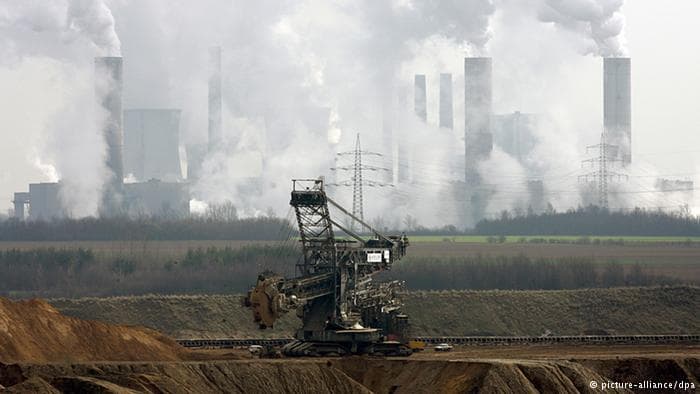
The appeal of a higher allowance price for the Germans lies in the fact that it can help them, on a market basis, bring about a relatively rapid retreat from the “dirtiest” coal-fired capacity and replace it, as an available solution, with gas-fired capacity producing less than half the emissions. All this would also bring renewables (hereinafter “RES”), long called for, into the electricity market without continued price support in the form of various guarantees.
However, I never wrote that the Germans would be “happy” with the high wholesale and, consequently, retail electricity prices that will drive these changes. Rather, I see it as something they will have to accept, while seeking savings in other components of the retail electricity price so that the consequences of rising emissions allowance prices do not further increase that price.
Significant scope to offset rising allowance prices
The truth is that this is precisely where German politicians have a relatively broad range of options to gradually eliminate the effects of rising wholesale electricity prices on their consumers.

One option is to reduce the relatively high tax burden in retail electricity prices, and who else but a country with a now chronic current-account surplus can afford it? Another very strong argument is the fact that, closer to 2025 and beyond, the most expensive consumer-funded subsidies for renewables, which caused the rapid rise in household electricity prices in previous years, will gradually expire.
In addition, a higher CO2 allowance price and therefore wholesale electricity price, combined with technological progress making renewables cheaper, could ensure that no new renewables support payments are added. It must be acknowledged, however, that a possible increase in contributions for building interconnections and reinforcing the transmission grid remains a risk, although here too a solution lies in seeking European funding for these “European” investments.
EU ETS developments as a key factor
Nevertheless, I agree that the rise in the EU ETS allowance price over the past year is unrepeatable and was surprisingly rapid. We can only speculate about the causes. On the other hand, this is how markets work: sometimes an emotion-filled market gets ahead of itself, and at other times it inexplicably lags behind.
The history of the EU ETS is full of major reversals. What matters is where the CO2 allowance price settles in the period after 2020, and especially during the period critical for the region, namely 2021 and 2022, when the output of German zero-emission nuclear power plants, which still supply 70-80 TWh of electricity a year today, disappears from the market.
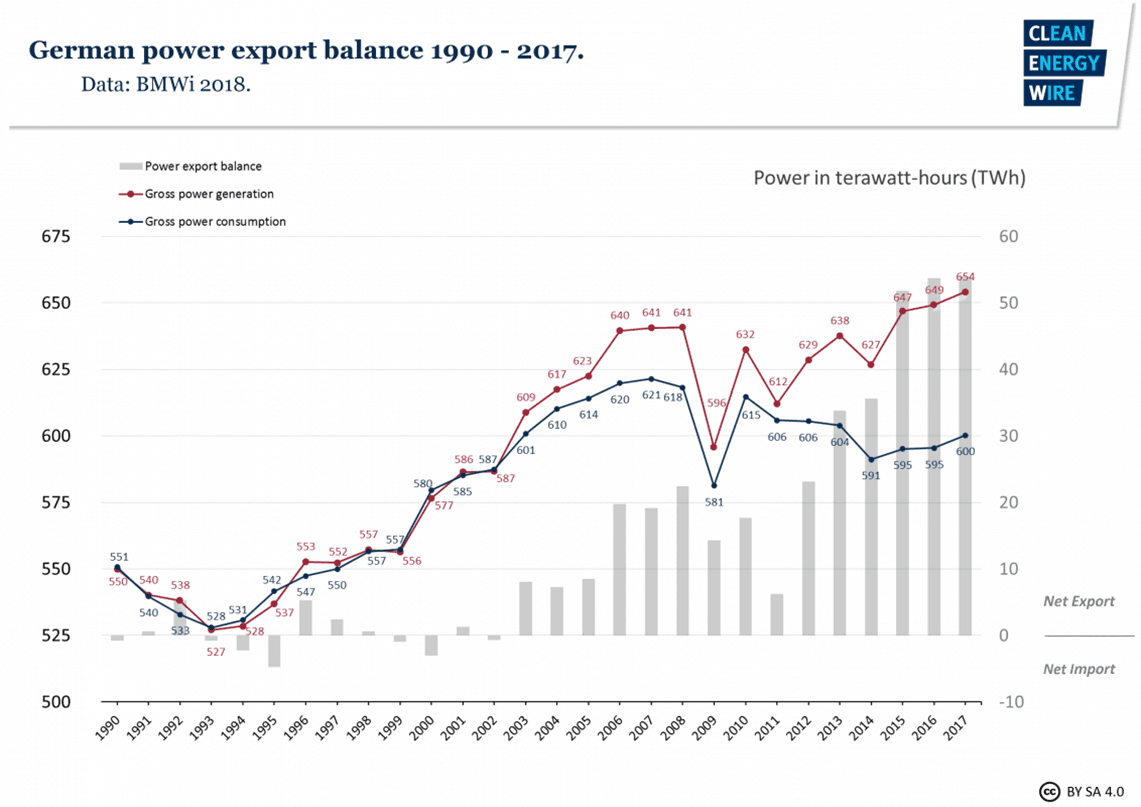
Crucial from this perspective is the fact that the growth rate of Germany’s electricity generation surplus has slowed despite continued growth in installed renewables capacity, and has now oscillated around 50 TWh per year for three years (see chart below). This does not appear likely to change this year either, when exports exceeded 30 TWh only slightly over nine months, mainly due to a drop in wind generation during the summer months.
Energiewende ineffective in cutting emissions
I personally believe that a CO2 allowance price of between 35 and 45 EUR/t is not unrealistic. The main argument remains that, despite the huge growth in renewable generation, the Energiewende has so far delivered almost no emissions reductions over the past decade. This is because Germany is primarily replacing clean, zero-emission nuclear capacity in its mix with renewables, leaving little room for the substitution of coal.
The rapid nuclear phase-out by 2022, followed by at least some coal phase-down, cannot be replaced by anything other than, at minimum, gas with half the emissions produced by coal-fired power plants. This is also reflected in the emphasis Germany places on rapidly expanding Nord Stream with a second line, come what may.
{„country“:“GER“,“type“:“PIE“,“from“:“2018-01-01″,“to“:“2018-09-30″,“caption“:“Share of individual sources in electricity generation in Germany this year.“,“url“:“https://energodock.cz/energodock/get_electricity_shares.php“,“source“:“shortcode“,“start_date“:“2018-01-01″,“end_date“:“2018-09-30″}
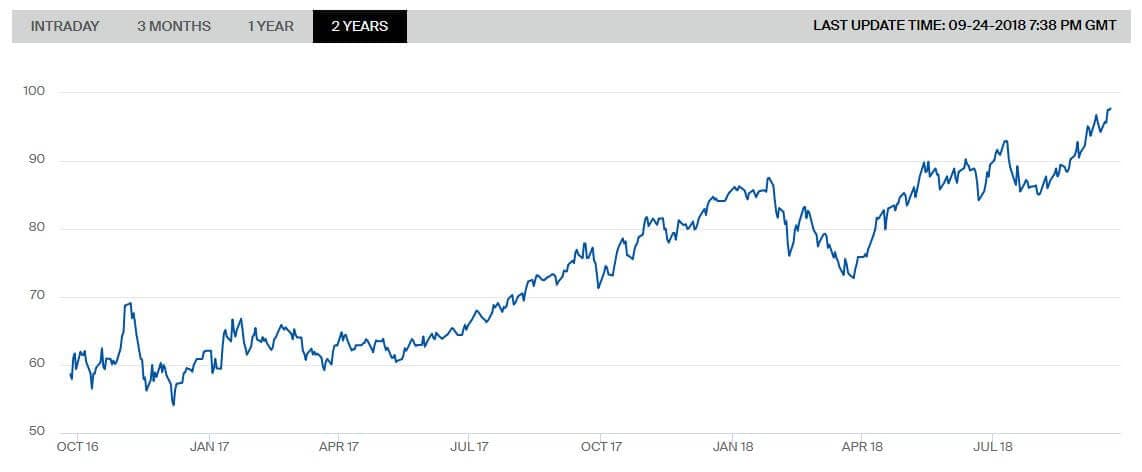
In this situation, it is not possible to expect any fundamental reduction in German emissions in the foreseeable future. The allowance price on the reformed EU ETS market therefore has every prerequisite to continue rising. The wholesale electricity price created by a rising allowance price will also depend on developments in other important parameters, including the gas price in EUR/MWh, the coal price in USD/t, the EUR/USD exchange rate itself, and quite possibly the aforementioned “new” balance of electricity generation and consumption across the entire region.
A stronger role for gas, rising electricity prices and decentralisation
In the electricity market, as well as the EU ETS market, we are now in fact merely picking up where we were ten years ago, before the period interrupted by the economic crisis and the subsequent Fukushima disaster, when ČEZ sold its output for two consecutive years at between 55 and 60 EUR/MWh. In response to some views on my original text, however, I am certain that this will still be far below (at most less than half) the key nuclear benchmark set for Europe by the guaranteed model for the UK’s Hinkley Point: namely, around 150 EUR/MWh at the start of generation (110 EUR/MWh at 2012 prices + inflation), followed by regular inflation-linked increases throughout the 35 years from the point at which the new units are due to start generating electricity (assumed 2025).
In conclusion, my vision of the market’s future consists of a significant strengthening of the role of gas in the mix across our region, continued development of the energy decentralisation trend, wholesale electricity prices significantly higher than over the past 5 years and, as a result, motivated, increased efforts in energy savings, and a further convergence of “market” electricity prices with the long-term declining profitable cost base of renewables.
It is still very difficult to predict whether nuclear power plants will return to the picture. The current experience of developed economies does not indicate this so far. The risks associated with such projects are difficult to swallow even for giants larger than ČEZ or the Czech Republic.
Moreover, Czechia is certainly not in a position where it must “close its eyes” and gamble on nuclear power, given how the construction of nuclear power plants is turning out today in Europe and the US alike. We have several options for addressing the situation. These include exploiting the synergies of the emerging Nord Stream 2, which specifically works in Czechia’s favour, or, like the US, France and Sweden, considering extending the lifetime of Dukovany Nuclear Power Plant to as much as sixty years.
Translation disclaimer
This article is a machine translation of the Czech original and has not yet been fully reviewed. In case of any doubt, please refer to the Czech version.
Sdílejte článek prostřednictvím:
You might also like
23 October 2026, 11:01
23 October 2026, 06:34