23 October 2026, 14:38
Loading...
Nuclear energy in 2021 and nuclear power in the EU taxonomy
Vladimír Wagner
8 January 2022, 13:06
Not least the weather developments in 2021 clearly demonstrated that the transition to low-emission energy cannot be achieved without nuclear capacity. It therefore appears that attitudes towards nuclear power are changing in at least some European countries. The European Commission has thus included nuclear power among green energy sources, albeit with conditions. However, these need to be interpreted correctly. The nuclear chain reaction has finally begun at Olkiluoto 3. In 2021, six Generation III reactors and one advanced small modular reactor entered operation.
The start of 2021, with the break-up of the European power grid on 8 January—which brought it close to a blackout—and the autumn and winter, when it would not be much of an exaggeration to speak of an energy crisis, clearly showed that a transition to a low-emission energy mix cannot be secured without nuclear capacity. A number of European Union countries are therefore changing their view on nuclear energy and considering the construction of new nuclear capacity. These include France, which already has a low-emission mix thanks to nuclear energy and the lowest carbon dioxide emissions per unit of electricity generated. As a large share of French households use electricity for heating, heating-related emissions are also very low there. The French now clearly understand that they cannot give up nuclear capacity and must build new plants if they are to maintain low emissions, energy security and socially affordable energy prices. This is why President Macron scrapped the rapid reduction in nuclear power's share and recently announced a plan to build six new units.
It was the strong pressure from France and other countries that understand they cannot cut emissions without nuclear energy that led the European Commission to include nuclear power among green, sustainable sources in its taxonomy. This happened despite enormous anti-nuclear pressure, especially from Austria and Germany. However, it must be stressed that nuclear power is described as transitional, and its support is limited by conditions that can seem almost absurd if taken literally. This part of the taxonomy too, and especially the discussion surrounding it, lays bare its fundamental problem.
It is not based on physical, technical and natural-science principles, but is predominantly guided by ideological notions and political compromises. It takes only limited account of the development of our knowledge and technologies. Many technologies have been assigned labels that rule them out regardless of reality. It can therefore very often lead not to lower emissions, reduced environmental impacts and lower risk, but in precisely the opposite direction. Moreover, through its complexity, ambiguity and the need for officials to continually assess every matter, it extends the implementation of any project and creates strong potential for corruption.
Let us look at the specific case of the newly published taxonomy in the area of nuclear energy. I should warn in advance that in many cases it is not clear exactly what its authors intended, what the specific wording really means and how it will be interpreted in practice. The following analysis is therefore preliminary and intended more to open a discussion.
In my view, the 2040 deadline for existing units and 2045 for newly built ones do not mean that anything would have to change for them after 2040 and 2045. This is how some Czech commentators interpreted them. Nor does it mean that nuclear energy would cease to be a green source in the European Union at that time. In my opinion, the taxonomy as currently set will be reviewed regularly and, if at the time in question it is found that some of the set parameters were not correct or a better new nuclear technology has emerged, the taxonomy will be amended. The following text therefore does not reflect the actual meaning of the conditions set, but merely the consequences of their dogmatic interpretation.
Let us assume the literal validity of the claim that existing nuclear plants will be considered green (sustainable) only until 2040, and newly built ones only if they have a construction permit by 2045. This would mean the end of nuclear energy development in the European Union. It would mean that research into nuclear energy technologies in the EU makes no sense. Developing new reactors takes many years or decades and is pointless if the region excludes nuclear energy from its energy mix before that development is completed.
It would mean, for example, that the development of advanced small modular reactors at ÚJV a.s. makes no sense, because they certainly will not be available before 2045. More generally, any small modular reactors that could be deployed in the European Union will not arrive before the 2030s. If they are to make economic sense, they must be built in sufficiently large series. However, this cannot be achieved under the condition that only those with construction permits before 2045 can be built. This is also because small modular reactors will only make economic sense if licensing appropriate to their safety parameters and characteristics is created. And that will certainly not be a quick process. Under a literal interpretation of this condition, small modular reactors will therefore not be deployed in the European Union at all, or only in minimal numbers.
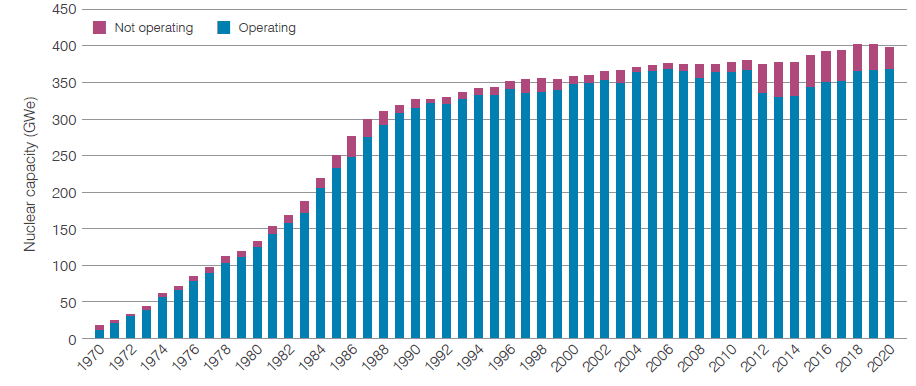
Development in the number of reactors (source: WNA)
For large Generation III reactors, the situation appears better. But if the nuclear industry and the construction of units were truly to end in the 2040s, there would be no point in developing this industry in the European Union. Given that not only China expects a breakthrough in this field and is working intensively towards it, such lagging behind would be catastrophic for the EU. As I have already mentioned, I consider such a literal interpretation of these dates nonsensical. In my view, it does not mean that nuclear facilities could not be built after 2045 or that existing ones could not be upgraded after 2040. Rather, technological developments and our knowledge of the environmental impacts of different technologies will be assessed continuously, and the taxonomy's parameters may be adjusted for subsequent decades. From this perspective, I see no problem with the taxonomy in question.
The requirement for a realistic repository project that could in principle be available by 2050 may be somewhat more problematic. Yet this too can be met through a prepared project. This condition may be one of those changed in the taxonomy before 2045. If it proves more environmentally beneficial to close the fuel cycle and abandon rapid development of a deep geological repository, this condition may disappear from a future taxonomy. As mentioned, the reality surrounding the taxonomy will depend very strongly on its interpretation and implementation. But in my view, the current wording is not critically restrictive from our perspective. To prevent misinterpretation, the taxonomy text should not even suggest that nuclear facilities are merely transitional. The conditions surrounding gas are a different matter. In that case, in my opinion too, it is a disaster for Czech district heating. In the area of nuclear energy, I would therefore recommend consulting the taxonomy's authors on the correct interpretation, and if it is as I believe, we can support it without concern. It also includes a number of highly sensible recommendations, such as an emphasis on fuel recycling and reducing the volume of nuclear waste sent to a deep geological repository.
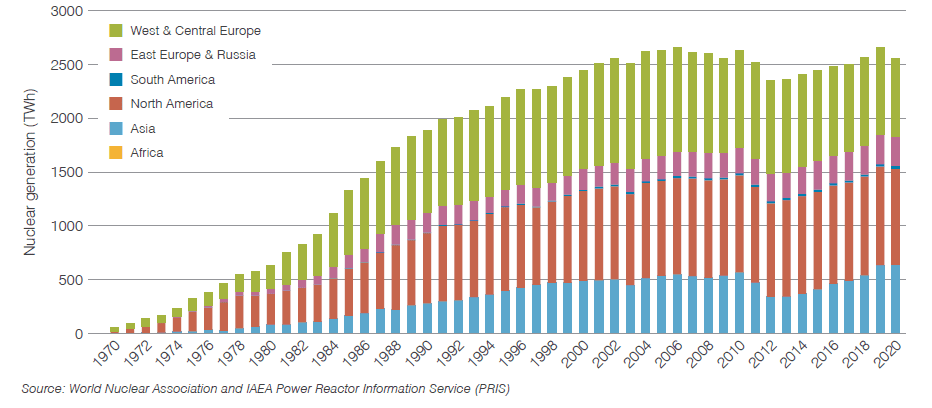
Development of electricity generation from nuclear power plants (source: WNA)
Overview and statistics
This thirteenth overview of nuclear energy developments over the past year follows articles from previous years. The latest instalment (here and here) covered 2020. At the end of 2020, there were 442 reactors with capacity of 393,5 GWe, while at the end of 2021 there were 440 with capacity of 393,2 GWe (data from the World Nuclear Association and the PRIS database). Fifty-six units are under construction. However, it should be stressed that these are figures from early December, when some of the reactors mentioned below that were shut down and started up had not yet been included.
Last year, the number of units completed was roughly balanced by the number shut down. This was even the case despite the closure of several reactors in Germany and the United Kingdom. Ten units ceased operation, and another was due to be shut down in early January. The shutdown of Sweden's Ringhals 1 boiling water reactor on 31 December 2020 was already covered in the previous overview. It joined the similar Ringhals-2 unit, which had been shut down earlier. The loss of these nuclear facilities had a considerable impact on electricity supplies in southern Sweden and led to higher electricity prices. Sweden now has six nuclear reactors in operation.
On the last day of 2021, three reactors were shut down in Germany: Brokdorf in Schleswig-Holstein, Grohnde in Lower Saxony and Gundremmingen C in Bavaria. The shutdown of the German units is truly regrettable. They are very high-quality, reliable and high-capacity reactors. For example, the Grohnde unit has capacity of 1400 MWe and holds the record for electricity generation over a reactor's operating lifetime. In total, it generated more than 400 TWh of electricity. It began supplying electricity in 1984 and could have remained in operation for another ten or twenty years.
Three units were also shut down in the United Kingdom during 2021. These were gas-cooled AGR reactors. Dungeness B-1 and Dungeness B-2 were the first to cease operation. At the end of November 2021, the reactor at Hunterston B was also shut down. This was the third unit at Hunterston; the plant's fourth unit was expected to be shut down in January 2022.
In Taiwan, Guosheng-1 was shut down in mid-2021. It is a 985 MWe boiling water reactor commissioned in 1981. In Pakistan, the oldest KANUPP-1 unit, also known as Karachi 1, was shut down on 1 August 2021. It was a CANDU heavy-water reactor commissioned in 1972. Its initial capacity was 137 MWe. However, this gradually declined, as did its capacity factor. In the United States, Indian Point's third unit was shut down, ending electricity generation at the entire plant after sixty years. On 19 December 2021, the first unit of Kursk nuclear power plant was shut down. It is an RBMK reactor.
Eight units newly entered operation in 2021. India's PHWR-700 heavy-water reactor, Kakrapar 3, was connected to the grid and gradually entered commercial operation. In China, an ACPR1000 reactor was started as Tianwan 6, and the same reactor entered operation as Hongyanhe 5, where the nuclear chain reaction began in mid-year. Two Hualong One (HPR1000) units also entered operation. Towards the end of 2021, the nuclear chain reaction began at Fuqing 6, the second reactor of this type at the plant. The same reactor was also started in Pakistan in 2021 as Karachi 2. China's HTR-PM200 small modular reactor began operation. Two South Korean APR1400 reactors also entered operation: the first unit at Shin Hanul in South Korea and the second unit at Barakah in the United Arab Emirates. Two further reactors are also very close to start-up: Olkiluoto 3 and Ostrovets 2. The former is an EPR unit and the latter a VVER1200.
Construction began on eleven reactors, with another following in the first days of January 2022; this is likewise a figure similar to those for reactors being shut down and started up. Construction of the first Hualong One unit began around the turn of 2020 and 2021 at China's San'ao plant (Sanaocun-1), while first concrete for the nuclear island of the plant's second unit was poured in the first days of January 2022. Construction of another reactor of this type began in March at Changjiang 3, followed by Changjiang 4 at the end of the year.
Other construction starts included two Russian VVER1200 reactors in China, Tianwan 7 and Xudabao 3. At Turkey's Akkuyu plant, which uses the same reactor type, first concrete for the third unit's nuclear island was poured in early March 2021. Concrete pouring began for Kudankulam 5 in mid-2021, followed by the nuclear island of Kudankulam 6 on 20 December. VVER1000 reactors are used there.
Construction of prototypes of fast breeder reactors also progressed. In Russia, first concrete was poured for the nuclear island of the lead-cooled BREST-OD-300 fast reactor in 2021. Construction of the second CFR-600 sodium-cooled fast reactor probably also began in China.
Construction of China's 125 MWe ACP100 (Linglong One) small modular reactor also began in early July 2021.
Nuclear electricity generation reached 2 553 TWh in 2020. It fell by 104 TWh from 2 657 TWh in 2019. This was the first time since 2012 that it had not increased. The coronavirus epidemic, economic decline and lower electricity consumption had a major impact. It can therefore be expected to grow again as early as 2021. Preliminary results indicate this.
Russia and China are building the most units
Russia and China are building the most new units. Rosatom is successfully replacing ageing VVER and RBMK units in Russia with Generation III VVER1200 reactors. Two of these reactors are operating very well at both the Novovoronezh and Leningrad plants. At Leningrad, they replaced the first two RBMK units in the plant's first phase. Based on this good experience, preparations began for construction of the third and fourth units of the plant's second phase. This will make it possible to shut down all the RBMK units there. RBMK replacement is also under way at Kursk nuclear power plant. VVER1200 and VVER1000 units are also the most commonly built abroad. A second unit of this type is already being commissioned in Belarus. Their construction is progressing successfully in Turkey, Bangladesh, China and India, and is being prepared in Egypt, Uzbekistan, Hungary and Finland.
China is shifting from commissioning Generation III ACPR1000 units to Hualong One reactors. Two are already operating there. Abroad, the first has started at the Karachi plant in Pakistan, and another will soon join it. Alongside VVER1200 units, Hualong One is becoming the reactor whose construction is most frequently initiated. According to Chinese announcements, the pace of its deployment will increase further. Given the high number of units China wants to build at home, the question is how much capacity it will have for projects abroad. However, it is certain that a number of Hualong One units will also appear internationally.
VVER1200 and Hualong One reactors are the only ones with enough completed units, units under construction and projects in the pipeline to achieve serial construction and stable supply chains that can rely on a long-term outlook. It is precisely under such conditions that the economic advantages of building and operating Generation III reactors should become apparent. This year, two Korean APR-1400 units entered operation, one in South Korea and one in the United Arab Emirates. Its problem, however, is that South Korea's political leadership decided to move away from nuclear energy, and the unit currently has no customers for new projects either abroad.
Russia and China plan to develop nuclear energy very intensively in the future as well. This is also why they are working on closing the fuel cycle and on fast reactors. Russia currently has the only two commercially operating fast reactors. In 2021, the BN-800 sodium-cooled fast reactor progressively switched to MOX fuel. In February 2021, one-third of its core used innovative MOX fuel; after another fuel replacement, this had risen to 60 %. In 2022, following a further fuel replacement, the core will be composed entirely of MOX fuel assemblies. The Beloyarsk plant would like to operate the BN-600 reactor, the older sodium reactor at the same plant, for 60 years.
China's CEFR sodium-cooled fast reactor began its second test cycle after fuel replacement. This is expected to take place at high power. Russia will supply fuel for the CFR-600 prototype sodium-cooled fast reactor for at least its first six years of operation.
In February 2021, the nuclear safety authority granted permission for construction of the BREST-OD-300 prototype lead-cooled fast reactor. Concrete pouring for its nuclear island began before mid-2021. Fuel development for this reactor is being completed. In addition to the reactor itself, the site will include facilities for fuel production and subsequently for its reprocessing. This reactor does not use neutron moderation. It will be cooled by liquid lead. For material reasons, BREST itself will have an operating temperature of around 500°C. In the future, this reactor type could have temperatures higher than 1000°C. In such a case, the turbine could in principle operate, for example, in supercritical mode with a steam temperature of 600°C and a thermal-to-electricity conversion efficiency of 40 - 45 %. Future reactors operating at high temperatures could use a gas turbine or directly produce hydrogen or industrial heat. Lead's advantage over sodium is its stability and the absence of violent chemical reactions with water and oxygen. Leaks in the primary circuit therefore do not pose the problems that create risk in sodium reactors. The core will allow a configuration with a breeding ratio of up to 1,2. Experience from operating this demonstration reactor should make it possible to design a commercial model.
America and Europe – efforts to complete long-standing unfinished projects
Only two new nuclear reactors are being built in the United States. Problems persist in the construction of the pair of AP1000 units at Vogtle. The start-up of the third unit, partly due to the pandemic, is shifting closer to the end of 2022. All problems that emerged during hot functional testing carried out in mid-2021 must also be resolved.
Europe has only a minimal number of projects, most of which also face major delays. Fuel has finally been loaded into the EPR reactor at Olkiluoto, and the nuclear chain reaction began on 21 December. The unit should begin generating electricity in February and enter commercial operation in June. Completion of Flamanville 3 is also reaching its final stage. Anomalies discovered in the containment welds, which need to be rectified, may be a problem. However, the unit could start up around the turn of 2022 and 2023 and load fuel. Based on this winter's experience, France has returned to its plan to build new nuclear reactors. Six new units are currently envisaged, using the improved EPR2 design.
EPR units are also being built in the United Kingdom. Construction of Hinkley Point C was affected by the pandemic. In 2016, the first unit was expected to enter service at the end of 2025. It is now clear that this will not happen before June 2026. Positively, work is progressing faster on the second unit, reflecting experience gained from building the first.
Preparations continue for construction of two EPR units at Sizewell C. The key issue there was the decision on the project's financing method. If a suitable financial model were selected, it could also be used to build further nuclear units. Resolving this issue and starting construction quickly became ever more urgent, especially after the shutdown of Dungeness B and the setting of closure dates for further AGR gas-cooled reactors. All of these should close within ten years. At the end of October, the UK government therefore approved a financing model for nuclear projects known as RAB (Regulated Asset Base), which should reduce financing costs and attract private investors. Under this model, future consumers contribute to project financing already during its construction phase. The UK government also began negotiations with EDF on the specific Sizewell C project.
Completion of the unfinished pair of VVER440 units at the Mochovce nuclear power plant is also awaited in neighbouring Slovakia. The start of the nuclear chain reaction at Mochovce 3 was not expected before February 2022.
Diversifying fuel sources is important not only for Europe. The range of fuel assembly suppliers for reactors is expanding. On one side, Rosatom supplies fuel for Western-type plants; on the other, Westinghouse supplies fuel for Ukrainian VVER1000 reactors, where it is already used in six units. It also offers this type of fuel to Bulgaria and Czechia. At the same time, it has developed fuel for VVER440 units, which will begin to be used at Ukraine's Rivne 2 unit from 2024. This option for diversifying fuel suppliers may also be of interest for Czech Dukovany and Slovak Mochovce or Jaslovské Bohunice. Conversely, Sweden is beginning to use the aforementioned Rosatom fuel for Western reactors.
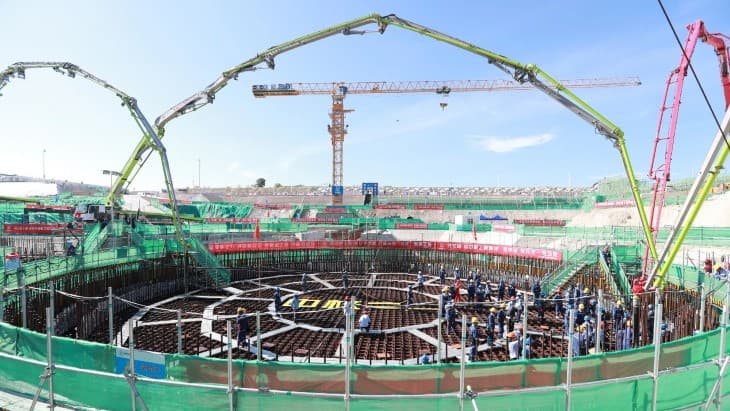
Start of construction of the ACP100 small modular reactor (source: CNNC)
Small modular reactors
In 2021, there was also a major breakthrough in small modular reactors. Experience from operating the Akademik Lomonosov floating nuclear power plant led to concrete steps towards building further small modular reactors based on Russian reactors designed for icebreakers, whether floating or land-based. It appears that they could indeed be deployed in larger series.
The start of operation of the HTR-PM200 high-temperature small modular reactor in China is likewise a landmark event. If it proves successful, its modules begin to be mass-produced and it is economically successful, it could be an ideal solution for producing industrial heat.
It will also be interesting to follow developments in China around the ACP100 (Linglong One) small modular reactor, construction of which began this year and which is expected to be completed in 2026.
These projects and experience with them may also inspire other small modular reactor projects being developed in many places. It must be acknowledged that they are still at the stage of paper projects and preliminary licensing. It should be recalled that their future use is being considered very intensively not only in Czechia.
This includes the Netherlands, Belgium, Sweden, Bulgaria, Romania, Poland, the Baltic states and others. For now, however, this involves preliminary selection of suitable sites, discussion of suitable licensing procedures, and the search for appropriate financing models and potential suppliers. The most frequently considered option is probably the US NuScale reactor, which also has strong support from the US government. Another is Rolls-Royce's British small modular reactor. We will return to the situation in this area in greater detail another time.
Conclusion
In Czechia too, the course of this winter clearly showed that we cannot do without nuclear capacity. Czech nuclear power plants generated a total of 30,73 TWh in 2021, the second-highest output after 2013, when they supplied 30,75 TWh. On 12 November 2021, they also generated their highest electricity output to date in a single day, 100,8 GWh. At that time, all six units were operating, and low temperatures increased the efficiency of heat-to-electricity conversion.
Besides electricity generation, it is increasingly important to use nuclear units as heat sources in the transition away from coal in district heating. It is therefore unfortunate that the bankruptcy of Tenza will delay the hot-water pipeline project from Temelín to České Budějovice. Of the planned 26 km, 17 km have been completed and 2,5 km are under construction. The pipeline should provide 30 % of heat supplies for the city. Let us recall that Temelín has already supplied heat to Týn nad Vltavou for twenty years.
A turning point came in preparations for construction of a new unit at Dukovany. Chinese and Russian suppliers were excluded from the planned tender. On the one hand, the potentially highest-quality bids were excluded; on the other, this was the only way to achieve sufficiently broad political consensus for proceeding with construction. We will be able to assess where this ideological decision by Czech politicians leads by comparing outcomes in Czechia with Hungary or Finland. It is now important that the tender be launched as soon as possible, implemented to the highest possible quality, and that construction of at least one unit finally begins. In March 2021, ČEZ received permission from SÚJB, the Czech nuclear safety authority, to site two new units at Dukovany. It is equally important to prepare a financing model for building a pair of units at Temelín and begin that construction as soon as possible.
It must be stressed that the current bleak situation is entirely the responsibility of the Czech political scene, which has failed to cooperate on energy, negotiate realistic compromises and then implement them consistently. Instead, Czech politicians gave priority to political and ideological conflict at any cost. Above all in the European arena, instead of taking a united approach in the interests of Czech energy and society, they settled domestic personal disputes. This has meant that we have lost not only years, but gradually decades. It is now no longer possible to continue wavering and delaying energy solutions.
However, we are not alone in this. China and Russia are building ever more Generation III reactors at home and abroad, and these countries are also making fundamental progress in small modular reactors and closing the fuel cycle. Europe and the United States are merely completing a few long-unfinished projects. Let us hope the lessons of this winter will be sufficient and the coming years will be decisive. After Olkiluoto 3, Flamanville 3 and Mochovce 3 and 4 will be completed quickly, and new reactors will begin to be built in Europe. As I wrote, current developments appear to be a turning point for the EPR reactor. If Sizewell C and construction of new units of this type in France, and possibly also India, are approved, the reactor's successful fate will most likely be decided and it will join VVER1200 and Hualong One units. The fate of the AP1000 reactor remains open; its success in Ukraine, or potentially in Poland or elsewhere in Europe, could be decisive. Discussion of its deployment in the United Kingdom is starting again. However, its future remains very uncertain. Let us nevertheless hope that a decisive turning point is now coming in the European Union.
The internationalisation of the nuclear industry and supply chains is very positive. Czech companies are therefore also supplying components for a wide range of diverse projects. These include the well-known Škoda JS, ÚJV a.s. and Nuvia with its nuclear supplies, as well as lesser-known companies Arako, Armatury Group, MSA Dolní Benešov, MPower Engineering, Mostro, which supplies valves, Kabelovna Kabex with its cables, ZPA Pečky with servo drives, Sigma Group with pumps, Lavimont Brno with piping, and many others. Let us hope they will have plenty of work in Czechia in the coming years as well.
A more detailed overview of the situation in individual countries is available in a more extensive article on the Osel website.
The author's lecture on the current state of nuclear energy is available here.
Translation disclaimer
This article is a machine translation of the Czech original and has not yet been fully reviewed. In case of any doubt, please refer to the Czech version.
Sdílejte článek prostřednictvím:
You might also like
23 October 2026, 11:01
23 October 2026, 06:34