23 October 2026, 14:38
Loading...
Preparations begin for discharge of tritiated water at Fukushima
Vladimír Wagner
8 May 2022, 09:28
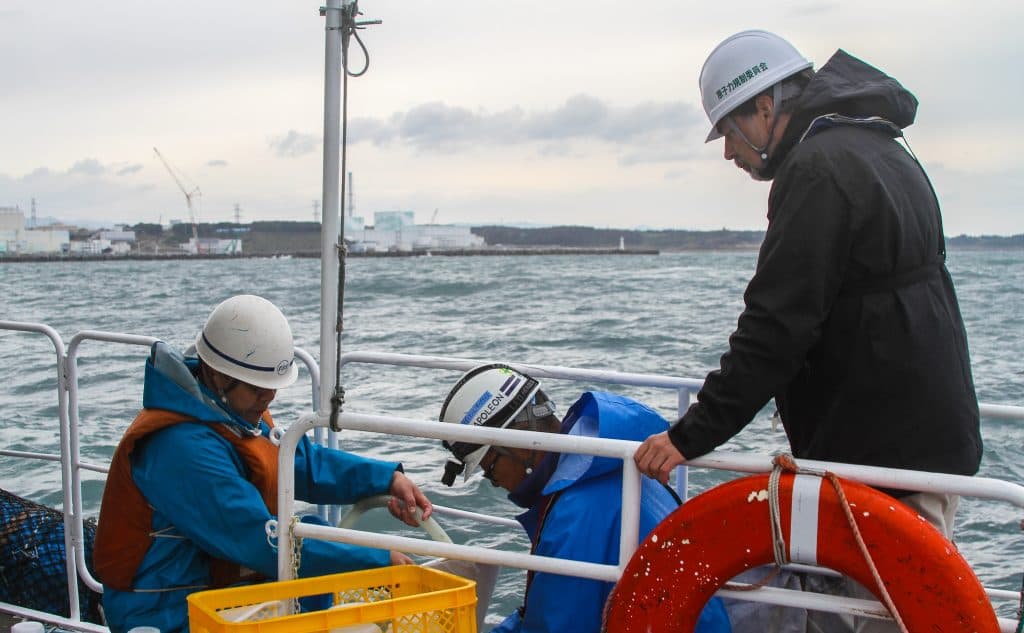
Work has begun at Fukushima on preparations for the discharge of tritiated water. Specific projects for the necessary equipment and methods are being prepared. Agreement is being sought on procedures for monitoring the discharged water under international oversight, which would increase the confidence of residents at home and abroad in the safety of catches by local fishermen. In practical terms, discharges should begin within two years.
Addressing the problem of accumulating radioactive water is a key challenge linked to the progress of dealing with the consequences of the nuclear accident at the Fukushima Daiichi plant. This year, a final decision was made to gradually discharge tritium-containing water into the sea. With the support of the International Atomic Energy Agency (IAEA), preparations are under way to carry out this operation, which will take many years. Let us use this turning point to review the current state of accident clean-up, reconstruction and revitalisation of the affected areas. It should be recalled that the last overview article in the Fukushima Daiichi series was published more than a year ago.
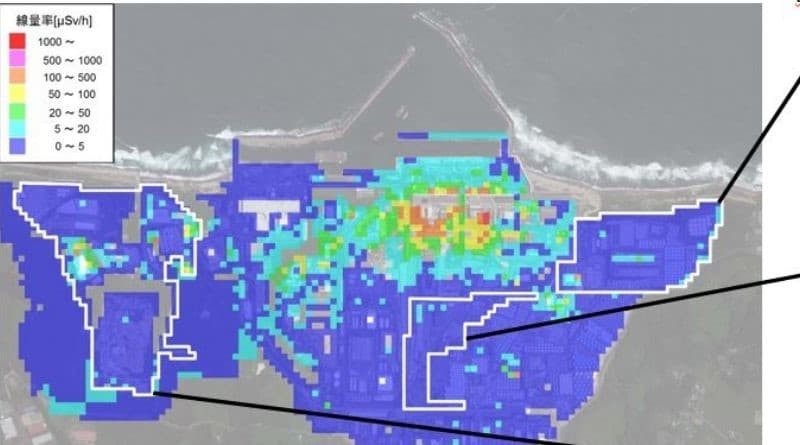
Dosimetric situation at the plant site. It is clear that the dose rate is high around the damaged units. In the rest of the plant, the dose rate is very low. The dose rate is shown in microsieverts per hour. It should be recalled that a dose rate of one microsievert per hour leads to an annual dose of just under 8 mSv (source: TEPCO).
Situation at the plant site
In mid-January 2022, the area was hit by an earthquake and tsunami, while in mid-March 2022 it experienced two stronger earthquakes of up to 7.3 on the Richter scale. Apart from minor problems that were resolved relatively quickly, the site was unaffected. This also shows that it is being kept in a resilient condition.
The radiation situation at the site will also be improved by removing piping connecting the reactor buildings to the emergency ventilation stack shared by Units 1 and 2. This is the most radioactive equipment outside the reactor buildings. It will be cut up remotely. Further processing will take place in a special facility near Unit 4. There it will be cut up further, placed in special containers and prepared for transport to longer-term storage.
A year ago, this publication wrote about shortening the aforementioned shared ventilation stack of Units 1 and 2. Preparations are now under way and the shared ventilation stack of Units 3 and 4 should be dismantled this year. Together with the removal of other heavily contaminated parts of the external equipment, this should contribute to decontamination and improve the radiation situation in parts of the site that remain heavily contaminated.
Preparing to discharge tritiated water
The final decision to gradually discharge tritium-contaminated water into the ocean was discussed in an article from April 2021. From a practical environmental perspective, the situation is clear. Tritium is also produced during normal operation of a nuclear power plant. The amount of tritium discharged is expected not to exceed 22 trillion becquerels, corresponding to the amount produced by Fukushima Daiichi during normal operation. It will therefore be well below the health limits assumed for drinking water. Specifically, tritium activity should not exceed 1500 Bq/l, which is one-fortieth of Japan's limit and one-seventh of the drinking-water limit required by the World Health Organization. The discharged water should thus be at drinking-water level.
Tritium is produced through the interaction of cosmic radiation in the atmosphere, amounting to around 200 g per year. The 1.25 million tonnes of water accumulated in tanks at the Fukushima Daiichi site are estimated to contain around 20 g. Discharges will take place over around 30 years, and the radioactivity of tritium in such water will be negligible compared with radioactive potassium and uranium, which are natural radionuclides contained in seawater.
The reason why the Japanese authorities considered options for removing tritium for so long was the sensitivity of Japanese fishermen to such discharges. Fishing is only now returning to its pre-accident level. Fishermen are therefore concerned about customers' reactions. These societal and social aspects are the main issue in this area.
Another problem is the very negative attitude to such discharges in some countries, notably South Korea and Taiwan. This is also why Japan is working very closely with the International Atomic Energy Agency in developing the discharge methodology and communicating with the public. Experts from South Korea are also members of the agency's commission. Agency staff will participate in assessing the discharge methodology used and monitoring the quality of discharged water. The agency delegation's first visit focused on this issue took place in October 2021, followed by another in February 2022. During that visit, samples were taken for analysis in the international organisation's laboratories, with experts from China and South Korea also taking part. Further visits will follow on an ongoing basis.
Before construction of the discharge facility, which will allow tritiated water to be released into distant deep waters, a geological survey of the seabed in the area was required. Construction began at the end of April 2022 on part of a 2.5 m-diameter pipeline that will run along the seabed, with its outlet ensuring water is discharged more than a kilometre from the coast at a depth exceeding 12 m.
The outlet will be in an area where no fishing takes place, and the surrounding volume of water will provide further extreme dilution of the tritiated water. At the same time, three additional measurement points were added at sea to monitor the radiation situation. Discharges should begin in spring 2023 and are to last 30 years in total. Over the past two years, the increase in the volume of radioactive water has declined somewhat, and the current volume of installed tanks could therefore last until summer 2023. This was achieved by repairing damaged roofs on some buildings, thereby reducing rainwater ingress, and by improving the functioning of the ice wall.
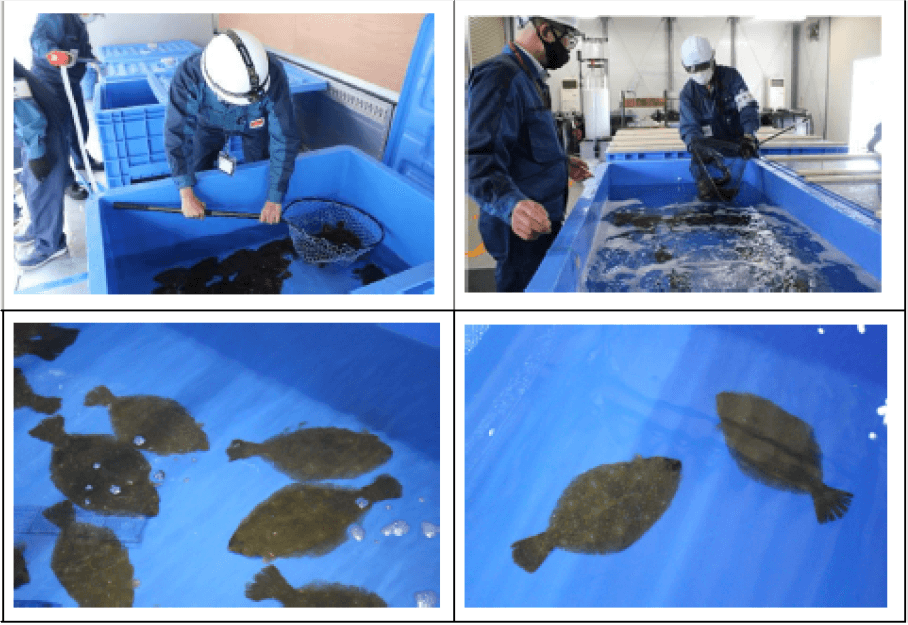
Flounder began to be raised in tritiated water at the plant site in March 2022 (source: TEPCO).
To dispel doubts about the safety of discharging tritiated water, TEPCO will begin raising certain edible marine animals at the plant site in water with a tritium concentration corresponding to that of the discharged water. By September 2022, it should have raised 600 flounder and 600 abalone. Specimens raised this way will be compared with those kept in water without tritium contamination. Further species of fish and molluscs are expected to be raised gradually, along with various types of aquatic plants.
Further assistance for fishermen is to consist of the state establishing a fund that will buy marine products from them at market prices for products from other areas if consumer distrust causes a loss of sales. The purchased products will be frozen and returned to the market once the controversy surrounding the discharges subsides.
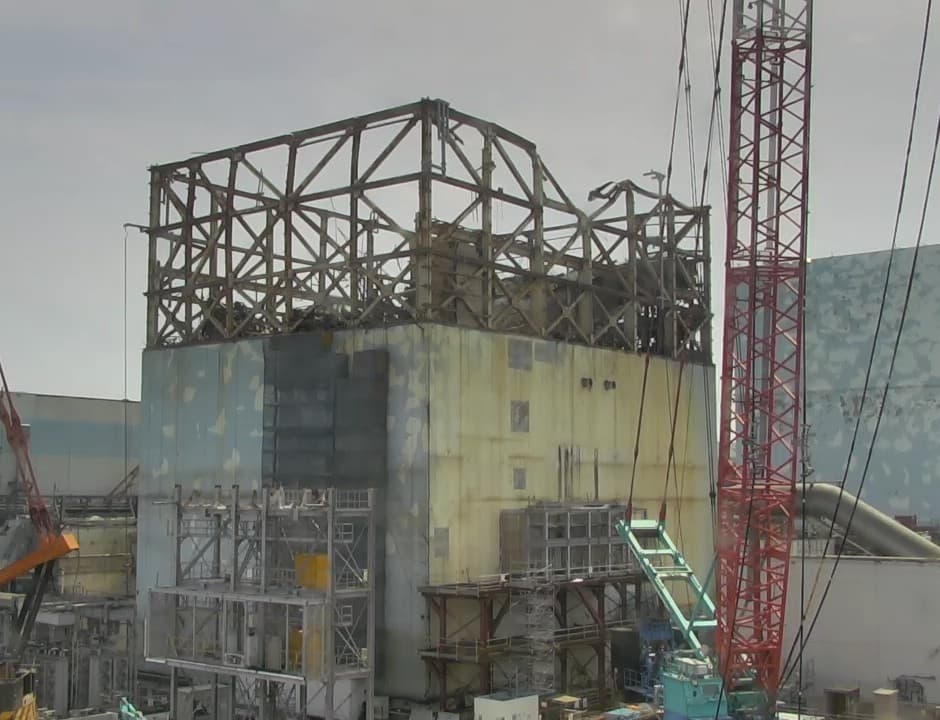
Examination of walls and drilling of holes to anchor the new upper part of the Unit 1 building (source: TEPCO).
Clearing spent fuel pools at the units
Preparations continue for construction of a new upper section at Unit 1. It should cover the spent fuel pool and its surroundings. This area has largely been cleared of fallen debris, and the water surface has been covered with a special cover. A year ago, we wrote that the collapsed beams had been supported. Completion of the new upper part of the building with a roof will make it possible to complete cleaning and decontamination of the covered area, prevent rainwater from entering the building, and install equipment for handling fuel assemblies and the containers in which they will be transported. The new building cover will be mounted on the original walls. To install the anchors, the condition of the walls had to be examined. Holes were then drilled in them to anchor the new upper section of the building. Parts of the new cover are already being manufactured outside Fukushima and will only be assembled on site. Everything should be completed in 2024.
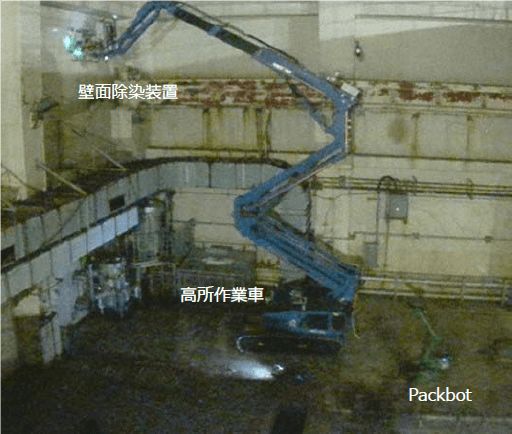
Decontamination work on the floor housing the spent fuel pool at Unit 2 (source: TEPCO).
At Unit 2, decontamination work continues on the floor containing the pool. The floor and walls there are also being covered with a shielding layer. The existing fuel-handling equipment will be moved above the reactor well to create space for installing new cranes to handle fuel and containers. A building adjacent to the unit is also being prepared, where containers will be transferred for transport to the common spent fuel pool storage facility.
So far, site grading and earthworks have been carried out. Due to the high contamination of the space between Units 2 and 3, these must be performed by remotely controlled machines. Once completed, the entire crane system for clearance operations should be installed. Completion and the start of removing fuel assemblies from the pool are expected after 2024. Clearance should then continue until 2026. During an inspection of internal spaces around the pool near the reactor well, several areas of damage were found through which radioactivity probably entered the upper parts of the building from the containment.
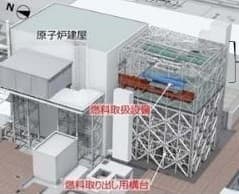
Diagram of structures at Unit 2 that will be used to clear its spent fuel pool (source: TEPCO).
All fuel assemblies have already been removed from the Unit 3 pool. In November 2021, the pool was inspected to examine the radioactivity of various equipment and debris on its floor. This includes, for example, damaged control rods or empty fuel assemblies used for various tests. In 2022, heavily contaminated items should gradually be lifted out and transported to storage, removing this source of radioactivity.
Exploration inside the containments of the damaged units
Preparations continue for an intensive survey of the internal spaces of the Unit 1 containment, which should allow samples to be taken from deposits at its bottom. The fact that the lower part of the containment is filled with water must be addressed. Remotely operated underwater vehicles (ROVs) have therefore begun to be used. The first ROV-A mini-submarine, with a diameter of 25 cm and a length of 110 cm, conducted an inspection in early February 2022. It was also used to install equipment needed for intensive work by additional underwater robotic devices. The installed equipment is intended to prevent the cabling that provides communication with and remote control of the mini-submarines from becoming entangled.
This first inspection using the mini-submarine already showed very substantial damage to the lower parts of the containment caused by the impact of molten parts of the reactor core and reactor vessel. Videos showing what the mini-submarine saw during the inspection can be found on TEPCO's website (here and here).
In mid-March 2022, a second mobile mini-submarine, ROV-A2, examined the internal spaces of this unit's containment. The device was also able to measure neutron fluxes. Its main task was to examine the distribution of debris and sediments, as well as their radioactivity and properties. Further variants of mini-submarines are being prepared for subsequent research. Up to six different robots with distinct tasks should be used in total. It is not yet known exactly where all the remnants of the melt have ended up in this unit. In any case, footage from the mini-submarines and measurements of the dosimetric situation confirm that destruction of the reactor core and internal containment structures was greatest at Unit 1. It is possible that parts of the solidified fuel melt are also in the torus of the suppression chamber. A video of this inspection can also be viewed.
The most information on the presence of molten and solidified fuel is available for Unit 2. It is expected that removal will begin there first. Unit 1 could follow. In this case too, deadlines have shifted because of the pandemic. Activities in this direction are therefore expected this year and next. Tests are still under way on an arm manufactured in the United Kingdom that will take material samples inside the Unit 2 containment. Sampling could begin in 2024.
Progress in dealing with the accident's consequences at the plant site can be viewed through an online tour that has recently been made available.
Affected areas
The Summer Olympic Games held in Japan last year also provided a major impetus for the region's return to normality. They had to be postponed by a year due to the epidemic and were held without spectators. Nevertheless, they provided Fukushima with a crucial boost for its recovery. As we have already written, J-Village has returned to its original sporting purpose. The Olympic torch relay set out from Fukushima as early as 25 March 2021. Some sporting events were held at J-Village. As part of preparations for them, reconstruction of the Jōban Expressway was completed, and all four lanes are now operational along its entire route through Fukushima Prefecture. The maximum speed restriction was thus eased from 70 km/h to 100 km/h. This will improve access to the area and the progress of reconstruction work.
In April 2021, the official number of evacuees fell to around 35,500. It should be recalled that at the peak of the evacuation in May 2012, it was around 165,000 residents. Apart from the town of Futaba, where no area had been opened for permanent return before the end of 2021, the most severely affected towns are Ōkuma and Tomioka. Only 2.5% of residents have returned to Ōkuma so far, and 9.2% to Tomioka.
The start of decontamination in the most severely affected areas was made possible by the construction of interim storage facilities for radioactive waste from decontamination work in the towns of Ōkuma and Futaba. By April 2021, around 76% of the total 14 million cubic metres of decontamination waste had been transported from provisional storage sites to these interim facilities. At the interim storage facility, the waste is sorted and its volume reduced. It should then go to permanent disposal.
The very severely affected areas that have not yet been opened for full return were originally home to 22,000 residents and cover around 33,700 ha. In August 2021, the government announced new plans for gradually opening the hardest-hit areas, which should allow a gradual return even to relatively sparsely populated places, especially Namie, where around 8,000 residents lived before the accident. At the end of spring 2022, around 1,510 ha should be opened in Ōkuma, Futaba and Katsurao, followed in spring 2023 by 1,237 ha in three surrounding municipalities, including the aforementioned Namie.
In January 2022, part of the reconstruction and revitalisation base in Futaba around the local railway station was opened for a trial period allowing overnight stays. Since then, all formerly evacuated municipalities have had at least some area open for residents' permanent return. In Futaba, a 780 ha residential area where 3,500 residents lived before the accident is being prepared for opening. So far, however, only eleven families have taken up the option of returning to repaired homes in Futaba. They comprise a total of 15, mostly elderly, people.
In summer 2022, several sites in the severely affected areas being prepared as reconstruction and revitalisation bases should be fully opened. One of them is in Ōkuma, which, like Futaba, directly borders the power plant. The reconstruction base will cover 680 ha in total and is concentrated around Ono railway station. Its boundaries sometimes provoke controversy. They mean that one person will already be able to return while their neighbour cannot, even where their dosimetric situations do not differ. However, defining the boundaries had to involve some compromise, and no delineation would have been ideal. The situation is especially particular in the settlement of Machi, which covers around 20 ha and is separated from the other areas of the reconstruction and revitalisation base. Half of it will not be opened. Eleven elderly residents currently intend to return there.
The further progress of decontamination work, and especially the selection of sites where it will be carried out first, will also depend on whether residents want to return to the area. There is no point in undertaking rapid and costly decontamination if people do not want to return to a given location.
A museum of the triple disaster—earthquake, tsunami and nuclear accident—has opened in Tomioka. In addition to its permanent exhibition, it should collect materials, conduct research and organise various events linked to these events. The institution could also support visitor numbers and development in the area.
Rice was grown in Futaba last year for the first time on a trial basis. These are areas that should open in early summer 2022. Full restoration of cultivation of this crop is expected in 2025. Restoring agriculture is a key condition for reconstruction and revitalisation of these hardest-hit areas adjacent to the damaged power plant.
Completion of the reconstruction of Ukedo fishing port in Namie, which was very severely damaged by the tsunami wave, marked the completion of restoration of all fishing ports in Fukushima Prefecture and another step towards restoring fishing there. This was achieved at roughly the same time as in other similarly affected prefectures.
At the end of 2021, the European Union lifted further restrictions on food imports from the Fukushima area. Only a very limited number remain, concerning certain types of seafood and wild mushrooms. The United States likewise moved to reduce restrictions on imports from the Fukushima area. It completely lifted restrictions on food imports from Japan introduced after the Fukushima accident. Singapore also lifted its food-import restrictions. This will again improve export prospects for Fukushima's farmers and fishermen.
A special International Atomic Energy Agency mission conducted sampling and inspections that made it possible to assess the quality of Japan's monitoring network. It proved to be of a very high standard. At the request of Fukushima residents, monitoring of the dosimetric situation will continue in the coming years. Monitoring of the radiation situation will also continue through around 3,000 devices at various public locations.
A study on the impact of contamination on forest wildlife in heavily affected areas was recently published. Wild boar have multiplied greatly there due to the absence of people. The study examined their health status. A paper studying the development and quality of populations of vipers and wild boar was published at the end of 2021. It indicates that their health is not affected by the existing radiation situation. Telomere studies show that they are in very good condition. While radiation has not affected the wild boar population, the departure of people from some areas has led to a significant increase in wild boar numbers and to the development of a population of hybrids between wild boar and domestic pigs that were left abandoned in evacuated areas.
Japanese nuclear power
Against the backdrop of current energy developments worldwide, which reveal dramatic dependence on fossil fuels and the impossibility of replacing them solely with renewable sources, attitudes towards nuclear power are also changing in Japan. Japan lacks raw materials and must import all fossil fuels. At the same time, Japan has a very high population density and only very limited areas for installing renewable energy sources. The coastline drops off very rapidly, limiting opportunities for offshore wind farms. This is also why Japanese representatives are now beginning to emphasise the need to accelerate the revival of nuclear power and restart nuclear units. The current rise in fossil fuel prices caused by the Russian military invasion of Ukraine could further speed up the restart of shut-down units.
Last year, Japan raised its targets for reducing carbon dioxide emissions. It wants to cut them by 46% by 2030 compared with 2013. However, this will not be possible without intensive use of nuclear power. At least 30 units will need to be in operation to meet these targets.
In principle, ten units received approval and had restarted by 2020. However, four of them were shut down pending completion of anti-terrorism measures. These included, for example, Ikata 3 and Takahama 3 and 4. Six reactors were therefore operating in spring 2021. Genkai 4 and Takahama 3 restarted in March 2021, followed in April by Takahama 4 after completion of the required emergency shelter with a backup control room. Ikata 3 restarted in early December 2021.
The Tokai 2 reactor is also being prepared for restart. It has already received government approval and could restart at the end of 2022. However, everything will depend on the outcome of legal disputes triggered by several court filings from various groups of citizens.
In Fukui Prefecture, its governor authorised in spring 2021 the restart of Mihama 3 and the first two units of the Takahama plant, which are more than 30 years old. At the end of April 2021, Kansai loaded fuel into the Mihama 3 reactor in Fukui Prefecture, and the unit entered operation in June. This was the first time a unit more than 40 years old had restarted. However, it operated only until the end of October. It was then shut down because a special resilient emergency bunker and certain other anti-terrorism measures had not been completed in time. Completion and restart are expected at the end of 2023. Based on expert opinions, the government is assessing the possibility of operating some reactors for more than 60 years.
In September 2021, the Nuclear Regulation Authority (NRA) granted Shimane 2 approval to operate once safety conditions are met. It is the seventeenth reactor to receive such approval and the fifth boiling-water reactor. The operator must now also obtain operating approval from local governments.
TEPCO is focusing on restarting the two most modern reactors at Japan's largest nuclear power plant, Kashiwazaki-Kariwa: Units 6 and 7. In 2020, several serious failures occurred there in terms of ensuring the safe handling of radioactive materials. The NRA therefore postponed its review and inspection before final restart. The company accepted this decision and is focusing on resolving all problems and doubts. It is also transferring personnel to the nuclear plant and strengthening its workforce there.
Operation of the small HTTR (High-Temperature Test Reactor), a high-temperature gas-cooled research reactor, resumed in early August 2021. Hydrogen production should also be tested there in the future. In this case, the high temperature of 940°C is a major advantage.
The NRA approved the safety programme for Japan's plant producing fuel for nuclear power plants.
Conclusion
The past year has seen major progress in dealing with the consequences of the Fukushima Daiichi nuclear power plant accident. A key decision has been to begin preparations for discharging tritiated water into the ocean. Surveys of the seabed off the coast and construction of the necessary facilities have begun, ensuring the required dilution of tritium-containing water and its discharge around one kilometre from shore. There is no environmental issue here, but highly sensitive discussion with fishermen, the public and neighbouring countries bordering the same ocean is important. Significant progress has also been made in decontaminating the plant site and improving conditions for workers. There has likewise been considerable progress in preparing to clear the spent fuel pools at Units 1 and 2. At the beginning of 2022, a longer-term programme was launched to survey the flooded internal parts of the Unit 1 containment using several types of mini-submarines. It appears that Unit 1 suffered relatively extensive destruction of the containment's internal structures. The situation inside the Unit 2 containment has so far been investigated most thoroughly, and it is expected that removal of solidified fuel melt will begin there first. For now, an arm that would operate inside this containment is being tested.
In reconstruction and revitalisation, decontamination and restoration of the hardest-hit areas have begun. The first residents have already returned to the first small parts of this zone. It is important that agriculture, fishing, industry and tourism are being restored. The Olympics also helped revitalisation, although they were delayed and heavily affected by the pandemic.
The current dramatic rise in fossil fuel prices could accelerate the restart of Japanese nuclear power plants and improve attitudes towards nuclear power among not only Japan's expert public. It is becoming increasingly clear that Japan has no chance of building a low-emission energy mix without a very substantial share of nuclear power. This is another reason why it is very positive that efforts to deal with the impacts of the Fukushima Daiichi accident are progressing successfully.
Inspection by staff of Japan's nuclear safety authority inside Fukushima Unit 1 in November 2021. They also examined potential locations that could provide access to the containment during removal of the damaged reactor core.
Translation disclaimer
This article is a machine translation of the Czech original and has not yet been fully reviewed. In case of any doubt, please refer to the Czech version.
Sdílejte článek prostřednictvím:
You might also like
23 October 2026, 11:01
23 October 2026, 06:34