23 October 2026, 14:38
Loading...
Should Czechia really build large solar and wind power plants?
Vladimír Wagner
10 June 2023, 13:31
ČEPS, the organisation that operates the power grid, is warning of a future shortage of energy sources in Czechia, while ČEZ is preparing to build large solar and wind power plants using subsidies. Let us look at the risks facing the future development of the Czech energy sector.
I recently attended a lecture by Svatopluk Vnouček of ČEPS, the organisation that operates the power grid, and Pavel Řežábek, chief economist of our largest energy company, ČEZ.
ČEPS recently published an assessment of power system resource adequacy through 2040. The results are highly alarming. The Czech Republic is currently an electricity exporter. However, this could change very quickly, and Czechia could soon become heavily dependent on electricity imports. And this would be under conditions of similarly severe deficits among our neighbours. How quickly an electricity generation shortage emerges, and how large it becomes, depends on how quickly other sectors are electrified. If the shift to electric mobility and the rollout of heat pumps proceed rapidly, electricity consumption will grow quickly despite efforts to reduce consumption.
Another factor is the pace at which our coal-fired sources are phased out. Let us recall that this is a domestic source and, together with nuclear power plants, the only one capable of covering periods when there is no wind and the sun is not shining. To a large extent, these sources also provide grid balancing. In principle, they could be replaced by gas-fired sources, but these would have to be newly built, while gas must be imported and its price and availability will certainly be a problem in the coming years.
Let us look at the situation regarding our lignite-fired power plants. There is currently a major battle over how long they will remain in use. In my view, and here I agree with the Coal Commission and the current government, they should not be shut down before low-emission sources capable of replacing them are brought online. And this applies not only to total generation, but above all to ensuring consumption can be met at every moment. In my view, this is what ensuring self-sufficiency and energy security, which are often discussed, means.
Green activists are doing everything possible to shut down all coal-fired sources as quickly as possible, regardless of the impact this will have on our energy sector and society as a whole. They are doing so after their own intensive efforts against nuclear energy have led us to a situation in which we have no low-emission replacement for coal-fired sources.
However, problems with electricity supply, particularly during windless winter periods, will not be the only consequence of shutting down coal-fired power plants. It should be recalled that a number of district heating plants and households still depend on coal. If coal-fired power plants are shut down, the decline in coal consumption may be such that mining in existing mines is no longer economically viable and they close.
ČEPS resource adequacy assessment
ČEPS's resource adequacy assessment is based on reported plans for the decommissioning of sources and the construction of new electricity generation facilities, energy storage and interconnection lines in Czechia and across the interconnected European grid. Naturally, plans in Czechia and among our neighbours may change in the future. In my view, Germany's ideas about the pace of building new capacity are, for example, extremely ambitious and in reality unachievable. Likewise, some planned shutdowns of fossil-fuel and nuclear sources may be cancelled when they collide with reality. Nevertheless, it provides a fairly accurate picture of the potential future problems facing our energy sector. It is one of the most serious overviews available, and I recommend studying it carefully.
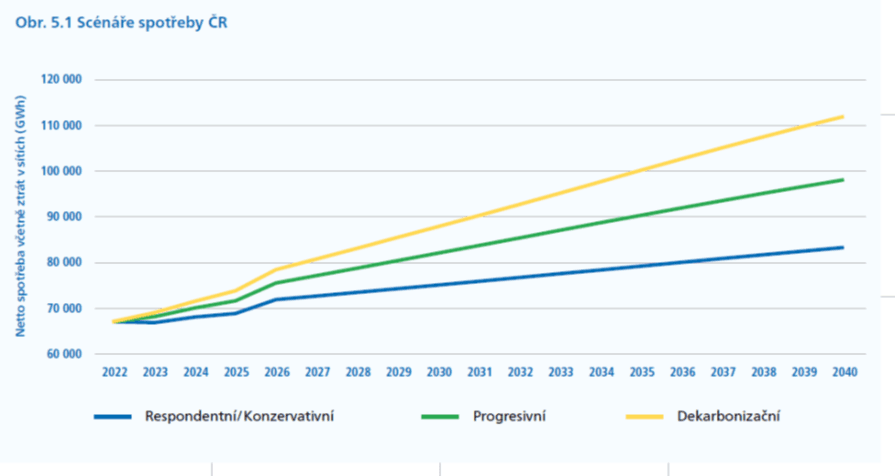
Development of consumption under different scenarios in ČEPS's resource adequacy assessment.
This study describes four consumption development scenarios, which differ in the pace of transport and heating electrification. The scenarios range from conservative to decarbonisation-oriented, with consumption growing progressively faster in each. While the Czech Republic is currently a net electricity exporter, it becomes a net importer after 2025 in all four scenarios. Net import requirements will then continue to rise in subsequent years; the lower-emission the scenario, the faster this growth will be. So-called unserved energy will also rise dramatically, meaning the total volume of missing electricity over the year, as well as the length of time during which the grid will be unable to meet demand. Similarly, the duration of periods in which consumer demand can be met only by using the most expensive sources will increase. For the two low-emission scenarios, unserved energy and the number of hours in which the grid lacks capacity to cover consumption already exceed values considered critical in 2030.
This is because in the coming years most European countries will begin suffering from a lack of available capacity, especially during windless winter periods, as well as insufficient total annual electricity generation. France and Germany, for example, will have significant surpluses in annual generation, which they will have to use to cover missing generation among their neighbours. However, there is a fundamental difference between these countries. Germany will have huge surpluses of wind and solar electricity at times when its neighbours also have enough electricity from wind and solar sources. After all, they all plan to build them. Conversely, during winter inversions, Germany itself, like its neighbours, will suffer from a shortage of the required capacity. France is able to supply the necessary capacity regardless of the weather.
I should point out that the stated unserved energy and the number of hours when consumption cannot be covered are calculated for a standard year. In the event of a prolonged winter inversion or another more extreme year, the situation would be far more critical. Naturally, some problems can be addressed through managed reductions in consumption and limits on production during the period in question. However, a strained grid situation dramatically increases the risk of a blackout. Crisis periods can of course be overcome. I remember my youth, when prolonged extreme frosts froze coal wagons and coal-fired power plants had to reduce output. Production was drastically curtailed, and this meant coal holidays for us. Even such situations in the energy sector could be survived. I am just not sure whether we should be aiming for them as the standard, as is happening now.
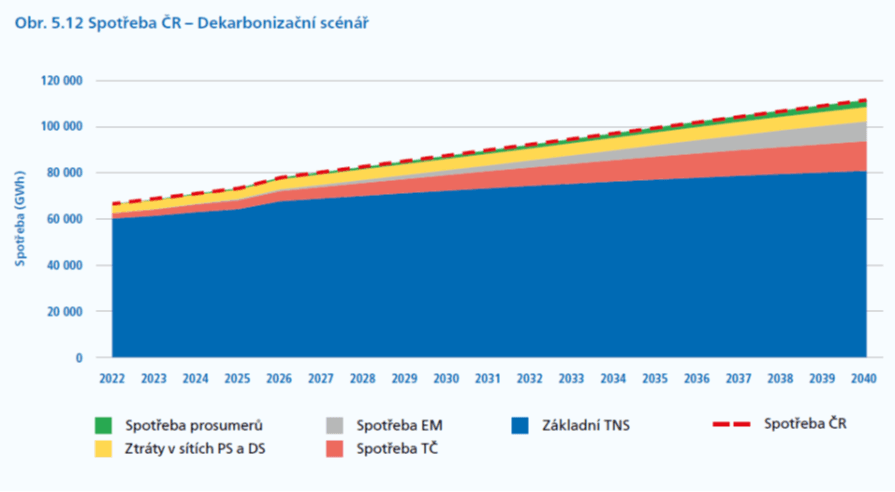
Electricity consumption by sector in the decarbonisation scenario with the greatest pressure to reduce emissions; grey is associated with electric mobility and orange with heat pumps (source: ČEPS resource adequacy assessment).
ČEZ strategy according to its chief economist
ČEZ is our largest energy company, and its direction is crucial for the Czech energy sector. It is therefore interesting to examine the presentation of the company's development plans by its chief economist, Pavel Řežábek. According to his presentation, the company will focus on using available subsidies to build large solar and wind facilities. However, these need backup when there is no wind and no sunshine. Due to the price of emission allowances, he does not consider the longer-term operation of coal-fired sources economically viable, and ČEZ therefore plans to close coal-fired power plants even faster than by 2030. They are to be replaced by new combined-cycle gas turbine plants built by ČEZ. Given the assumed prices of emission allowances and gas, their construction and operation would not be economically viable with limited operating hours as a complement to wind and solar sources. ČEZ is therefore seeking subsidies for new gas-fired sources in the form of capacity payments or guaranteed electricity prices through CFDs.
ČEZ's chief economist further expects intensive use of cheap wind and solar electricity from Germany when the wind is strong and sunshine is intense in our region. I therefore asked him what sense it makes for ČEZ to build subsidised large-scale solar and wind capacity when it simultaneously expects extremely cheap, even negative-priced, electricity from Germany at times when there is strong wind and sunshine in both Czechia and Germany. The answer was: “When politicians want self-sufficiency, they are willing to pay for it, and it is economically advantageous for ČEZ, why not accommodate them?” However, not all self-sufficiency is the same. As I wrote in the highlighted text at the beginning of this article, in my view self-sufficiency in electricity means being able to ensure the necessary capacity at every moment of the year: producing electricity when neighbours have trouble doing so, and importing electricity when neighbours have a surplus and it is cheap. According to Pavel Řežábek, the desired self-sufficiency consists of ČEZ using subsidies to produce large surpluses of wind and solar electricity at times when Germany will also need to dispose of huge surpluses from these sources. Total annual generation may then match annual demand, but there will be major surpluses when there is wind and sunshine, while capacity will be dramatically lacking during an inversion, for example.
There is another risk in such a strategy by ČEZ. For now, subsidies for large solar and wind facilities are assumed to be investment-only. However, it may turn out that under ideal conditions, high wind and solar output in Germany will dramatically drive down prices. ČEZ and other companies that have built large solar and wind facilities, whether with investment subsidies or without them, may then start pressuring the state to grant them operating subsidies for the price of the electricity they generate. They will also be backed by the banks that provided loans for them.
Pavel Řežábek presented his views in two articles, for example: the first concerned his recommendation to build as many wind and solar sources as possible, while the second concerned the economic necessity of shutting down coal-fired power plants. Readers can also form their own impression of his views from these articles. I will attempt to comment on just two of his claims in those two articles.
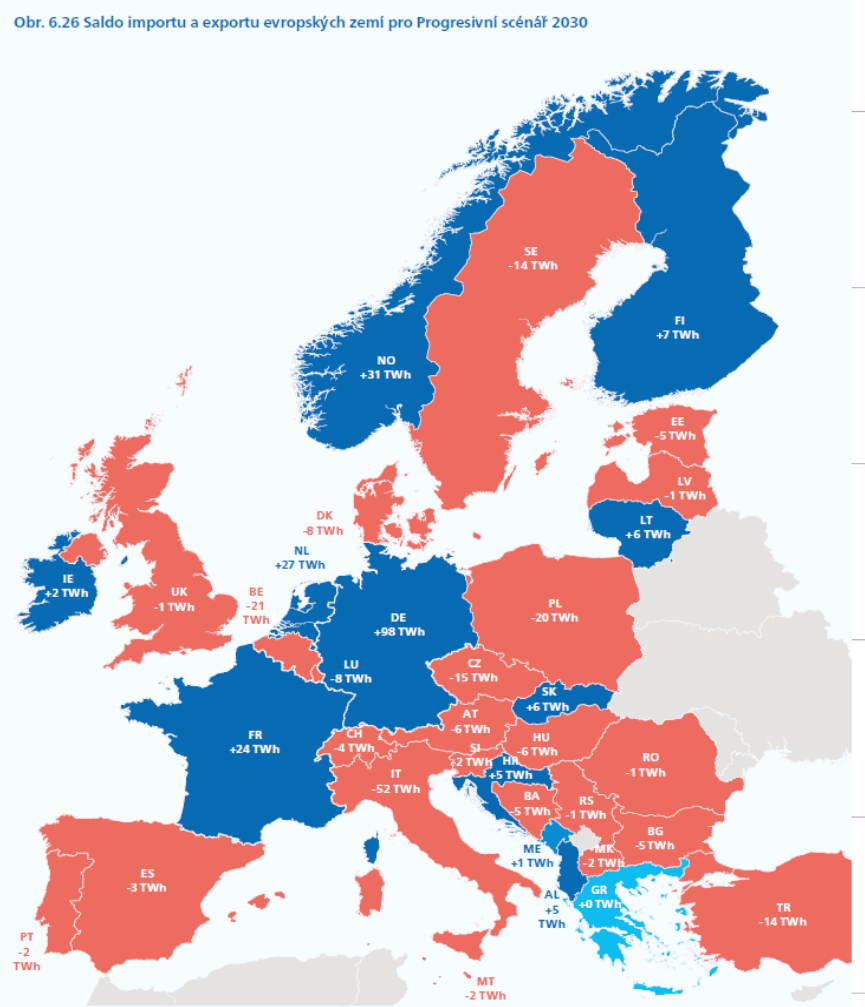
In 2030, with few exceptions, there will be a shortage of electricity sources across Europe. Germany will have a surplus, but the problem is that it will have major surpluses during windy and sunny periods, and equally dramatic shortages during periods without wind and sunshine (source: ČEPS resource adequacy assessment).
The first concerns his claim that Germany has cheap wholesale electricity when there is plenty of sunshine and wind. According to him, we could have electricity just as cheap if we built large solar and wind capacity. The problem is that this notion is highly misleading. Pavel Řežábek does not mention that German wind turbines and solar plants are economically viable at low to negative prices only because they have guaranteed subsidised prices. However, these must be paid by consumers through the price component covering green subsidies, or by the state from tax revenues. Wholesale electricity may therefore be cheap, but the value of green subsidies is high. For German consumers and the state, the final cost of this electricity is therefore high because they pay not only the wholesale electricity price but also green subsidies for guaranteed renewable energy prices, even where the facilities must already be curtailed and their generation is not needed at that moment. Cheap electricity is possible in Czechia when taking wind and solar electricity from Germany. In that case, German consumers and the German state pay the green subsidies for its guaranteed price. If this concerned wind and solar sources in Czechia, low to negative prices would undermine their economics. As I have already mentioned, there is then a risk that ČEZ and other investors will press for operating subsidies for electricity prices from these sources as well.
The second comment concerns the possibility of using existing coal-fired sources to bridge the period until construction of the low-emission sources that would replace them is completed. Pavel Řežábek argues that their operation is not economically viable. This is said to be due to the high price of allowances and the inability to secure European Union approval for capacity payments or other corresponding support for their operation as a complement to existing low-emission sources and for grid balancing. Pavel Řežábek proposes building new combined-cycle gas turbine plants instead. Naturally, these are also not economically viable without subsidies and guaranteed capacity payments. However, Mr Řežábek argues that it will be easier for gas to secure better conditions for capacity payments and that these sources have lower emissions allowance costs. In his view, it will not be possible to obtain suitable conditions for capacity payments for coal from European Union bodies; he believes they will insist on dramatically limiting their operating time, which would prevent the profitable operation of coal mines.
The problem is that Mr Řežábek, like many others, does not distinguish between real natural, technological and environmental constraints and artificial rules imposed by authorities. Unlike gas, coal is a domestic raw material; coal-fired power plants already exist and, unlike combined-cycle gas turbine plants, do not have to be newly built; the price of emission allowances is an artificial construct, as are administratively mandated limits on the operating time of coal units. Not only Poland, but also Germany and other countries have managed to negotiate appropriate capacity payments for their fossil-fuel sources; our politicians should have been seeking something similar long ago.
Closing coal-fired sources as quickly as possible and replacing them with gas-fired sources is not justified on environmental grounds either. Greenhouse gas emissions associated with building new gas-fired sources and using liquefied gas obtained through fracking will not have lower environmental impacts than extending the operation of current coal-fired sources for the same period.
An obstacle preventing the rational development of the Czech energy sector is that ČEZ's plans are to a large extent decided by Pavel Řežábek and Michal Šnobr, whose concern is not long-term strategic development but purely their own short-term profit. The state is the majority shareholder, but ČEZ's high profits, based on subsidies and high prices for consumers, are unlikely to help our country and its citizens. Green “religious” activists and politicians, whose sole concern is short-term gain in the struggle for political power, are also significantly undermining the European and Czech energy sectors through an approach to energy that disregards scientific and technological knowledge.
Translation disclaimer
This article is a machine translation of the Czech original and has not yet been fully reviewed. In case of any doubt, please refer to the Czech version.
Sdílejte článek prostřednictvím:
Topics:Opinion
You might also like
23 October 2026, 11:01
23 October 2026, 06:34