23 October 2026, 14:38
Loading...
What does the current development in the Czech power sector tell us?
Vladimír Wagner
11 August 2021, 06:34
At present, electricity prices on the German market, which also determines prices in Czechia, remain above 70 EUR/MWh even in summer and quite often exceed 100 EUR/MWh. It is highly likely that the situation will deteriorate significantly from this perspective in winter. In the years ahead, these trends will be accentuated by the complete closure of nuclear units in Germany and the shutdown of further coal-fired power plants.
Wholesale electricity prices in Germany and its neighbouring countries are currently being driven upwards by three main factors. The first is the rise in the price of emissions allowances. These are approaching 60 EUR/tCO2 from 5 EUR/tCO2. At the same time, the closure of nuclear capacity and the shift from coal to gas are increasing gas consumption worldwide. This is leading to lower inventories and a rise in its price. The increase in gas prices is the second factor pushing up electricity prices. The rapid rise in gas prices also means that even higher emissions allowance prices cannot displace coal-fired power plants with gas-fired ones. The final factor driving up electricity prices in Germany and its neighbouring countries, including Czechia, is the shutdown of nuclear and coal-fired power plants.
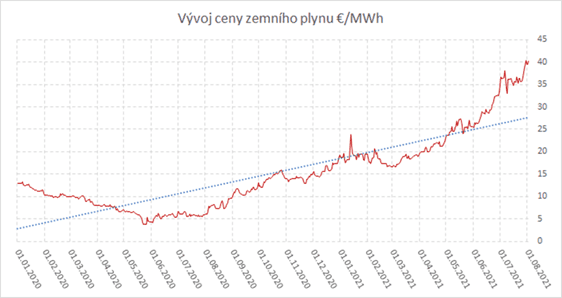
Development of the spot price of natural gas.
Let us look in more detail at the competition between gas-fired and coal-fired generation. CO2 emissions from coal are roughly 0.36 tCO2/MWh of fuel calorific value, compared with 0.20 tCO2/MWh of fuel calorific value for natural gas. This value can be affected by fuel quality, particularly in the case of coal. At the current price, emissions allowances therefore cost 21 EUR/MWh for coal combustion and 12 EUR/MWh for gas. However, it should be recalled that many energy companies bought emissions allowances in advance at significantly lower prices. The price of natural gas also depends heavily on when it was purchased for the current delivery date. Its price also differs between exchanges and locations. However, its current spot price is already above 40 EUR/MWh. A year ago, these prices were well below 10 EUR/MWh. For coal, especially domestic lignite used only on the domestic market, price changes are incomparably smaller.
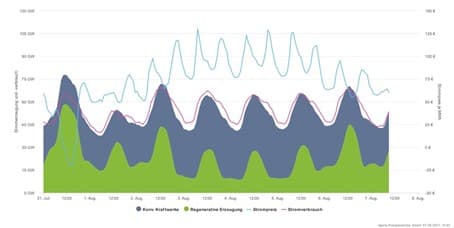
During the current summer period, the price of electricity on the German exchange has mostly ranged between 70 and 120 EUR/MWh. Renewable sources are shown in green and conventional sources in grey. The purple line shows electricity consumption and the blue line its price (source: AGORA).
It is therefore clear that the rapidly rising price of gas is erasing gas's advantage of lower emissions allowance costs. It should be recalled that the amount of fuel consumed, and thus the cost of both fuel and emissions allowances, depends on the efficiency of the particular energy facility. The efficiency of thermal power plants in electricity generation is between 30 and 40%. As already mentioned, CO2 emissions from coal depend strongly on the quality of the particular fuel used. However, at current emissions allowance and gas prices, coal-fired power plants remain competitive in most cases in Czechia and Germany. If gas prices remain unchanged or even rise further, the allowance price required to displace coal with gas would have to exceed 100 EUR/tCO2. This is also why many experts expect further growth in allowance prices.
High emissions allowance and gas prices have meant that electricity prices on exchanges in Germany and Czechia are very high even during summer. In Germany, prices mostly range between 70 and 120 EUR/MWh. They fall to low or negative values only exceptionally, at weekends or on public holidays, when conditions for renewable sources are ideal. It should be remembered that the current summer period is ideal for photovoltaics. Last year, electricity prices on the German exchange normally ranged between 30 and 40 EUR/MWh.
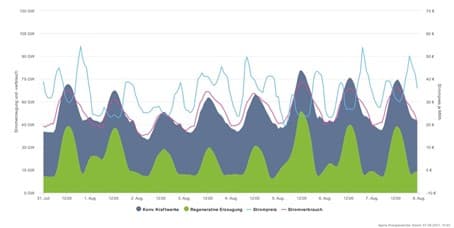
Last year, electricity prices on the German exchange ranged between 20 and 40 EUR/MWh in August (source: AGORA).
It can be assumed that in winter, when electricity demand is much higher and photovoltaics delivers very little, prices will rise further even if allowance and gas prices remain unchanged. There will admittedly be periods of strong winds in the region, when there is a surplus of wind power and prices may even turn negative, but overall electricity prices will be higher than in summer.
The higher price of gas also contributed in the manner described to a one-third increase in lignite-fired electricity generation in Germany in the first half of this year compared with last year. It should be remembered that total electricity consumption fell last year as a result of the COVID-19 pandemic, while the first half of the year was also very windy. This year, hard coal-fired, gas-fired and nuclear power plants therefore also generated more electricity. All coal-fired power plants supplied 26.4% of electricity, gas-fired plants 11.5%, and nuclear plants still 13.1%. The improved profitability of coal-fired power plants and the increase in their output also occurred in Czechia. This is described in more detail in two articles on oEnergetice.cz (here and here).
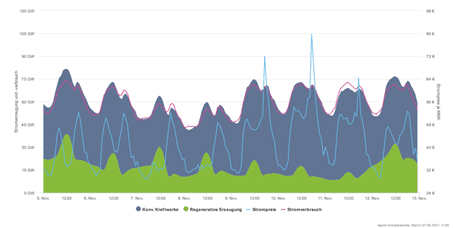
Development of electricity prices at the beginning of November 2020 (source: AGORA).
At the end of this year, Germany will shut down three of its six nuclear reactors still in operation, followed by the remaining ones at the end of next year. At the same time, several coal-fired power plants will be shut down in Germany. The shortage of weather-independent generation capacity will therefore deepen further, leading to another increase in electricity prices.
Gas consumption is rising worldwide, and European storage facilities are at their lowest level in many years this year. It can therefore hardly be expected that these trends will change and that its price will fall in the coming years. Rather, it will rise further. If Europe or Germany wants to economically displace coal-fired capacity with gas-fired capacity, it will have to raise the price of emissions allowances even more dramatically. The question, however, is how the public and industry in Germany and Czechia will respond to the resulting increase in electricity and heating prices. It is therefore possible that allowance prices will no longer rise radically. In that case, however, the economic displacement of Czech coal-fired units, which some expect in the near future, will not occur.
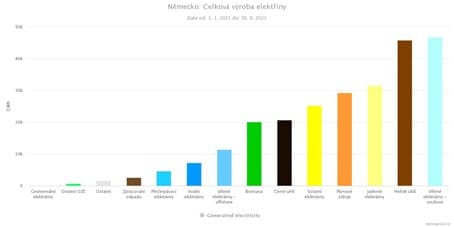
Electricity generation in Germany from various sources in the first half of this year (source: oenergetice.cz).
The rapid rise in electricity and heat prices that occurs under the scenario described is slowed by the fact that most electricity is sold under longer-term contracts. This forward price rises more slowly than spot prices on exchanges. However, it too will gradually reach the levels described. This is one of the main risks I described in a recent article regarding the gas-based scenario for replacing coal-fired power plants, advocated, for example, by Michal Šnobr and a number of green anti-nuclear organisations and activists. Germany is extremely wealthy and economically powerful. Its population and industry may therefore be able to withstand the extremely high electricity prices of this scenario it has chosen for much longer than their Czech counterparts. This is also why we should not copy Germany's energy strategy.
One of the few advantages of this scenario is an overall reduction in operating subsidies for renewable sources. This effect will be countered by the fact that prices will be lowest, and sometimes negative, when weather conditions are ideal for wind and photovoltaic power plants. A second factor working against this reduction will be increasing charges for facilities that were shut down because their surplus electricity could not be transmitted from north to south. Construction of the key transmission lines will still take many years.
Overall, however, it can be said that a highly turbulent and risky period in energy sector development awaits us in the coming years. It will be characterised by high electricity prices, increasing grid instability and a higher risk of outages. Such developments could have quite dramatic impacts on the social, economic and living standards of our society.
Translation disclaimer
This article is a machine translation of the Czech original and has not yet been fully reviewed. In case of any doubt, please refer to the Czech version.
Sdílejte článek prostřednictvím:
You might also like
23 October 2026, 11:01
23 October 2026, 06:34