Why fast charging is expensive and why it is not really such a problem in Czechia
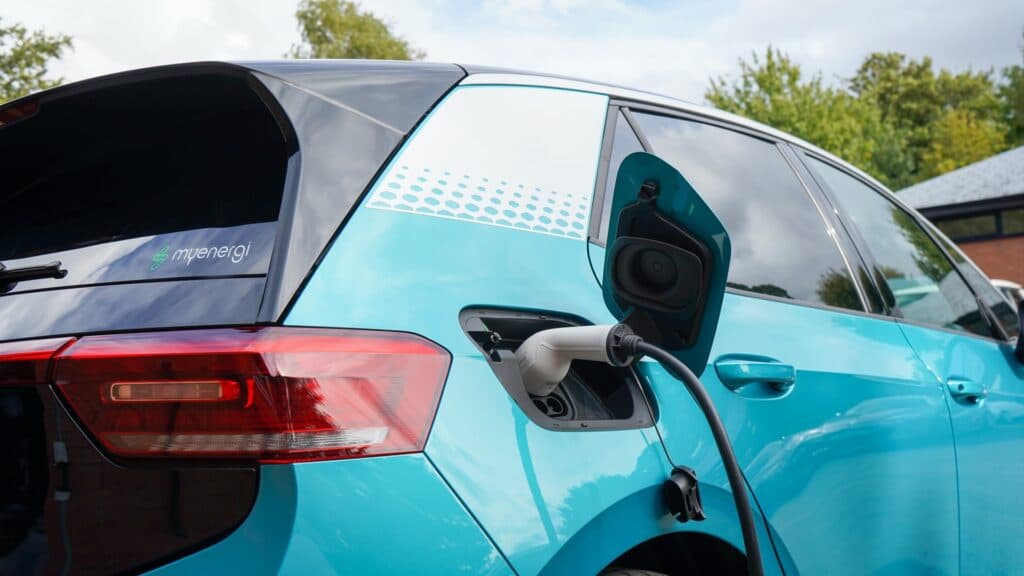
When comparing electricity prices at home and at fast chargers, it is impossible to overlook the significant difference in the price per kWh consumed. Let us go through the main reasons and outline possible solutions.
Whether it is charging or refuelling while travelling, it is generally always more expensive regardless of the drivetrain. Even for liquid fuels, prices per litre several Czech crowns higher than elsewhere are not unusual. It is always possible to leave the motorway and refuel elsewhere, but that entails a certain delay, so people simply accept the higher price. However, for fast charging of electric vehicles, the difference compared with other charging methods is considerably greater, and this reason very often features in debates as an argument against electric mobility. It must be acknowledged that current fast-charging prices really are high. While electricity prices including distribution of around 5 Kč/kWh can be achieved at home or at businesses, prices of around 13 Kč at slower charging stations and around 18 Kč at ultra-fast stations are not unusual. An average electric vehicle travelling at motorway speeds therefore pays around 3 Kč/km for electricity, a price that is comparable to, or higher than, that of its combustion-engine equivalent.
Experience and statistics show that most charging generally takes place at slower and cheaper stations, whether at home, at businesses or at public chargers, so the higher price of fast charging does not ultimately hurt EV owners all that much. Nevertheless, the high price naturally makes operation more expensive.
To understand this situation, it is necessary to look in detail at the individual components of the final price. As I do not have access to the specific data of individual charging-station operators, I will try, for simplicity, to estimate the individual components from prices available in public sources. However, even this highly simplified calculation can show where the problem lies. The final price for the user consists of an energy component, meaning the price of electricity including distribution, followed by a fixed component comprising various overhead costs associated with operating the station. The total price is also subject to VAT. While the energy component is paid exactly according to the amount of electricity consumed, the fixed component must be paid by the station operator regardless of how much electricity flows through the station each month.
If we consider the energy component, it will be somewhat lower than the final household price because large consumers can secure better prices. The energy component may therefore be around 4 Kč/kWh and, regardless of its exact level, accounts for only a small part of the total price at a fast-charging station. In other words, even if the electricity and distribution component were completely free, the final price would still be much higher than at home.
The reason for this is not some cartel agreement among fast-charger operators, but the fixed component mentioned above. Simplified, it consists of 3 parts: charges for the station's reserved capacity, the costs of construction and equipment servicing, including site rental, and finally the distributor's overhead costs.
Charges for reserved capacity
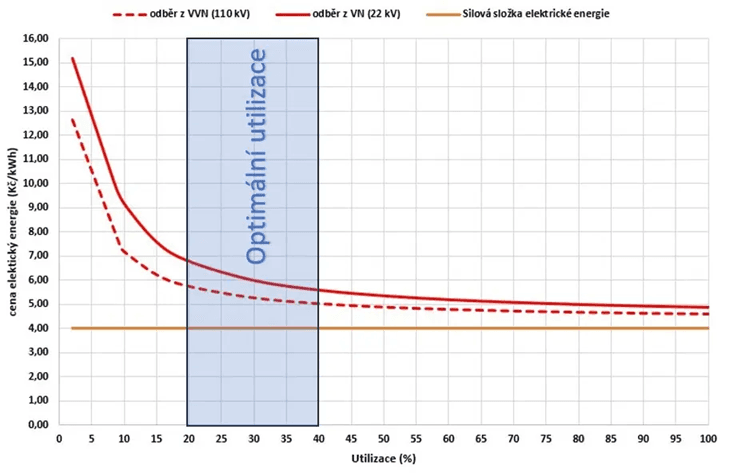
This charge, sometimes referred to as the circuit-breaker charge, is a fixed part of the distribution fee that electricity consumers pay for reserved capacity. This amount depends on the size of the main circuit breaker upstream of the electricity meter and is set by the electricity distributor (ČEZ, E.ON, PRE). By paying the circuit-breaker charge, you reserve capacity in the distribution grid, i.e. the maximum amount of electricity you can draw at one time. Distributors must maintain a grid sized to meet consumer requirements, and use this revenue to maintain and expand the distribution grid. Since fast-charging stations achieve relatively high outputs, their operators must reserve the necessary capacity and then pay for it every month. Monthly charges for reserved capacity vary by distribution area, at around 110 000 Kč/MW of capacity at the extra-high-voltage level (generally 110 kV) and around 250 000 Kč/MW at the more common medium-voltage level (22 kV). To give a simple illustration, the operator of a 50 kW charger must therefore pay around 13 000 Kč per month for capacity, regardless of how much energy motorists consume there. Station utilisation, known in technical terminology as utilisation, thus has a fundamental impact on the overall price calculation.
What is charging-station utilisation?
Charging-station utilisation indicates how efficiently and frequently EV charging stations are used compared with their available capacity. It is a key indicator of the economic efficiency and operational use of these stations.
Utilisation is usually expressed as the percentage of time for which a charging station is occupied and actively in use, relative to its total available time.
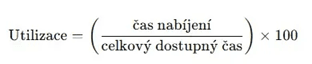
For example, if a charging station is used for 6 hours a day and is available for 24 hours, its utilisation is 25 %. High utilisation means that the station generates revenue and is not unnecessarily idle. Low utilisation means the station is often available, but excessively high utilisation may mean it is frequently occupied and drivers have to wait. Too low a level means an inefficient investment, while too high a level may lead to long waiting times. Operators therefore usually target utilisation of around 20–40 % as optimal for returns and availability. The following chart shows the theoretical price of a kWh of electricity when charges for reserved capacity are included. This is a classic hyperbolic relationship, showing very high values at low utilisation, which fall as use rises and, at higher utilisation levels, approach the electricity energy component.
Current situation in Czechia
As for the current number of charging points in Czechia, the number of public points already exceeds 6000. With the current number of 40 000 electric vehicles, this works out at around 6 vehicles per charging point. By contrast, there is roughly the same number of filling stations for approximately 6.5 million combustion-engine vehicles. There are therefore around 1000 vehicles per filling station. Even taking into account the number of fuel pumps, the number of vehicles per pump is orders of magnitude higher than it is today for electric vehicles. The construction of charging stations is therefore significantly outpacing the number of vehicles. On the one hand, this is good, because practical use of electric vehicles requires broad territorial coverage; however, it also brings one major drawback: very low station utilisation. According to their operators, this reaches only around 2 %. For the purpose of explaining the issue, there is no point speculating about other costs associated with building stations, as these are likewise fixed costs independent of consumption. If we are therefore looking for the reason behind current high prices, it is clearly their current low utilisation.
Solutions
There is currently no simple, quick solution to higher prices. Charging stations are necessary for the further development of electric mobility. It would certainly help if the state coordinated station construction so that larger charging hubs were built primarily in places where they are most needed. Such locations are identified, for example, by this application.
An attractive location means higher throughput, and with a larger number of charging units, installed capacity can be shared more efficiently among them. Another interesting opportunity may be to install charging hubs at industrial sites near motorways, which already have a high-capacity connection paid for for other purposes and also have space on their premises for such use. A station's power draw can be easily controlled through software, so in such cases the station merely uses the existing spare capacity of the connection. The network of railway traction substations also offers enormous possibilities, as they have already paid for connections of tens of MW, often at the cheaper extra-high-voltage level. Operators of conventional charging hubs can only dream of such a connection.
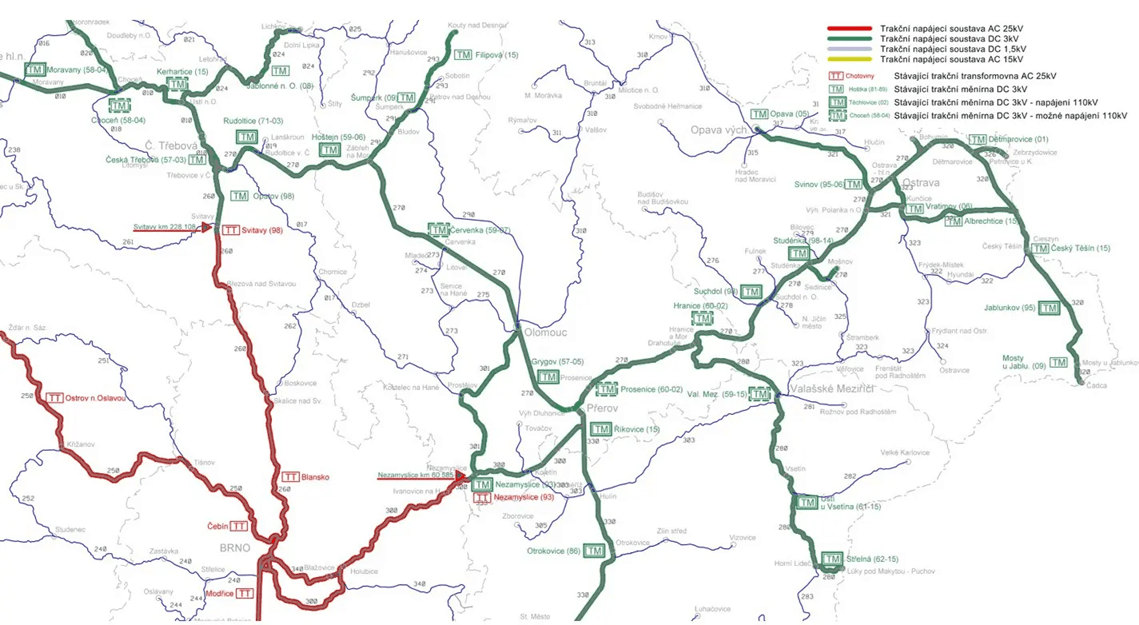
How individual owners of industrial parks and Správa Železnic (the Railway Administration) approach this issue will depend on their business plans. However, further cost reductions will also come automatically in the future as the number of vehicles increases. They will automatically ensure higher throughput, and adding additional charging units at existing locations is cheaper than establishing an entirely new site. In any case, it cannot be expected that the price of fast charging will fall to the level of slow charging. However, given that it will always account for a relatively small share of total mileage, this does not matter all that much overall.
Sources:
https://www.cistadoprava.cz/
https://eru.gov.cz/energeticky-regulacni-vestnik-132024
The article was originally published here.Translation disclaimer
This article is a machine translation of the Czech original and has not yet been fully reviewed. In case of any doubt, please refer to the Czech version.