13 October 2026, 16:07
Loading...
Coal's comeback? Consumption set to rise slightly, but Asian economies will be decisive
Barbora Zimová
13 October 2026, 16:07

The crisis in the Middle East and related developments have revived debate about a return to coal. According to the International Energy Agency (IEA), global coal consumption is expected to rise slightly this year to a record high. Asian economies, especially China and India, will be decisive for the global outlook. Preliminary data point to an increase in lignite consumption in Czechia, too.
2025 brought significant signs of a turning point in the power sector. According to the British think tank Ember, renewable energy sources (RES) generated more electricity globally than coal for the first time. Zero-emission sources met all growth in electricity demand. Electricity generation from coal fell in China and India, too, together accounting for two-thirds of global coal-fired power generation. In its analysis, the IEA reached the more cautious conclusion that RES generation had matched generation from coal-fired power plants for the first time. Oil remained the primary energy source.
The February attack on Iran by US and Israeli forces shook global energy markets. The closure of the Persian Gulf and damage to export infrastructure sent liquefied natural gas prices soaring to unprecedented levels. As a result, according to the IEA, investment in coal reached its highest level in fourteen years.
Since then, headlines proclaiming a major comeback for coal have appeared in some international media, including the US Wall Street Journal. The Economist says coal is back in fashion. The Washington Times called it an opportunity the United States would be foolish to miss. An article in France's Le Monde interprets the phenomenon as a symptom of an incomplete energy transition. Analysts at the World Bank have also written about the unexpected comeback on its blog. In Czech media, for example, an article has been published about coal's return to the limelight.
In September, the IEA published a mid-year report revising its forecasts for global coal production, demand and mining from the end of 2025. In its earlier report, it confirmed its expectation of a gradual decline through 2030 and, thanks to ample stocks and stagnant demand, a slight fall in global coal production. Following the turbulent events of 2026, it now expects global coal consumption to rise by 1.2% this year to a record 8.94 billion tonnes, with further growth possible.
Asian countries as decisive players
Before publishing its 2020 report, the International Energy Agency published a commentary setting out expectations for the following five years. The authors said that global coal demand had peaked in 2013, with only a slight recovery in 2017 and 2018. Based on their analysis of markets, energy policies and technologies, they expected global coal consumption not to return to its 2018 level in the following years. In their view, 2013, with 8 billion tonnes of coal, would therefore mark a historic peak.
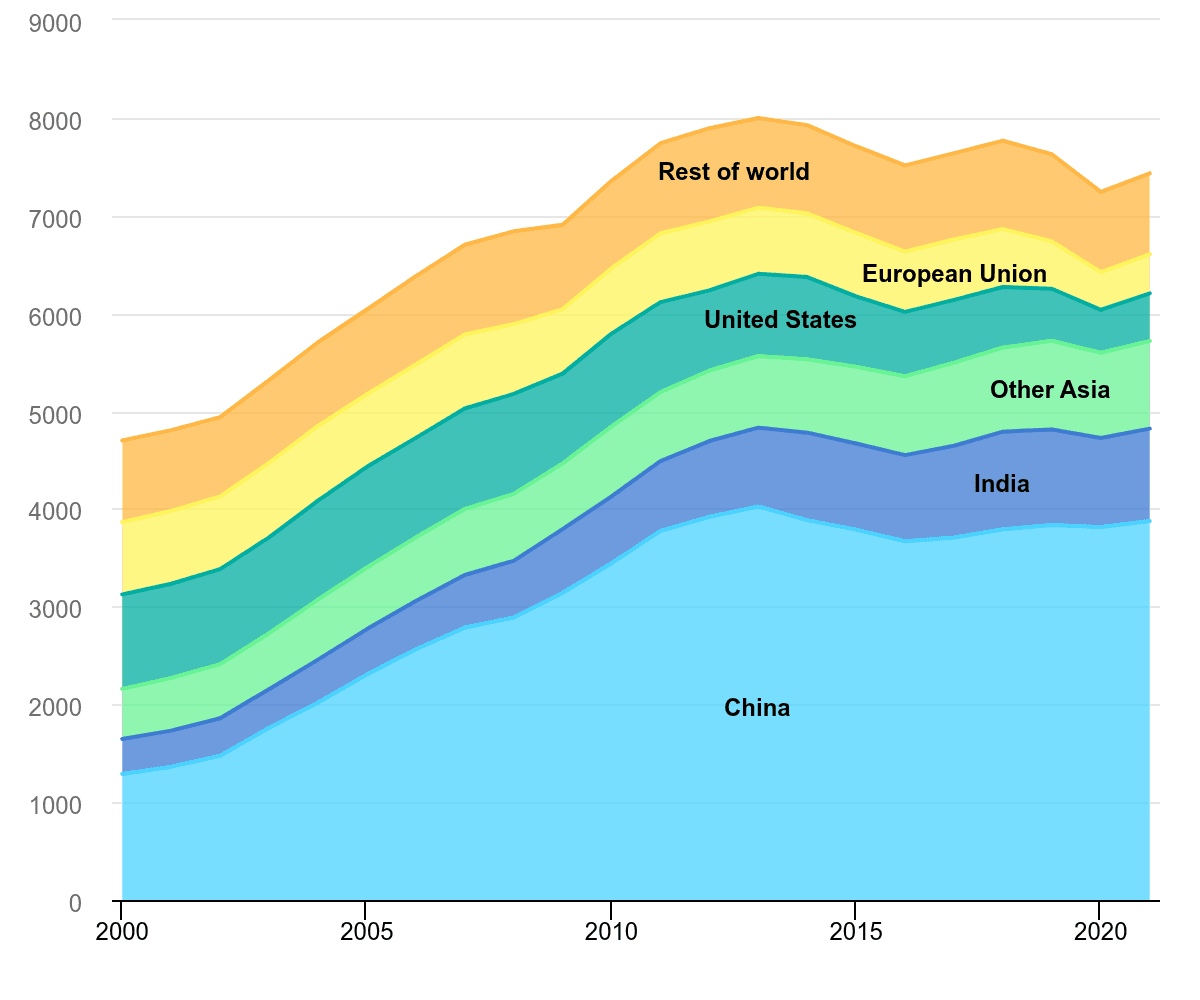
Global coal consumption by region, 2000–2021. Source: Creative Commons / CC BY 4.0 / IEA
At the same time, however, they highlighted two major uncertainties associated with their projections. The first was the rapidly growing Asian economies, specifically India, Pakistan, Bangladesh and the countries of Southeast Asia. Together, their 2.4 billion people consumed roughly as much electricity as the European Union's 450 million. The report's authors described meeting their growing demand without additional coal as feasible, but challenging. China, which consumes half the world's coal, was another wild card. Although the IEA's scenarios assumed its demand would stagnate or decline, they did not rule out a temporary increase—and even a small change in China would have a significant impact on the global market.
China: More coal-fired units, but a smaller role for coal in power generation
China now accounts for 56% of global coal consumption, and last year's data in the IEA report forecast that it would remain stagnant. The outlook through the end of the decade therefore envisaged a gradual decline in coal-fired generation. The September update forecasts a slight 1% increase in Chinese coal consumption, to 5 billion tonnes. This is driven by strong electricity demand, low wind generation and higher prices for liquefied natural gas. Supply was also affected by an accident in May: following an explosion at a mine in Shanxi province, authorities introduced safety inspections across the board, and mining output fell by around a tenth year on year over the summer.
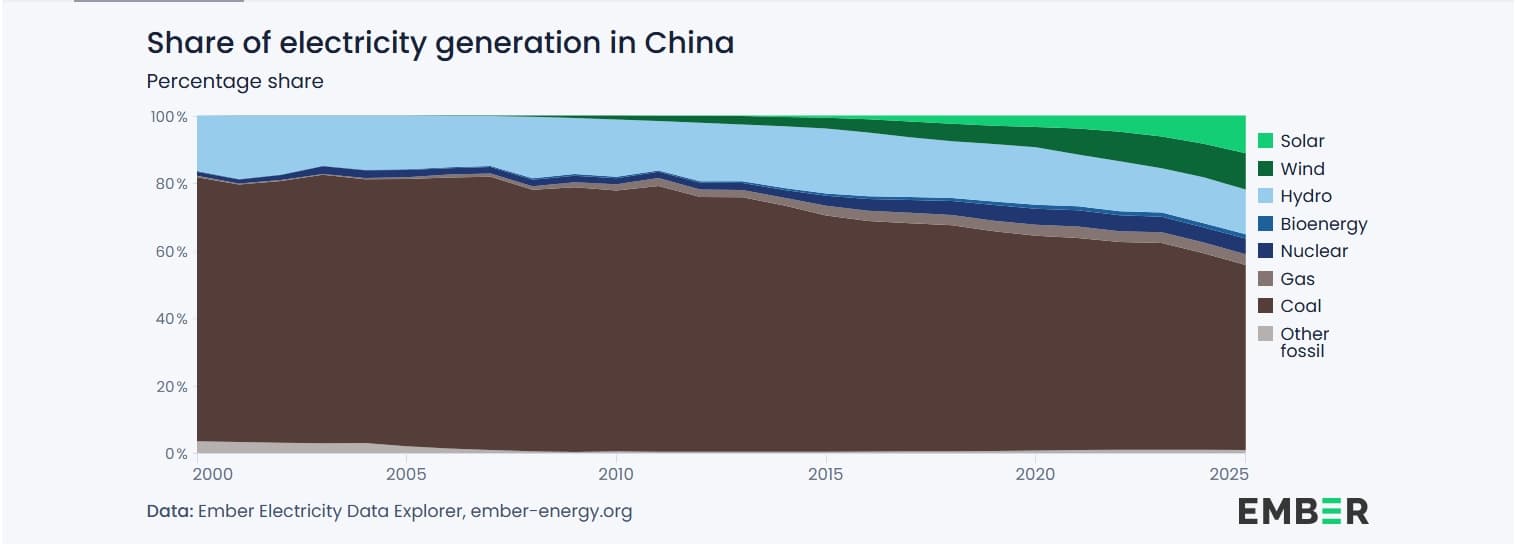
Share of different sources in China's electricity generation, 2000–2025. Source: Creative Commons / CC-BY-4.0 / Ember
The IEA does not expect this to be a significant long-term increase, however. Steel and cement production, two major energy-consuming sectors, were expected to have peaked as early as 2020. If the Middle East crisis eases, power-sector consumption is expected to fall slightly again next year, thanks to the expansion of RES and better grid integration. According to Ember data, coal's share of electricity generation has fallen from 78% to approximately 55% over the past 25 years
A report published last year by Global Energy Monitor and partner organizations reaches a similar conclusion. It says that in 2025, installed capacity at newly commissioned coal-fired power plants rose by 3.5%, while coal-fired electricity generation fell that same year. The country connected 78 gigawatts of new coal-fired capacity to the grid, the highest figure in a decade, yet wind and solar power plants met most of the growth in demand. The report's authors say coal-fired units are increasingly serving not as the main source of generation, but as a back-up in case of outages. Expensive gas following the attack on Iran may increase coal use temporarily, but new installed capacity does not necessarily mean higher coal consumption.
India: Coal as a prerequisite for growth
If anywhere seems not to be moving away from coal, it is India. This was already suggested by leaked comments on a draft report by the Intergovernmental Panel on Climate Change ahead of the COP26 global conference in Glasgow, Scotland. Documents obtained and published by the BBC in 2021 included the position of a scientist from an institute affiliated with the Indian government.
“Coal is likely to remain the backbone of energy generation for the next few decades if the country is to achieve sustainable economic growth,” said a senior official at India's Central Institute of Mining and Fuel Research.
The unnamed scientist's words reflect the long-standing state of India's power sector. According to the IEA, coal consumption is expected to rise by 4.2% this year to 1,353 million tonnes, while mining output is set to reach a historic record. This growth is by no means as closely linked to the crisis in the Strait of Hormuz. In addition to rapidly rising electricity consumption, it is driven by expanding industry and, this year, the particularly strong El Niño climate phenomenon. This is increasing cooling needs and reducing hydropower generation in some Asian countries.
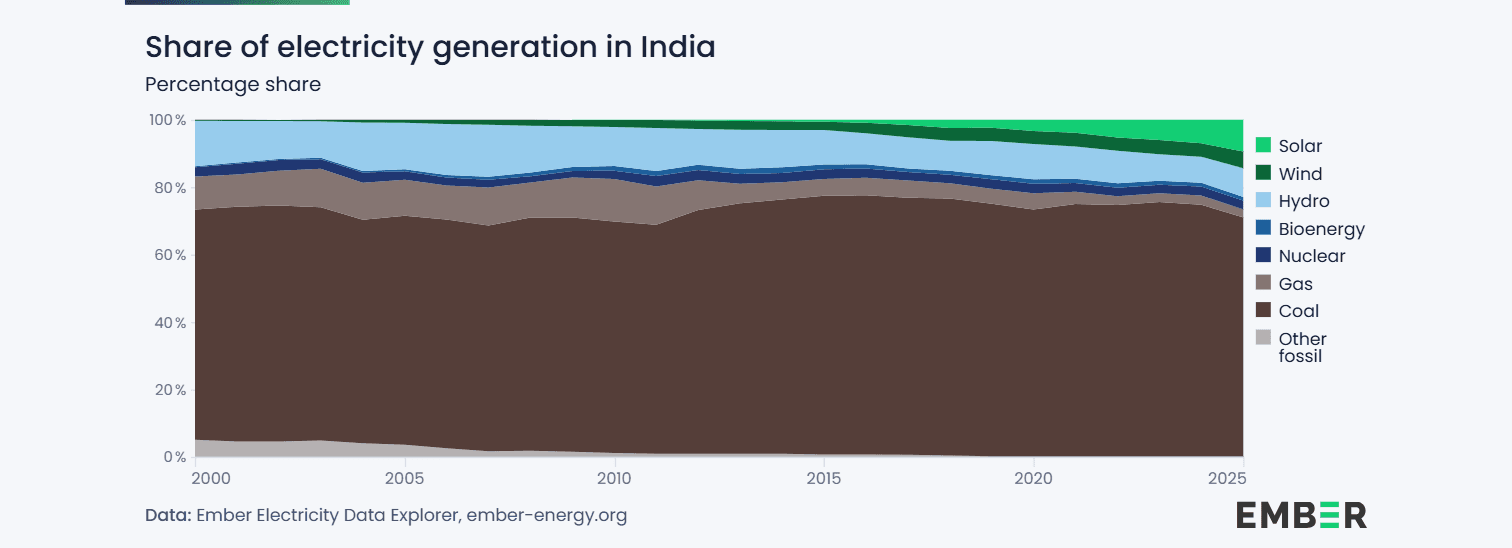
Share of different sources in India's electricity generation, 2000–2025. Source: Creative Commons / CC-BY-4.0 / Ember
Coal accounted for an average of 73% of India's electricity generation over the past 25 years, according to Ember data. A Carbon Brief analysis published this year notes that while the expansion of clean energy is meeting most or all of India's growth in electricity demand, significant capital investment continues to flow into the fossil fuel industry. This includes, among other things, a large amount of new coal-fired generation capacity and efforts to increase domestic production of coking coal for the steel sector.
With coal stocks falling sharply and prices rising, consumers are now facing power cuts, according to Bloomberg. India's Ministry of Power said that as of 10 October, nearly half of coal-fired power plants had less than a quarter of the required level of fuel stocks.
Czechia: Preliminary data point to a slight increase in consumption
According to the Czech Statistical Office, lignite consumption fell by 3.2% last year and hard coal consumption by 4%. Exact data for this year are not yet available, however. A preliminary picture is provided by the monthly statistics published by the Ministry of Industry and Trade. These track so-called coal deliveries for consumption, a rough estimate that takes mining, imports, exports and producers' stocks into account. According to the Ministry's rough estimate, 13.3 million tonnes of thermal coal reached the domestic market in the first half of the year, up 2.3% year on year. Growth was driven entirely by lignite, deliveries of which rose by 3.4%. By contrast, deliveries of hard coal fell by a quarter.
Translation disclaimer
This article is a machine translation of the Czech original and has not yet been fully reviewed. In case of any doubt, please refer to the Czech version.
Sdílejte článek prostřednictvím:
You might also like
13 October 2026, 15:54