Czech nuclear waste repository to cost over CZK 100 billion, four sites shortlisted

A roundup of information on repositories for spent nuclear fuel in the Czech Republic (the Chamber of Deputies today approved the law on the nuclear waste repository, which the Senate returned to it in December, in its original wording):
– A site for the permanent disposal of spent nuclear fuel from Czech nuclear power plants and other radioactive waste has been sought since the 1990s. Spent fuel assemblies are currently stored in an interim storage facility at the Dukovany power plant, while other radioactive material is held in the former Richard limestone mine near Litoměřice and the exhausted Bratrství uranium mine near Jáchymov. They are managed by the state-owned Radioactive Waste Repository Authority (SÚRAO).
– SÚRAO is also tasked with finding a site for a future deep geological repository, which would solve the problem of storing radioactive waste over the long term. The number of sites under consideration has changed over the years. In 2003, for example, SÚRAO had identified six areas; the number later rose to seven and then to nine. In June 2020, the SÚRAO Council approved narrowing the shortlist to four sites, and the government decided on this in December of the same year. The nuclear waste repository is therefore to be built in one of four locations in the Czech Republic: Janoch near Temelín, Horka in the Třebíč area, Hrádek in the Jihlava area, or Březový potok in the Klatovy area.
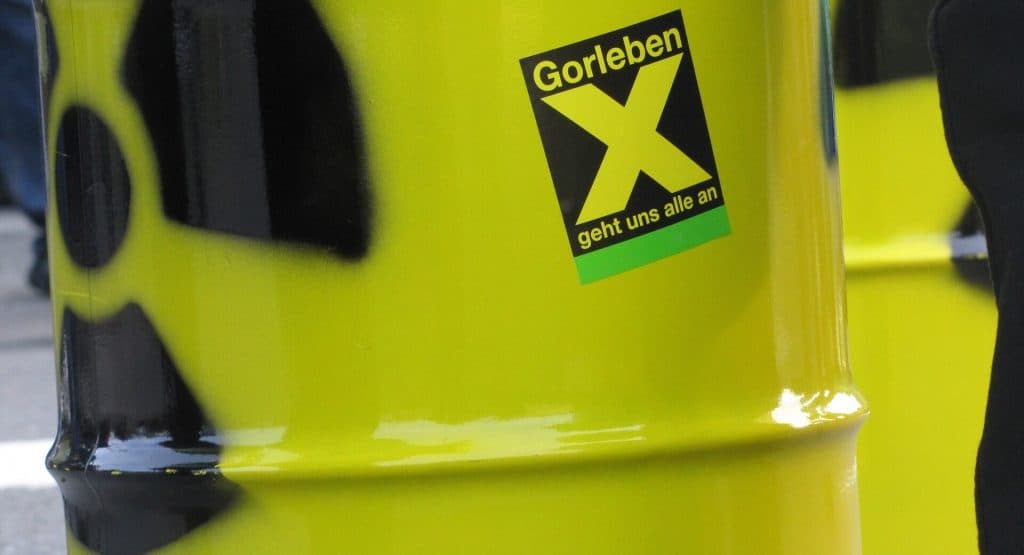
– The proposed repository has many critics. Some have established the Platform Against the Deep Geological Repository, which now brings together more than three dozen municipalities and towns and several associations. In the past, it has organized events such as a Day Against the Repository at the sites under consideration. The platform is also calling for other strategic options for managing spent nuclear fuel to be considered. According to the platform, alternatives to moving quickly towards construction of a deep geological repository do exist. It says long-term storage could serve as a medium-term alternative.
– Affected municipalities are also protesting against the repository. For example, municipalities in the Hrádek area of the Jihlava region have long opposed it, citing the risk of damage to water sources. They have previously taken their case to court. Two years ago, for example, the Supreme Administrative Court (NSS) rejected their cassation complaint against the resolution by which the government narrowed the selection of possible sites to four in December 2020. A group of municipalities then appealed to the Constitutional Court (ÚS) early last year, but it too rejected their case.
– At the end of February 2023, SÚRAO applied for exploration-area designation in all four selected municipalities. If the Ministry of the Environment grants the applications (which it has not yet done), the authority will begin geological surveys to assess possible sites for a future deep geological repository. Under current plans, the most suitable site should be selected by 2028. SÚRAO also plans to investigate the rock in the areas concerned using boreholes tens or even hundreds of metres deep.
– As part of preparations for building a deep geological repository, SÚRAO operates a laboratory at the former Rožná uranium mine near Bukov in the Vysočina region. At a depth of around half a kilometre, researchers are studying the best approaches to constructing a permanent disposal site for radioactive waste. These include suitable methods for excavating the rock, as well as how an actual container of spent fuel from a power plant behaves underground. Construction of the Bukov Underground Research Facility (PVP) began in 2013, and experiments have been conducted there since 2017.
– The final decision on building the repository rests with the government. “We are open to solutions other than a final deep geological repository in the Czech Republic,” the current governing coalition’s agreement states. The agreement also pledges to strengthen the rights of affected municipalities in any decision on the repository’s location. The government approved a draft law on proceedings concerning a deep geological repository for radioactive waste, which sets out the rights of affected municipalities and the deadlines for individual proceedings, in mid-January last year. The Cabinet then agreed that the final site selection would be a joint decision by the government and Parliament.
– The Chamber of Deputies approved the law in mid-November. However, unlike the government’s original bill, the version passed by MPs omitted a provision making the government’s decision to build the repository conditional on parliamentary approval. As a result, senators returned the law to the lower house at the end of December. The Senate also recommended that the government be required, rather than merely allowed, to set compensation for municipalities hosting the repository above and beyond what is provided for under the Atomic Act. The Senate rejected giving municipalities a veto, as did the Chamber of Deputies.
– Today, MPs approved the law in its original version as passed by the Chamber of Deputies. The government alone will therefore decide where to locate and build the deep geological nuclear waste repository.
– Last December, members of the Platform Against the Deep Geological Repository for Radioactive Waste agreed that all four sites under consideration would continue to work together. “We agreed on a communications strategy following the law’s passage. The state has created the false impression that the repository must be ready by 2050, or we will not be able to build nuclear power plants. That is not true,” said the platform’s secretary, Edvard Sequens. Platform representatives have also recently voiced concern that the planned construction of more nuclear units would mean a larger repository and thus more significant negative impacts.
– In January this year, a newly established expert advisory committee met for the first time. It will oversee the selection of the final repository site and subsequently make a recommendation to the government. Its members include experts in fields relevant to preparing the repository, such as hydrogeology, radiation protection and underground construction. Municipalities and regions may also nominate their own experts.
– The cost of building the complex, whose main section is to be around half a kilometre beneath the surface of the Bohemian Massif, is estimated at 111 billion crowns, according to previous reports. In November 2020, the Supreme Audit Office (NKÚ) said that SÚRAO had spent more than 1.8 billion crowns on preparations for the deep geological repository by then. The Czech Republic is not the only country facing this issue; other countries are also addressing the future of spent fuel and other materials. Finland is probably the furthest along: construction of a repository is under way there, and the country plans to open the first facility of its kind within two years. Sweden and France are also at an advanced stage.
– The Czech repository was originally supposed to be built by 2065, but accelerating construction is now being discussed because nuclear power has been temporarily included among the EU’s green investments. The condition is that countries relying on nuclear energy must have deep geological repositories from 2050.
Translation disclaimer
This article is a machine translation of the Czech original and has not yet been fully reviewed. In case of any doubt, please refer to the Czech version.




