Renewables investment decline comes to a halt. New capacity additions are nevertheless set to fall for the first time in more than 10 years this year


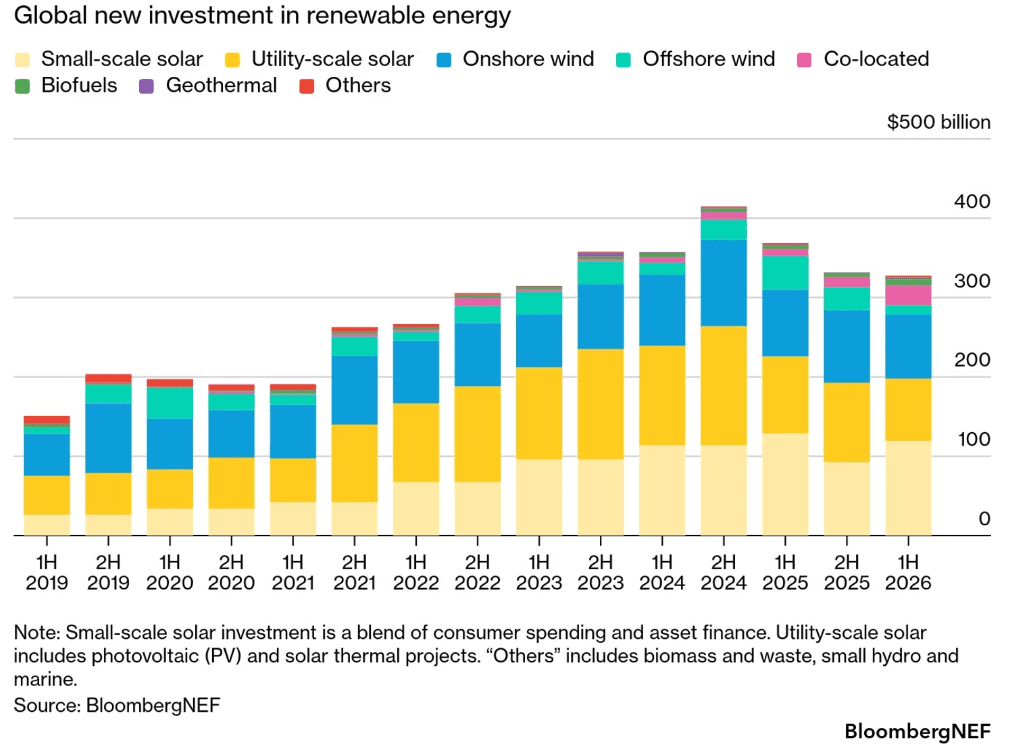
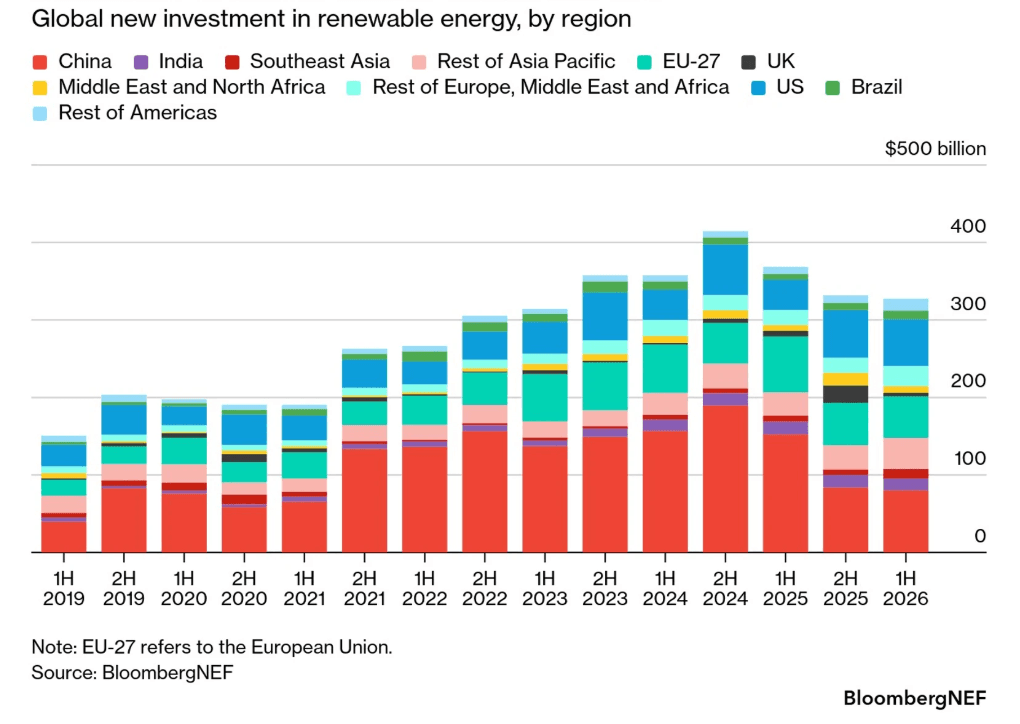
Global investment in renewable energy reached 327.5 billion dollars in the first half of 2026, roughly the same level as in the previous six months, bringing the further decline to a halt. The stabilisation in investment does not, however, signal a return to the previous model. Investors are paying closer attention to revenue and grid risks, with growing interest in projects combining generation with storage. BloombergNEF (BNEF) also expects this year's increase in new renewable capacity to fall year on year for the first time in more than a decade.
Behind the stagnation in total investment lies a change in its composition. Standalone large-scale solar and onshore wind projects, which typically account for around two-thirds of annual investment, together represented less than half of investment in the first half of this year. The standalone large-scale solar segment weakened most sharply, falling 20% year on year to 75.4 billion dollars, its lowest level since the start of the solar boom in 2021.
Investor caution is driven by concerns about generation curtailment, falling market prices during hours of high output and grid congestion. These factors reduced financing for solar projects in several regions, particularly China, Brazil and parts of Europe. Capital is therefore shifting towards projects whose economics allow greater control over electricity supply. Investment in co-located solar and battery projects reached a record 25 billion dollars.
The wind power sector recorded global investment of 92.3 billion dollars in the first half of the year, down 27% year on year. Offshore projects saw the steepest decline, with investment falling by 72%. BNEF links the drop, among other things, to weak results in auctions for operating support in 2024 and 2025, as well as higher construction and financing costs. Onshore wind performed better, attracting 80.7 billion dollars globally, 4% less than a year earlier, while Europe bucked the trend. Germany, Romania and Serbia reported record investment following recent auction rounds.
The investment map is shifting
The strongest growth was recorded in the United States. Investment there rose 54% year on year, partly in anticipation of tax incentive deadlines and due to rapidly growing electricity demand from data centres. Solar financing reached a record 45.8 billion dollars, while investment in wind more than doubled to 13.8 billion dollars.
China remained the largest market, but its share of global investment fell to a quarter in the first half of the year. In 2022, it had exceeded half. BNEF links this shift to adjusted revenue expectations following reforms to China's electricity market. Other regions seeing growth included Southeast Asia, where investment topped 12 billion dollars and quadrupled in Vietnam alone. In Central Asia, investment in the first half of the year exceeded 4 billion dollars for the second six-month period in a row, while Brazil helped drive biofuel investment to its highest level since the second half of 2008.
According to BNEF, total additions of new renewable capacity are set to fall below last year's level, for the first time in more than a decade. The agency considers this dip temporary, however, and expects growth to accelerate again from 2027.
IEA outlook: Less favourable conditions in the US and China
The International Energy Agency already cut its forecast for global renewable growth through 2030 by 5% in 2025, or 248 GW, mainly due to weaker prospects in the United States and China. The US outlook was affected by the early termination of federal tax incentives and other regulatory changes, while in China the shift from fixed tariffs to auctions weakened the expected economic viability of projects.
The outlook for Europe, by contrast, improved thanks to more ambitious policies, larger auction volumes and faster permitting, while auctions, permitting and rooftop solar are expected to support growth in India.
The IEA expects global installed renewable energy capacity to increase by 4 600 GW by 2030. Electricity generation from these sources is projected to rise from 9 900 TWh to 16 200 TWh over the same period. Around 80% of new capacity is expected to come from solar power, while the agency cut its forecast for offshore wind development by a quarter due to supply chain and grid constraints.
Translation disclaimer
This article is a machine translation of the Czech original and has not yet been fully reviewed. In case of any doubt, please refer to the Czech version.