
12 October 2026, 10:27
Loading...
Corporations buy less clean electricity as four companies account for half of market activity

Jan Budín
27 February 2026, 12:00
The volume of long-term clean electricity purchase agreements (Power Purchase Agreements, or PPAs) signed last year fell year on year for the first time after nearly 10 years of steady growth. This follows from an analysis by researchers at BloombergNEF (BNEF), according to which corporations signed contracts for a total of 55.9 GW of capacity from clean sources last year. This is 10% less than in the record year of 2025.
According to BNEF researchers, the decline in market activity was mainly due to developments in electricity prices and changing political risks. Although a roughly 10% decline was recorded last year, it was still the second-best year in history.
From a regional perspective, the United States continues to lead the global market, where the volume of PPAs signed last year was roughly the same as in the record year of 2024. The largest decline occurred in Asia due to slower market activity in India and South Korea.
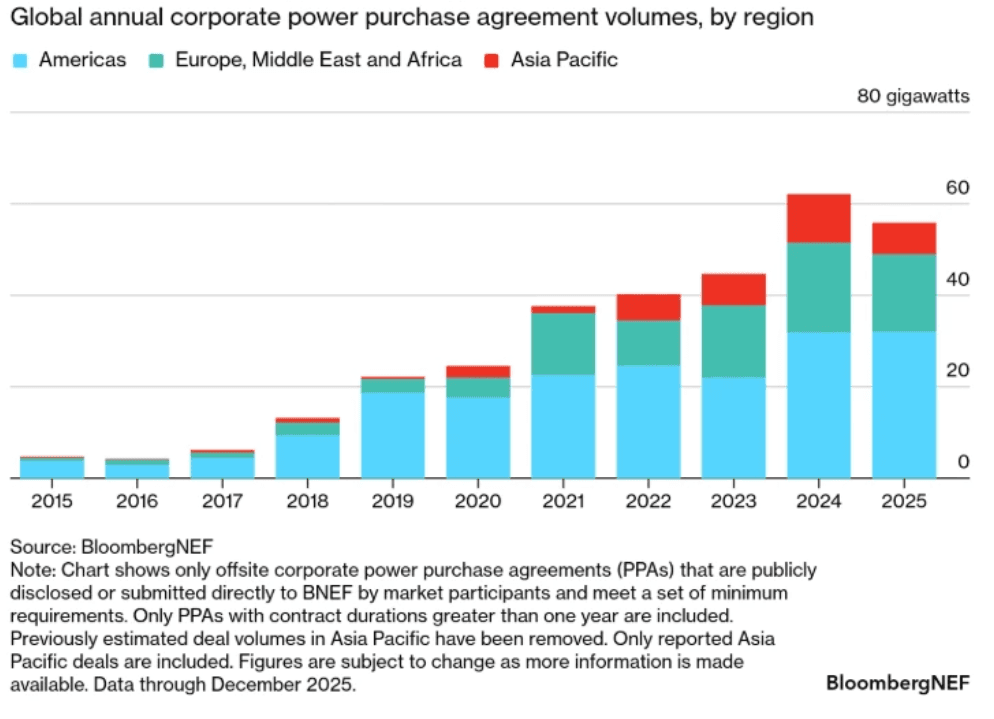
Volume of signed PPAs for electricity from "clean" sources by region. Source: BNEF
Four companies account for half of the market
BNEF's analysis further shows that four technology giants – Meta, Amazon, Google and Microsoft – accounted for half of all market activity last year. The two leaders in this area, Meta and Amazon, together signed PPAs for more than 20 GW of clean-source capacity last year, of which nearly 5 GW was from nuclear power plants.
While Meta purchased electricity exclusively from sources in the United States, Amazon was much more active in Europe and Asia.
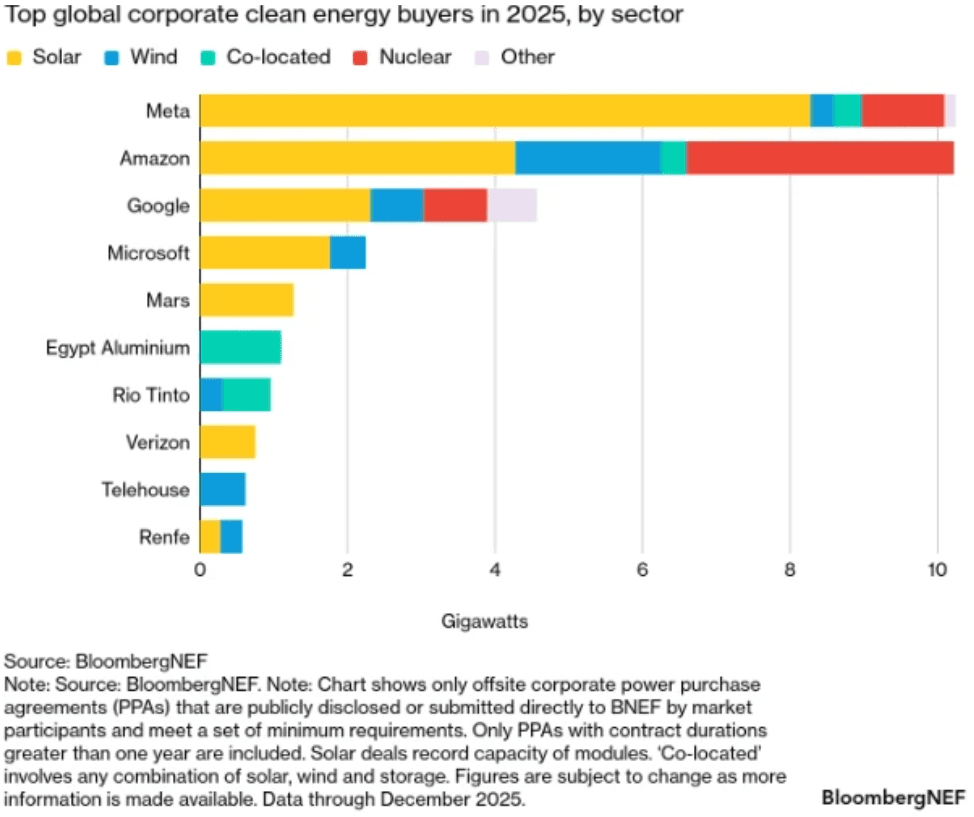
Volume of PPAs signed in 2025 by purchasing company. Source: BNEF
On the generation side, French company Engie was the market leader in long-term PPAs last year, signing contracts totalling 3.6 GW.
"Developers offering clean and reliable supplies are becoming increasingly visible among the largest suppliers. Seven of the ten largest suppliers offer such contracts, including solar paired with batteries, hybrid solar and wind projects, or PPAs from nuclear power plants. These ‘baseload’ products accounted for 5.2 GW of signed contracts," BNEF added.
Pressure to conclude more sophisticated contracts is also coming from regulation, as requirements are increasing to demonstrate the matching of electricity generation and consumption under signed PPAs on an hourly basis. Under an hourly matching regime, it will be significantly more difficult for many corporations to claim that 100% of their electricity consumption comes from clean sources.
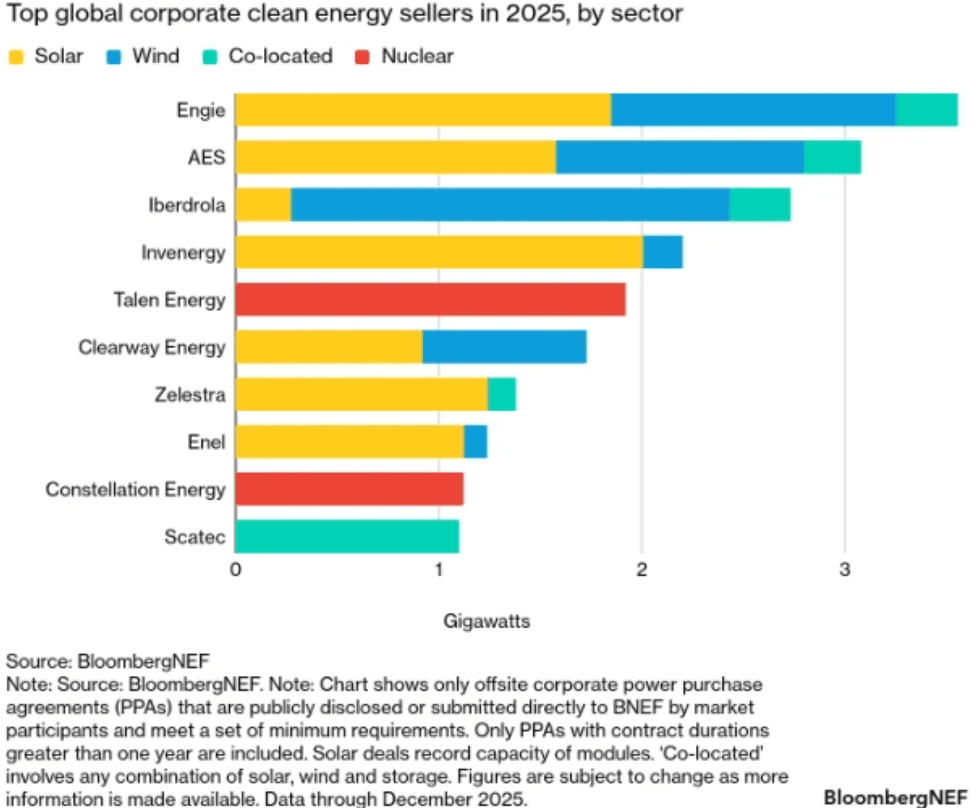
Volume of PPAs signed in 2025 by electricity supplier. Source: BNEF
Translation disclaimer
This article is a machine translation of the Czech original and has not yet been fully reviewed. In case of any doubt, please refer to the Czech version.
Sdílejte článek prostřednictvím:
You might also like
12 October 2026, 07:40
11 October 2026, 20:09
11 October 2026, 08:24