3 October 2026, 13:01
Loading...
War in Iran drives Africa and Asia to buy Chinese solar technology
Vojtěch Kříž
29 April 2026, 10:15
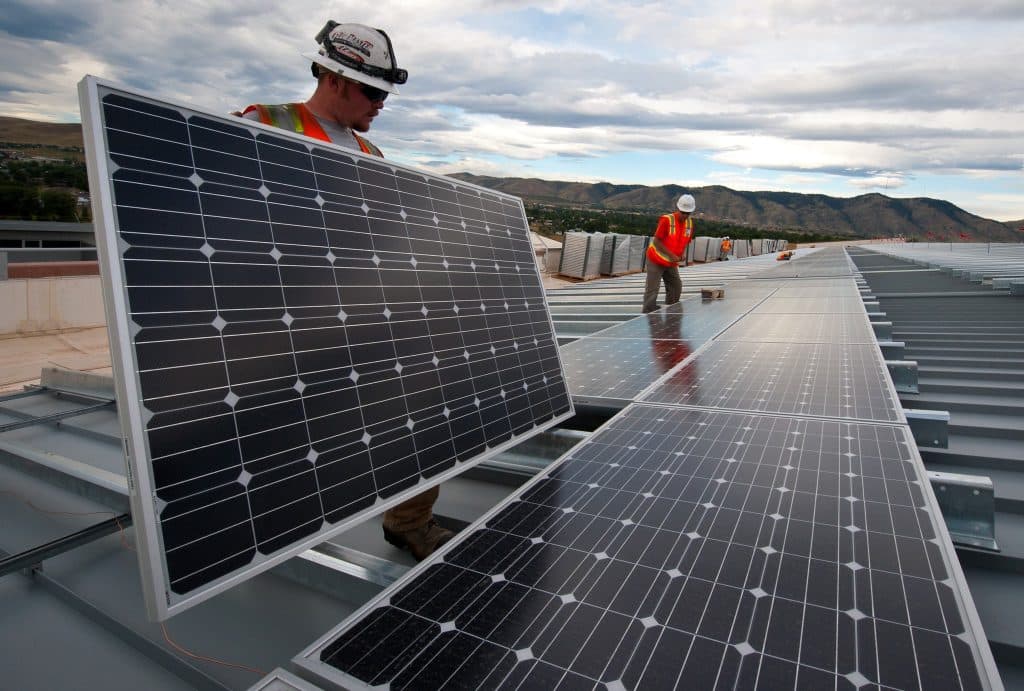
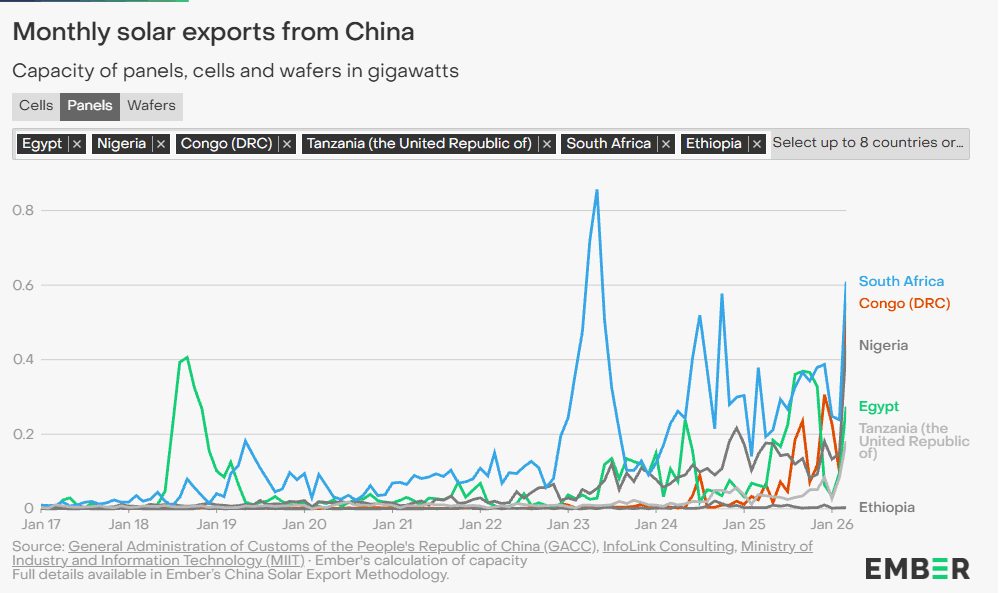
According to data from think tank Ember, Chinese technology exports to Africa have surged since the beginning of March, especially solar panels. The increase has not been the same in every country, however. South Africa, for example, imported solar panels with a capacity of 600 MW in March.
The US-Israeli attack on Iran at the end of February led to the closure of the Strait of Hormuz, triggering the largest disruption to global oil and liquefied natural gas supplies in history. While some countries are profiting from the crisis and others are buying at high prices, shortages are becoming increasingly apparent elsewhere. Africa is one of the regions where supply shortages are threatening, as both governments and citizens lack the fiscal capacity to cope with high prices.
Many of these countries and their citizens have started looking for alternative ways to meet their energy needs.
Solar growth driven by individuals and governments
Ember published a report in early April stating that purchases of solar technologies are accelerating in many countries, surprisingly often in those classed as developing economies. The study was prepared in collaboration with the Climate Vulnerable Forum (CVF), a group of countries disproportionately threatened by climate change. According to the think tank, the process is being driven by households in these countries: it points out that in many countries there are discrepancies between statistics on solar technology imports and those on connections to the grid.
Ember, for example, offers the example of someone in Africa who has had no access to electricity, or only very unreliable and expensive access, and who begins to gradually “climb the energy ladder”. At first, they may be able to buy only a panel and a light, then add a battery and gradually acquire more appliances as their finances and energy savings allow. Until recently, such a person would have depended entirely on the central government and its willingness to supply energy to their area. Pakistan is the best-known example of this kind of development, but we are gradually seeing similar trends in other countries too. Two-thirds of people without electricity live in CVF member countries—up to 500 million people, a significant proportion of whom are in Africa.
The shift to solar is now clearly visible in imports of solar components and panels into many of these countries. The figures show that many have sharply increased their imports from China. The oEnergetice.cz editorial team looked at the most populous African countries, followed by selected countries in Southeast Asia, and their imports of solar components from China.
Note: Ember measures these imports in the installed capacity of imported components (GW). Data is available through March 2026.
Imports often vary by component type. South Africa was the largest importer of panels (0.6 GW), followed by the Republic of the Congo (0.55 GW) and Nigeria (0.44 GW), while Egypt led imports of solar wafers (0.46 GW).
This is because Egypt is seeking to invest in renewable energy while also requiring local content. The aim is to support local industry, including in the renewable energy sector.
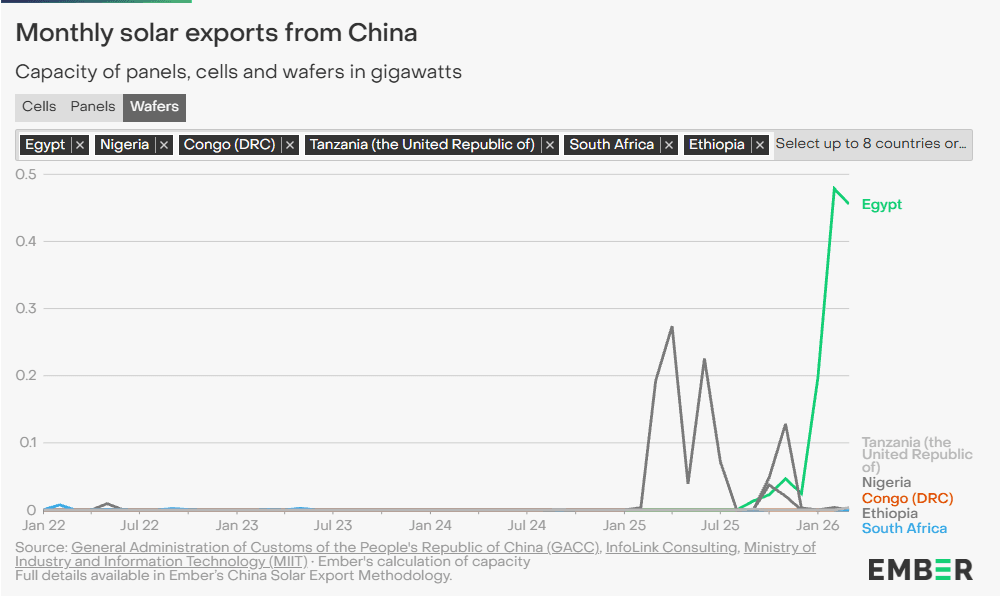
Solar wafer imports into selected African countries. Source: EMBER
A similar picture emerges for solar cells, which are imported mainly by Ethiopia (1.34 GW) and Nigeria (0.96 GW). Both countries aim to play a role in clean technology supply chains.
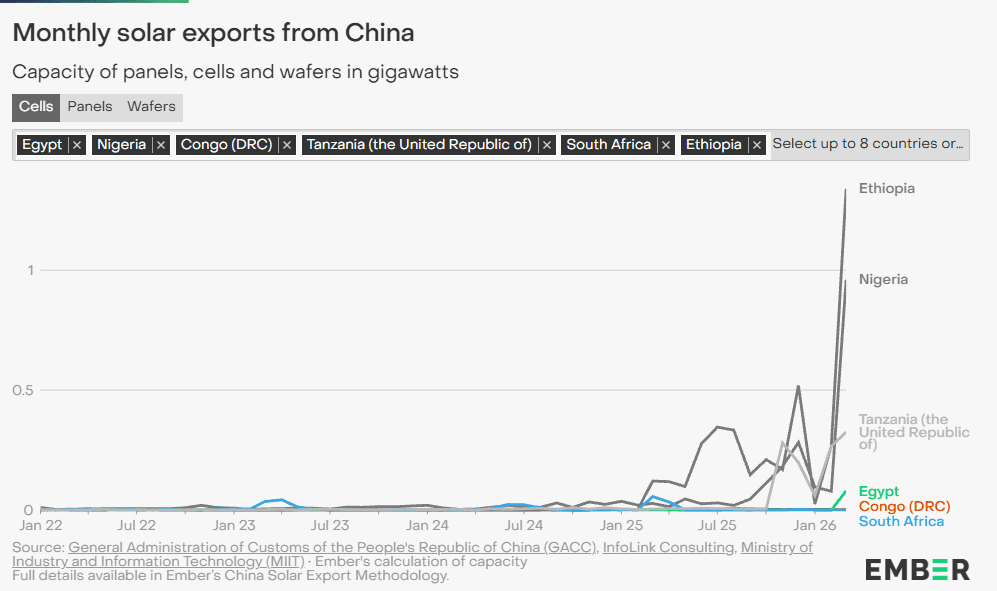
Solar cell imports into selected African countries. Source: EMBER
Asia's role
Southeast Asia was probably the region most directly affected by the shock of the war in Iran, and it is also highly likely to continue suffering from high oil and LNG prices. Some countries are also CVF members, making it interesting to look at changes in their imports.
Here, we can see a similar jump, which again reflects the countries' positions in supply chains. The Philippines led imports of complete panels (2 GW), followed by Vietnam (just under 1 GW), Thailand (0.92 GW) and Malaysia (0.78 GW), while Laos (3 GW) and Vietnam (1.9 GW) led imports of solar wafers.
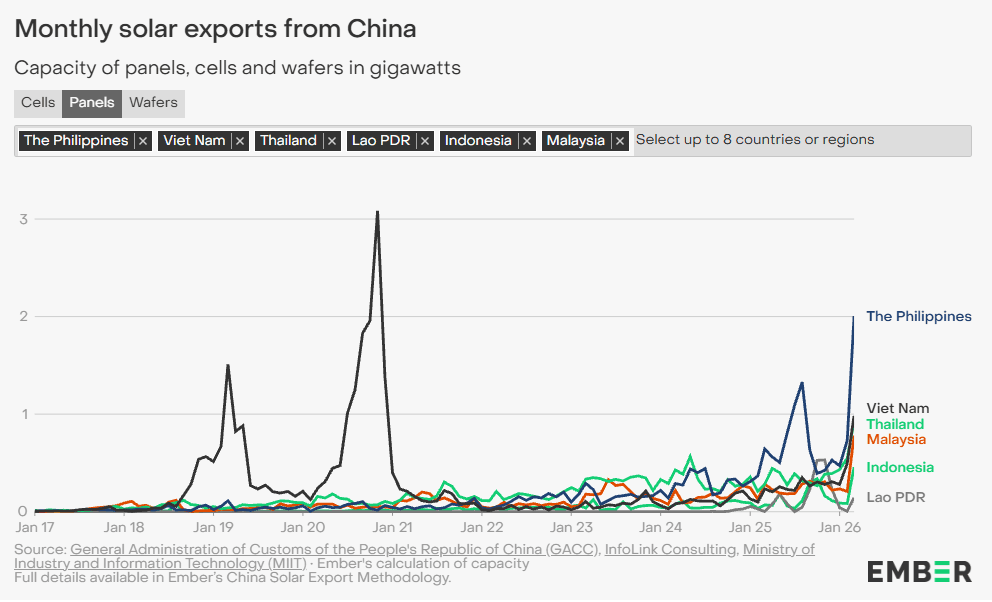
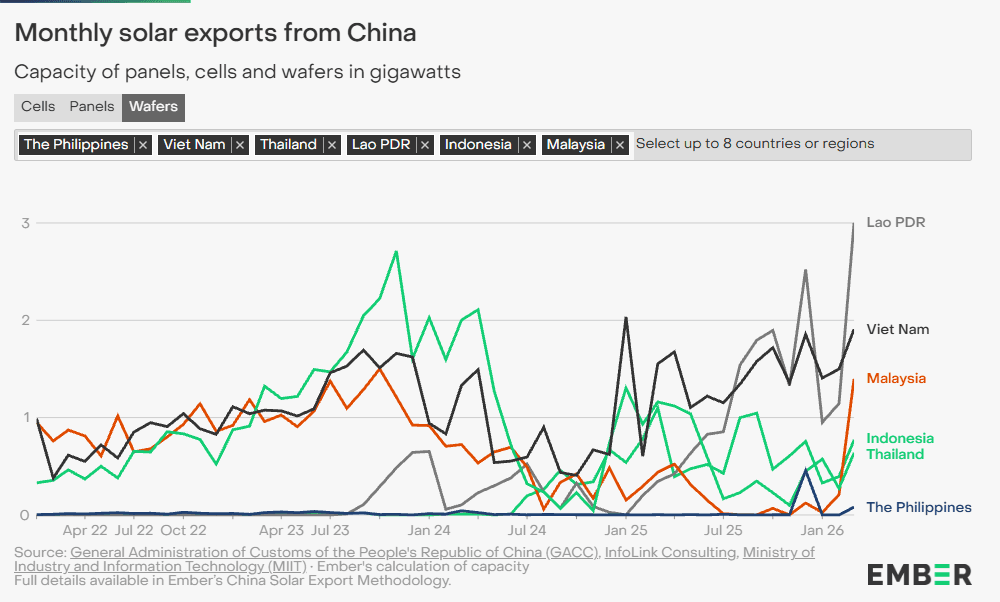
Solar wafer imports into selected Asian countries. Source: EMBER
Indonesia (5 GW), which has been integrated into the supply chain for some time, leads imports of solar cells. It is followed by the Philippines (1.35 GW) and Laos (1.27 GW).
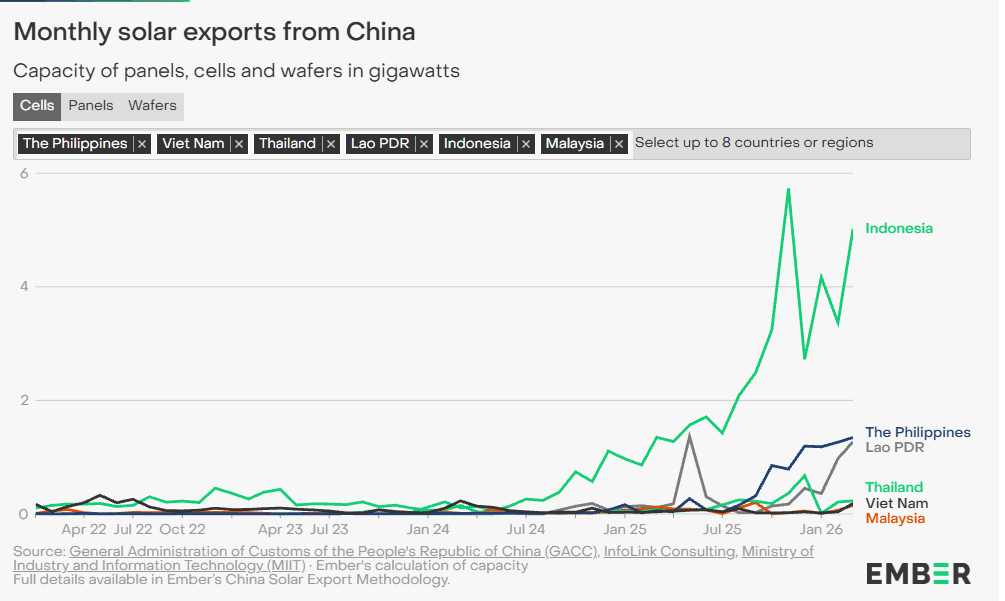
Solar cell imports into selected Asian countries. Sources: EMBER
Component imports are therefore driven both by countries' positions in supply chains and by what their citizens can afford. It is clear, however, that higher prices for imported fossil fuels have prompted many institutions and individuals in these countries to look for alternative energy sources.
Translation disclaimer
This article is a machine translation of the Czech original and has not yet been fully reviewed. In case of any doubt, please refer to the Czech version.
Sdílejte článek prostřednictvím:
You might also like
3 October 2026, 07:43

2 October 2026, 21:55

2 October 2026, 15:14