5 October 2026, 16:20
Loading...
Georgia–Romania submarine cable moves towards seabed survey. Its cost has risen by half in four years

Lukáš Lepič
11 August 2026, 16:22
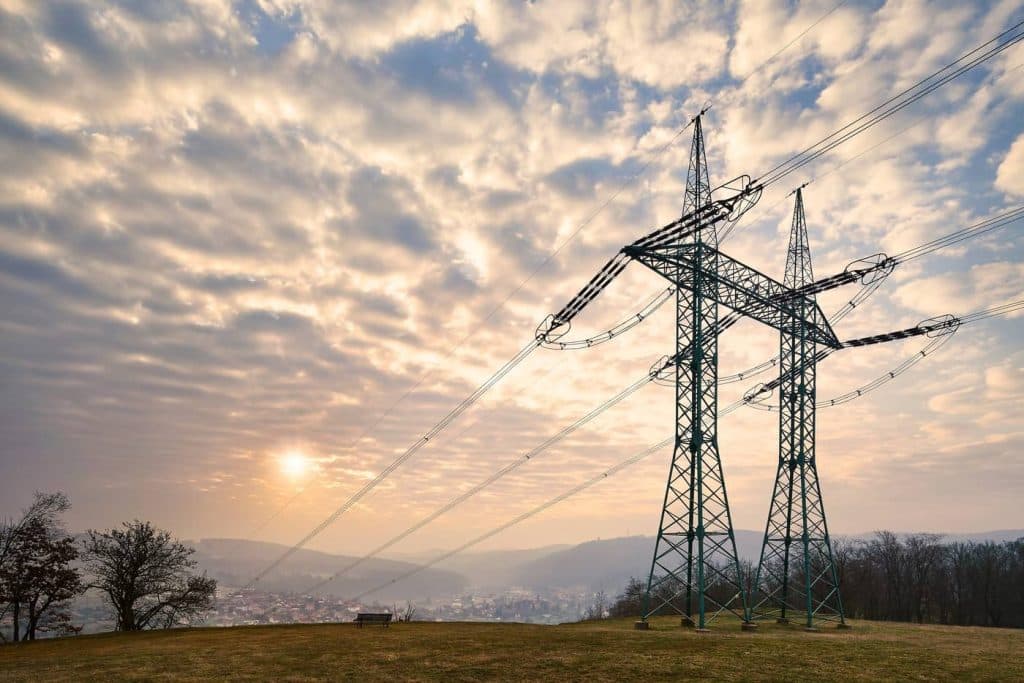
The project for the world’s longest submarine electricity interconnector, intended to link the Caucasus with the European grid, moved to the preparatory phase for a Black Sea seabed survey at the end of July. At a meeting on 29 July, Romanian transmission system operator Transelectrica confirmed that the feasibility study is also being updated and that economic and regulatory analyses are being prepared. The cost estimate has meanwhile risen from EUR 2.3 billion to around EUR 3.5 billion, while the question of whose electricity will flow through the 1,300 MW cable remains open.
The Black Sea Submarine Cable project envisages a direct-current interconnection between Anaklia in Georgia and Topraisar near Constanța in Romania. According to information from Transelectrica, a 2024 study by Italian company CESI recommended an option with a transmission capacity of 1,300 MW, at a voltage of ±525 kV and with a total length of around 1,155 kilometres, of which approximately 1,115 kilometres would be underwater. Parts of the route would run at depths exceeding 2,500 metres.
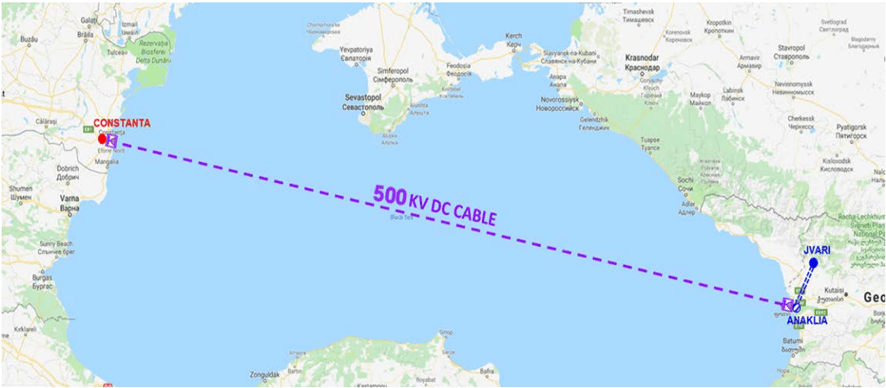
Geographical location of the Black Sea submarine cable project; Source: GSE
If built in this form, it would be the world’s longest submarine power cable. The current record holder, the North Sea Link interconnector between Norway and Great Britain, is 724 kilometres long. Alongside the power cable, the project also envisages an optical fibre link, whose cost is estimated by the study at USD 70 million to USD 90 million.
According to the Romanian side, the meeting at the end of July addressed the cable route, the permitting process for the Romanian section and the investments needed for the grid in the Constanța area to accommodate 1,300 MW. The preparatory phase is being financed by the World Bank.
The European Commission included the interconnector in the EU’s second list of projects of common and mutual interest, adopted on 1 December 2025 and published in the Official Journal on 9 April 2026 as Regulation 2026/764. The list contains 235 projects, including 25 projects of mutual interest with third countries. The status brings streamlined permitting and the possibility of applying for funding from the Connecting Europe Facility, but does not guarantee funding itself. The project is now also being assessed in ENTSO-E’s 2026 ten-year network development plan.
The deadline for an investment decision passed without a decision
The timetable is a key issue. A summary of the feasibility study published by Georgian transmission system operator Georgian State Electrosystem envisaged the preparatory phase running from December 2024 to July 2026, with the final investment decision to be made around April 2026.
Neither April nor July 2026 brought a decision. A memorandum signed by Transelectrica and GSE in Bucharest in early February explicitly states that it does not constitute a final investment decision, and the project is only now preparing for a marine survey intended to confirm the optimal route. Yet in a 2022 presentation to the Energy Community, GSE had still placed the start of commercial operation in 2030.
Cost estimate rises by more than half
In the same 2022 presentation, GSE put approximate costs at EUR 2.3 billion for a transmission capacity of 1,000 to 1,500 MW. In its 2023 programme document, the World Bank used an estimate of EUR 2.5 billion.
The feasibility study completed in July 2024 puts total costs at EUR 3.57 billion. For the 1,300 MW cable system itself, it estimates USD 3.1 billion to USD 3.6 billion. Compared with the initial 2022 figure, this represents an increase of more than half, even before the seabed survey begins and provides more precise laying conditions. Per unit of capacity, the project works out at around EUR 2.75 million per megawatt.
Georgia’s Ministry of Economy said in December that grant funding could cover 30% to 50% of costs, and up to 75% in exceptional cases. A significant part of the investment would therefore have to come from public sources, including European funds.
Capacity exceeds a quarter of Georgia’s generating capacity
The fundamental question is how the cable will be used. Installed capacity in Georgia totalled 4,675 MW at the end of 2025, including 3,489 MW in hydropower plants and 1,154 MW in thermal plants. Wind and solar plants accounted for a combined 31.5 MW, generating 84 GWh, or 0.5% of total supply.
The cable’s transmission capacity is equivalent to roughly 41 times Georgia’s wind and solar capacity and more than a quarter of all installed capacity in the country.
The project has therefore from the outset rested on the assumption that Azerbaijan will supply the electricity and Georgia will serve as a transit country. This is also reflected in the green energy partnership agreement signed by the governments of Azerbaijan, Georgia, Romania and Hungary in December 2022.
Baku is rapidly building up its renewable base, albeit from a low starting point. In June, Deputy Energy Minister Orkhan Zeynalov said that around 2 GW from eleven solar and wind power plants is to be added to the grid by the end of 2027, while renewables’ share of installed capacity is to reach 39% by 2030. President Ilham Aliyev spoke in March of 6 GW of wind and solar by 2030 and 8 GW by 2032.
Translation disclaimer
This article is a machine translation of the Czech original and has not yet been fully reviewed. In case of any doubt, please refer to the Czech version.
Sdílejte článek prostřednictvím:
You might also like
5 October 2026, 15:34
5 October 2026, 13:26