
23 October 2026, 14:38
Loading...
How quickly are wind farm costs falling? US data show a 27% drop in 6 years

Martin Voříšek
19 August 2021, 10:56
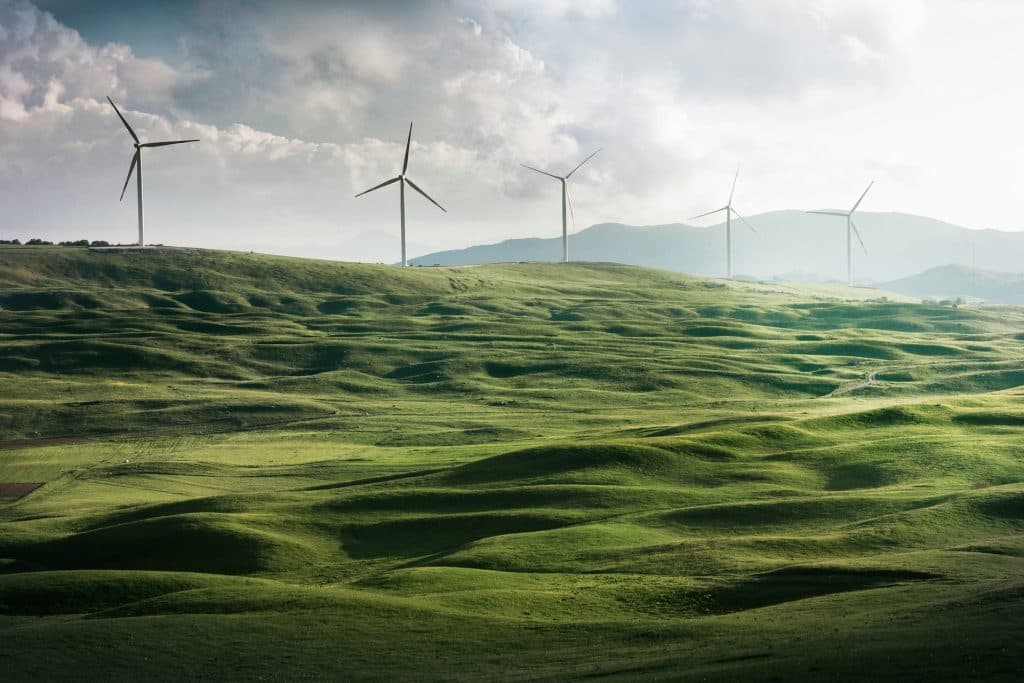
According to data published by the US government agency, the U.S. Energy Information Administration (EIA), the cost of onshore wind farms fell by an average of 27% between 2013 and 2019. In 2019, average costs per unit of installed capacity thus stood at USD 1,391/kW. Prices, however, vary substantially between individual US states.
The cost of building wind farms has been steadily falling in recent years, as shown by recent data from the United States. The price decline has been helped most by strong demand, which supports a competitive environment, as well as the greater capacity and efficiency of new wind turbines. More than 9 GW was built in the United States alone in 2019, and more than 14 GW of installed capacity in 2020. Total onshore wind capacity in the US now stands at roughly 120 GW.
US price data confirm the generally declining trend in the cost of building renewable energy sources. While average wind farm construction costs were around USD 1,900/kW in 2013, the average fell to USD 1,391/kW in 2019. Prices, however, vary substantially by region.
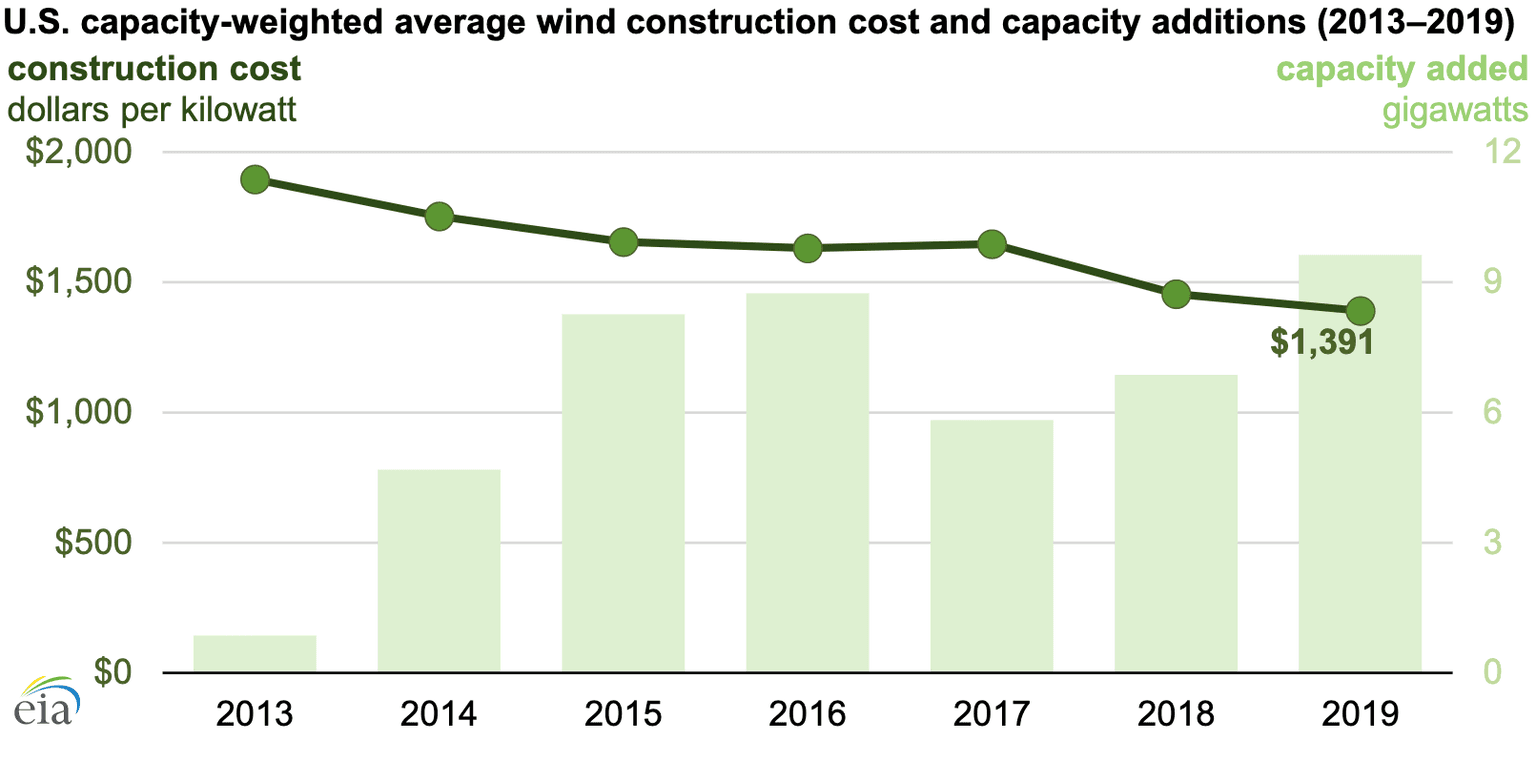
Average wind farm construction costs in the US. Source: EIA
Some of the lowest construction costs can be achieved in the ERCOT system in Texas, where the price has fallen to as low as USD 1,114/kW. In contrast, prices are substantially higher in California, where average costs between 2013 and 2019 stood at as much as USD 2,310/kW. Higher construction costs there are mainly linked to local legislative requirements and land-use restrictions, which may force developers to use less suitable sites.
Wind farms are the third cheapest to build
When comparing only the cost of building a unit of capacity, wind farms in the US rank third behind gas-fired power plants and plants burning oil products.
However, considering the amount of capacity installed in 2019, only gas-fired power plants can be regarded as competition for wind farms, with 8 GW added during 2019. According to EIA data, no power plants using oil products to generate electricity were added.
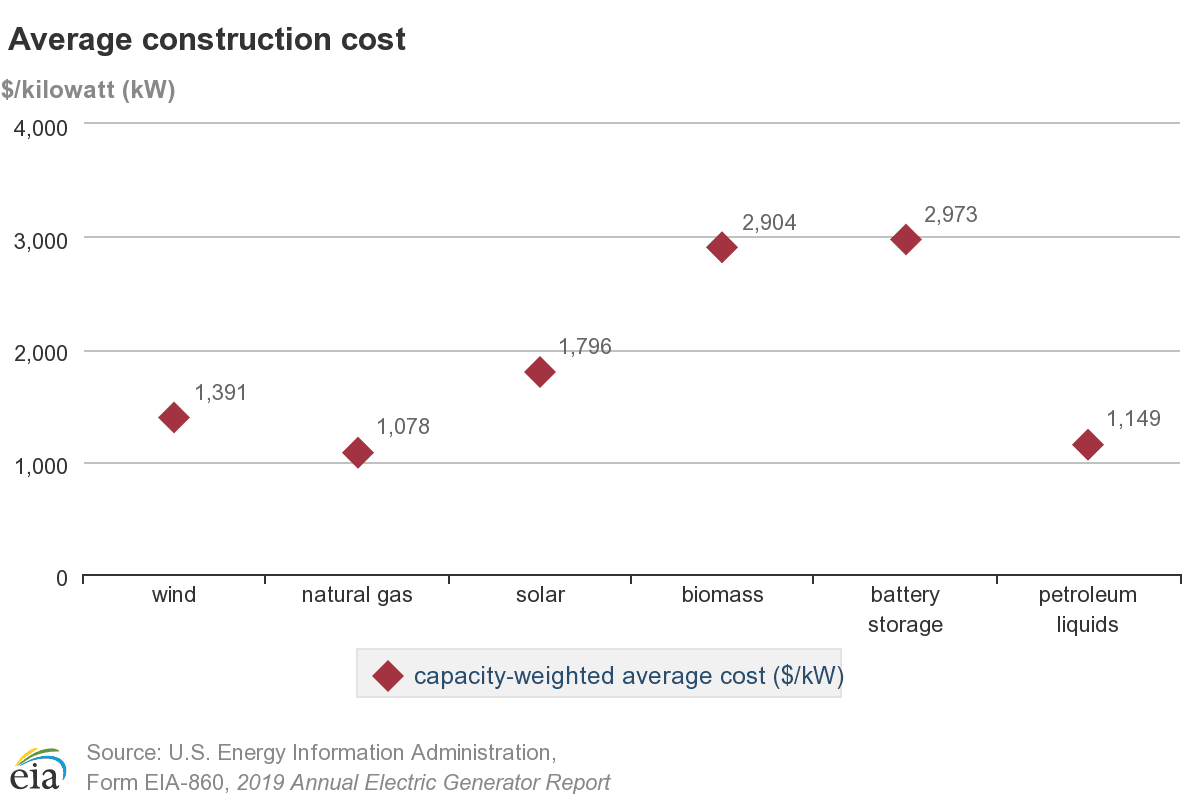
Average construction costs for power sources in the US. Source: EIA
Without competition, technology costs may not be decisive
The US market illustrates the impact of a strong competitive environment and its positive effect on the cost of building renewable energy sources. A strong competitive environment is crucial to reducing costs, as demonstrated, for example, by the situation in neighbouring Germany.
After initial success following the transition from a fixed feed-in tariff to an auction system, when prices fell below EUR 40/MWh thanks to the high number of competing projects, the situation has changed fundamentally in recent years. Due to a severe shortage of projects, also caused by changes to auction rules, bid prices began to rise again and, with a few exceptions, have in recent years reached levels close to the price ceiling set by the German energy regulator, which stands at EUR 60/MWh this year.
Translation disclaimer
This article is a machine translation of the Czech original and has not yet been fully reviewed. In case of any doubt, please refer to the Czech version.
Sdílejte článek prostřednictvím:
You might also like
23 October 2026, 11:01

23 October 2026, 06:34