25 September 2026, 09:51
Loading...
Offshore wind farms were meant to be a pillar of future energy. Recent developments suggest otherwise

Martin Voříšek
18 September 2023, 07:24
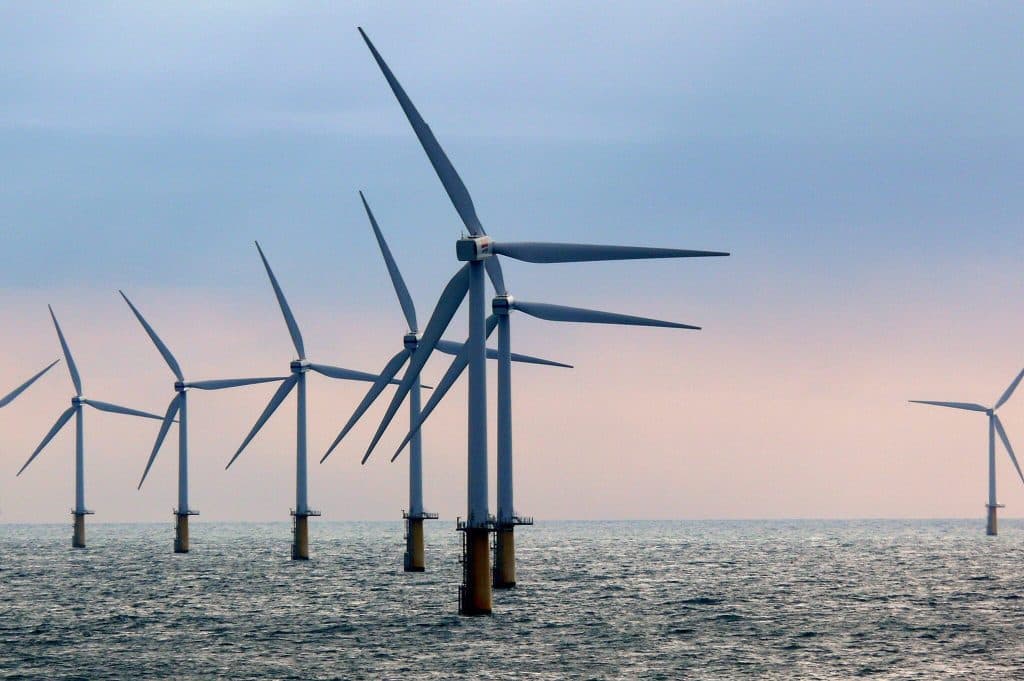
Wind power projects around the world are reporting problems. One of the latest examples is an auction in the United Kingdom, which received no bids. An auction in the Gulf of Mexico also ended unsuccessfully, with only one of the three planned sites awarded. Experts are also beginning to doubt whether the United States will meet its target for building offshore wind farms. The blame lies with higher construction costs, driven by both increased material costs and higher financing costs.
A number of coastal countries with suitable conditions for their construction rely on electricity generation from offshore wind farms. Although their construction costs are more than twice those of onshore wind farms when comparing their levelised cost of energy (LCOE, see below), they offer a number of indisputable advantages.
For example, offshore wind farms have higher capacity factors. According to WindEurope statistics, new offshore wind farms can reach up to 50%. This is one reason why many countries with favourable conditions are betting on them in the future. Developers also do not have to deal with opposition from residents near construction sites, as is often the case with onshore wind farms.
However, a number of negative reports have emerged from the sector in recent weeks. They suggest that the offshore wind sector has "stalled" this year. The ambitious targets of some countries will therefore need to be reassessed.
For example, not a single bid was submitted in the latest UK auction, in which applicants were to compete for operational support. This was despite prospective participants having projects ready for implementation. They agree that the price cap for operational support was set too low and therefore does not reflect rising construction costs.
RWE and Vattenfall are examples. Both companies have warned that the costs of offshore wind projects have risen by up to 40%. As a result of higher prices, Vattenfall even had to suspend a project that received support in the UK last year.
This is not the only problem, as Markus Krebber, CEO of RWE, told the Financial Times. According to him, the world is suffering from a shortage of manufacturing capacity needed to meet global renewable energy targets.
"If you . .. simply add up the renewable build-out targets in Europe and also in the US and compare them with manufacturing capacity ... you find that current supply chains cannot meet these targets," Markus Krebber told the FT.
Cost increases in the US point to a price rise of up to 50%
According to BloombergNEF, the cost of building wind farms in the United States has risen even more, by up to 50%. In 2023, the levelised cost of energy (LCOE) was therefore USD 114.20/MWh. This represents an increase of more than 50% compared with 2021.
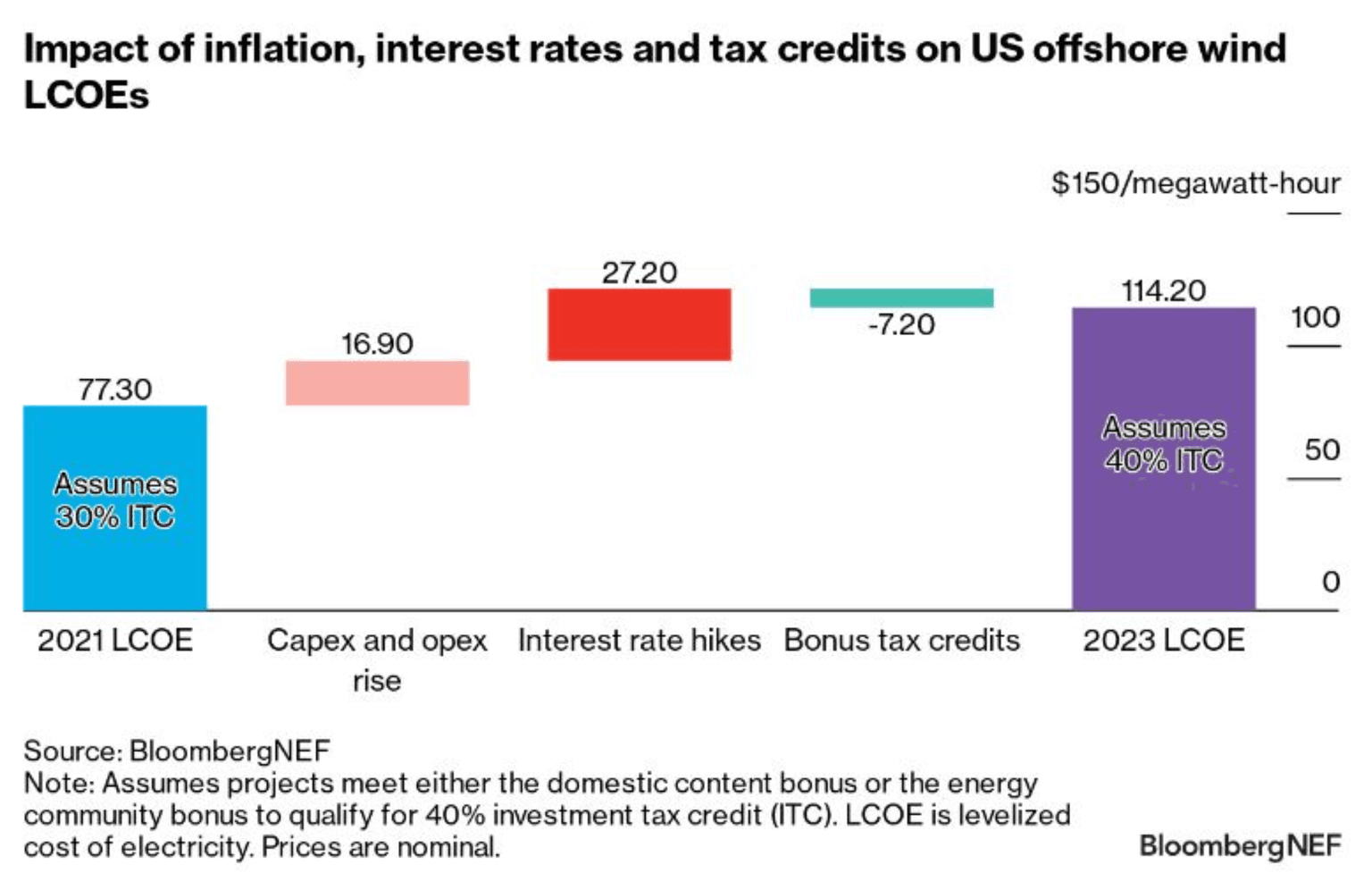
Rising costs of offshore wind farm construction. Source: BloombergNEF
The increase in capital and operating costs raised the levelised cost of energy by USD 16.90/MWh. Higher financing costs due to interest rates increased the levelised cost of energy by a further USD 27.20/MWh.
Levelised cost of energy (LCOE) is a metric that makes it possible to compare the economic competitiveness of different energy sources. It is calculated as the ratio of all costs associated with the construction, operation and decommissioning of a power plant (including any fuel purchases) to the amount of energy the plant generates over its lifetime. In Europe, it is most commonly stated in EUR/MWh. Prices do not include subsidies or emissions allowance prices. Source: Fakta o klimatu.
High wind farm construction costs are why experts are beginning to doubt that the United States will have 30 GW of installed offshore wind capacity by 2030.
In recent months, US companies have also seen material and financing costs rise sharply. At the same time, supply-chain delays have led Ørsted, Equinor, BP, Avangrid and Shell to cancel or seek to renegotiate power purchase agreements concluded for offshore wind farms in the US.
Translation disclaimer
This article is a machine translation of the Czech original and has not yet been fully reviewed. In case of any doubt, please refer to the Czech version.
Sdílejte článek prostřednictvím:
You might also like

24 September 2026, 11:23

24 September 2026, 10:30
24 September 2026, 06:56