25 September 2026, 09:51
Loading...
Charles University presents scenarios for the future of Czech energy
Barbora Zimová
20 January 2026, 14:59
A study modelling scenarios for the development of Czech energy and their economic impacts has been produced under the auspices of Charles University. The background material for strategic government documents offered findings on impacts on the Czech economy, households and the achievement of climate targets. A peer review analysis by the Czech Technical University challenged both the input parameters used and the conclusions drawn.
The National Energy and Climate Plan and the State Energy Policy are strategic documents setting out the direction of Czech energy. One of the key analytical inputs for their update was a study prepared by researchers at Charles University. They carried it out in cooperation with colleagues from Cambridge Econometrics in the SEEPIA project.
The study aimed to assess possible trajectories for the development of Czech energy and the economy through to 2050. Its approaches are intended to comply with the European Commission's methodological recommendations and the national strategic assumptions approved by the government in 2023. The study compared alternative scenarios focused on substantial emissions reductions with a reference scenario that does not envisage the implementation of such measures.
The variants discussed also differ in their assumed generation mix and energy savings. The scenarios were based on assumptions defined by the Ministry of Industry and Trade and the Ministry of the Environment, and consulted with relevant stakeholders. Modelling was conducted between 2022 and 2024 using four internationally recognised models.
The TIMES-CZ model captures the entire energy system of the Czech Republic, from the extraction and import of raw materials to their final consumption across economic sectors in order to meet total demand. The E3ME model assesses macroeconomic impacts. The DASMOD microsimulation model enabled researchers to include projections of the social impacts of policies on households in the analysis. The trio is complemented by the PLEXOS model, used to assess power system resource adequacy in cooperation with the Czech Electricity Transmission System Operator.
Reference scenario
The baseline scenario does not consider the implementation of policies under the Fit for 55 package or the achievement of climate neutrality by 2050. It envisages the construction of one nuclear unit with installed capacity of 1.1 GW at the Dukovany site (EDU5), assumed to enter operation in 2040. However, the currently valid contract concluded between Elektrárna Dukovany II and Korea Hydro and Nuclear Power Company already covers the construction of two nuclear units. Completion of the first is targeted for 2036.
The reference scenario assumes relatively slow development of renewable energy sources. By 2030, it reaches a maximum of 6 GW of installed capacity in photovoltaic plants and 0.7 GW in wind power plants. Total installed solar capacity in Czechia currently stands at around 4.9 GW, of which an estimated 600 MW was added last year. Installed wind capacity in Czechia stood at 377.6 MW at the end of 2025. Projects with total capacity of 17.73 MW were commissioned during the year..The reference scenario is the only one that does not envisage the creation of hydrogen import routes to the Czech Republic at all.
As regards the potential for energy savings in buildings, it corresponds to the Optimal Scenario of the Long-Term Renovation Strategy prepared by the Ministry of Industry and Trade in 2020. Although this approach does not envisage using the full decarbonisation potential of the building stock, it is presented as a realistic option under the given conditions. It is based on adjustments to existing policies and the gradual introduction of further tools aimed at improving the quality of renovations.
![Image showing modelling of final energy consumption in buildings [PJ]](/_next/image?url=https%3A%2F%2Foenergetice.cz%2Fwp-content%2Fuploads%2F2026%2F01%2FSnimek-obrazovky_16-1-2026_151145_mpo.gov_.cz_.jpeg&w=1536&q=75)
Modelling of final energy consumption in buildings through to 2050 [PJ]. Source: Long-Term Renovation Strategy (2020), Ministry of Industry and Trade
Decarbonisation scenario
The second scenario already includes additional measures resulting from Fit for 55 and REPowerEU. It also applies an enforced emissions target of no more than 8 Mt CO₂eq (carbon dioxide equivalent) in 2050. In addition to EDU5, it assumes the construction of two further units of the same capacity at the Temelín site (ETE3 and ETE4). It plans for the three new large nuclear sources to enter operation between 2036 and 2041. It also includes a 350MW small modular reactor (SMR).
Renewable energy development is faster in this case. By 2030, it assumes installed capacity of 10.1 GW in photovoltaic plants and 1.5 GW in wind power plants. In line with the updated Hydrogen Strategy, it envisages the gradual ramp-up of hydrogen imports from 2033, specifically 8 thousand tonnes for industry.
Energy savings in buildings are higher than in the reference scenario and correspond to the hypothetical scenario under the Ministry of Industry and Trade's strategy. This ideal scenario is based on rapid and deep renovations of the building stock, but its implementation is hindered by a number of barriers. According to the ministry's findings, these lie primarily in non-financial factors. Administrative complexity, low awareness of the benefits of comprehensive renovations, and a preference for gradual or do-it-yourself renovations result in low uptake of available funding, slowing the pace of renovations across the residential, public and private sectors.
Ambitious scenario
The final scenario is likewise based on Fit for 55 and REPowerEU measures and sets the same emissions limit for 2050 as the previous variant. It also assumes the construction of three large nuclear units and deployment of an SMR.
Compared with the decarbonisation scenario, it assumes an even more intensive transformation of energy and consumption. The key difference is the fastest development of renewable energy sources, with installed capacity reaching 12.6 GW in photovoltaic plants and 1.7 GW in wind power plants by 2030. Like the decarbonisation scenario, it envisages hydrogen imports in the same volume.
The scenario also assumes a higher level of energy savings in buildings under the hypothetical scenario of the ministry's strategy. It also includes behavioural changes among the population, specifically a 10 % reduction in demand for heating and individual transport from 2030.
GDP growth driven by investments in climate policies
The decarbonisation scenario assumes substantially higher investment than the reference scenario. By 2030, capital expenditure reaches approximately CZK 4.1 trillion, around CZK 1.1 trillion more than in the first scenario. The largest share goes to building renovations and the development of electricity and heat generation. Over the period to 2050, total investment in the decarbonisation scenario is almost CZK 2.9 trillion higher.
The authors nevertheless note that impact assessment cannot be limited solely to investment costs. Financing costs, investment support, changes in spending on energy and fuels, and payments for emissions allowances also play a significant role. Once these factors are included, the total costs of the decarbonisation scenario are approximately 11 % higher than in the reference scenario, equivalent to around CZK 3.6 trillion. Investment support significantly reduces the difference between the scenarios, reaching approximately CZK 1.3 trillion by 2050.
Macroeconomic modelling suggests that climate policies may have a positive effect on the Czech economy. GDP is 1.5 to 3.5 % higher in the decarbonisation scenario over the long term, mainly due to increased investment..
Declining energy consumption will fall short of targeted savings
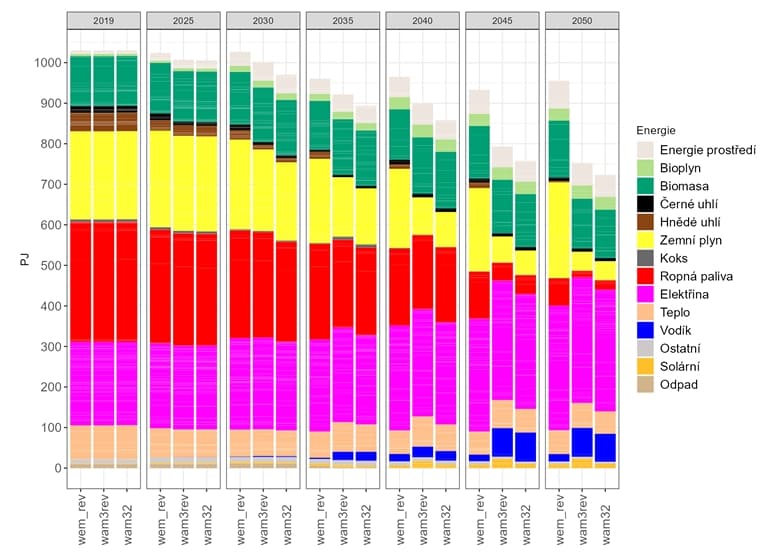
Total final energy consumption. Source: Methodological Guide to Energy Scenario and Economic Modelling 2022–2024 (2025), Environment Centre, Charles University
By 2030, consumption of primary energy sources is expected to decline compared with 2005 in all scenarios. Lignite consumption falls substantially in the projections, while hard coal remains in limited industrial use, with carbon capture technology (CCUS) from 2035. Natural gas declines over the long term, especially in the more ambitious scenarios. Oil consumption falls mainly after 2040 as a result of the transition to electric mobility and hydrogen. Final energy consumption declines slightly by 2030, but savings do not reach the targets set by the Energy Efficiency Directive.
Electricity generation temporarily declines due to the shutdown of coal-fired power plants, but rises again after 2025 thanks to new sources. After 2045, the study's projections show a decline in generation as a result of the Dukovany nuclear power plant ending operations. Overall, however, electricity's share of final energy consumption rises significantly by 2050.
Beyond 2030: EU ETS insufficient to meet targets
The modelling results show that all assessed scenarios meet, or exceed, the EU target for reducing greenhouse gas emissions by 2030. By that year, member states committed to cut emissions by 55 % compared with 1990. Estimated emissions reductions reach approximately 65 % in the reference scenario, 68 % in the decarbonisation scenario and up to 71 % in the ambitious scenario..
Conversely, the long-term climate-neutrality target for 2050 is not achieved in any of the modelled scenarios, either at the level of the Czech Republic or across the European Union. The emissions trading system alone is insufficient for the stated target. Cutting emissions by more than 90 % compared with 1990 requires extremely high allowance prices, as confirmed by both European and national models.
For this reason, the authors justify imposing a reduction in greenhouse gas emissions to no more than 8 Mt CO₂eq in 2050 in the modelling. This assumes additional regulatory and support measures beyond the Fit for 55 package, particularly in sectors that are difficult to decarbonise.
Household expenditure will rise with ETS2.
The study's authors expect the introduction of the ETS2 system for buildings and transport from 2027 to increase household expenditure. The average increase in annual spending compared with the Reference Scenario is around CZK 4.3 thousand, or less than 1 % of total household expenditure. For energy, this amounts to approximately CZK 1 thousand annually. Appropriately designed policies can ensure that the changes do not have a major impact on the overall level of energy poverty, which would therefore remain stable until 2032.
According to findings by the Platform for Social Housing in cooperation with the University of Ostrava, energy poverty affected approximately 1.3 million Czech residents in 2023. Extreme energy poverty affects one-third of them. These residents cannot afford to use energy to an adequate extent or incur debt in paying for it.
The impacts of ETS2 differ by household type and characteristics, rather than varying linearly by income. The groups most at risk are seniors and single parents. Regionally, the impacts are lowest in Prague and highest in the Vysočina Region, with differences between regions gradually widening. The authors recommend supporting incentives for energy savings, especially among the most vulnerable groups, rather than providing blanket compensation..
Savings on energy costs. Source: Unsplash
Peer review analysis by CTU.
An assessment of the proposed 2024 update to the State Energy Policy, as the document's subtitle reads, was prepared by experts from the Czech Technical University at the request of the Ministry of Finance. Its findings and overall tenor challenge the SEEPIA study. The Vysoké napětí platform published it in full with commentary on Datarun.
Its authors criticise methodological errors and the use of incomplete or incorrect data. According to them, the study, for example, ignores losses in transmission and distribution networks and underestimates actual electricity consumption, the country's dependence on imports and other key parameters of resource adequacy.
The criticism also concerns the study's use of unrealistic assumptions about the capacity and utilisation of individual sources. It overestimates the potential of renewables and does not take into account the load-following capabilities of nuclear units, which would have to be shut down at high shares of solar and wind energy, or else renewable electricity generation would have to be curtailed. It assumes the use of gas-fired sources and continued operation of coal mines despite their economic inefficiency for investors under such conditions.
Czechia still lacks an updated State Energy Policy.
Of the two documents for which the Charles University study was used, only one has been adopted. The Czech government approved the update to the National Energy and Climate Plan in December 2024, thereby avoiding fines for failing to meet its obligation to the European Commission. However, an updated State Energy Policy is still missing. As its latest information, from February 2024, the responsible Ministry of Industry and Trade states that the draft update was submitted for interministerial consultation.
Translation disclaimer
This article is a machine translation of the Czech original and has not yet been fully reviewed. In case of any doubt, please refer to the Czech version.
Sdílejte článek prostřednictvím:
You might also like
24 September 2026, 11:23
24 September 2026, 10:30
24 September 2026, 06:56