German Amprion announces new transmission line project to connect the North Sea directly with western Germany

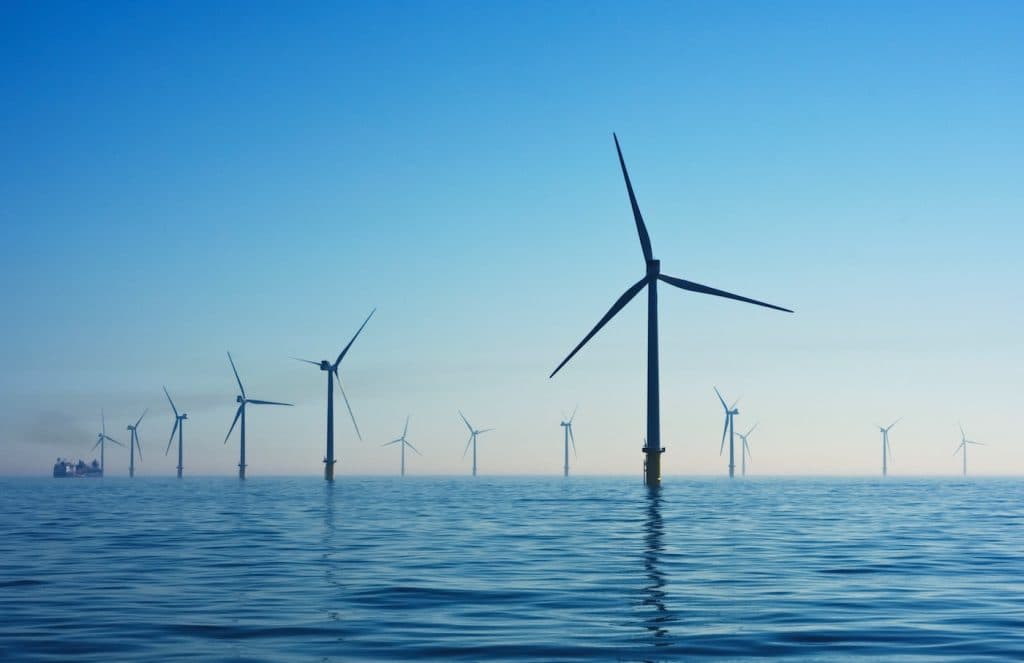
Transmission system operator Amprion has announced plans to build a power line that would connect offshore wind farms in the North Sea with consumers in industrial western Germany. The energy corridor, called "Windader West", is planned to have a transmission capacity of 8 GW.
To meet its climate targets, Germany plans to increase its installed offshore wind capacity to 50 GW by 2035. Offshore wind is expected to replace conventional energy sources, particularly in load centers in western Germany. This requires not only new offshore wind farms, but also new lines that will connect the wind farms to the onshore transmission grid and strengthen the existing onshore grid.
The Windader West project, consisting of four parallel cable lines, will connect offshore wind farms in the North Sea with the industrial Rhine-Ruhr region in western Germany. The first line, which will enable the transmission of up to 2 GW of power, is scheduled for completion in 2032. The remaining three lines are due to enter service in 2033, 2034 and 2036.
According to a report by German news agency dpa, total investment is expected to range from 16 to 18 billion euros (the equivalent of 386 to 435 billion crowns).
"Windader West" brings together four projects, each with a transmission capacity of 2,000 MW. They are part of a new generation of high-capacity 2 GW offshore connections. Amprion is thus making a significant contribution to the efficient and rapid transformation of the energy system, with the aim of bringing large amounts of wind power to North Rhine-Westphalia," says Peter Barth, managing director of Amprion Offshore GmbH.
Amprion will now begin the process of determining the route for the underground cables, which will run largely in parallel to minimize their impact on residents and nature.
"To ensure the project is compatible with people, nature and the environment, and to minimize the impact locally, the systems will largely be installed in parallel," says Eric Zieschang, head of the Windader West project.
Stakeholders and the public will be able to participate as early as the search for a corridor for the line route.
"Early involvement of all stakeholders is particularly important to us. This allows us to engage with people on the ground and gather important information to help us with planning," emphasizes Linus Dahm, the project's spokesperson for the northern part of North Rhine-Westphalia."In October, we will hold information events for the public. Among other things, we will focus on the first approval stage, known as the regional planning procedure," adds his colleague Stefan Sennekamp, who is responsible for the Lower Saxony section.
Development of the German grid is not progressing fast enough
The development of Germany's transmission grid is significantly behind the original plans. Major transmission line projects such as SuedOstLink and SuedLink, which are comparable to Windader West, are facing delays of several years, partly due to lengthy procedures and opposition from residents affected by the construction of the lines.
At the end of last year, German transmission system operators reached an important framework agreement setting out rules for compensating landowners and users affected by the construction of the lines. The lines were originally due to enter service last year, in line with the planned shutdown of the last nuclear power plants. However, according to current plans, SuedOstLink and SuedLink are scheduled for completion in 2027 and 2028.
Translation disclaimer
This article is a machine translation of the Czech original and has not yet been fully reviewed. In case of any doubt, please refer to the Czech version.