25 September 2026, 09:51
Loading...
While the Czech Republic awaits storage legislation, Hungary will provide billions for its development

Martin Voříšek
27 June 2023, 06:35
The European Commission has approved public support for electricity storage in Hungary. Hungary will obtain part of the funding directly from EU funds, while the remainder will be financed through a separate levy in the electricity price. While Hungary is drawing subsidies for storage, electricity storage has not yet even been enshrined in the Czech Energy Act. The Czech Republic is already two years overdue in its obligation to incorporate storage into legislation.
Electricity storage is rightly regarded as the missing link in the transition to an energy system based on renewable energy sources. This has become increasingly apparent in recent weeks, particularly during sunny non-working days, when electricity prices on short-term markets often fall into negative territory.
Hungary has decided to help address this situation. It has announced support totalling EUR 1.1 billion (approximately CZK 26 billion) for new electricity storage facilities. The support will be available in the form of an operating subsidy, funded through a separate payment collected alongside the electricity price, and an investment subsidy provided through the European Recovery and Resilience Facility.
A total of up to 1,600 MWh (or 800 MW) of new electricity storage facilities are to receive support. The programme is open to all types of electricity storage, meaning that, in addition to battery storage facilities, it could also include electrolysers for hydrogen production.
Projects will compete for support in auctions that should take place by the end of 2024. Similarly, in the Czech Republic, developers compete for support for larger renewable energy sources, such as wind power plants. If successful, an applicant will conclude a so-called contract for difference with the state, which is also favoured by the proposal for a new European electricity market design (see earlier articles here and here).
The subsidy programme is not limited solely to facilities in Hungary; applicants in neighbouring countries may also receive support. However, sufficient transmission capacity between the countries concerned must be available.
The Czech Republic still lacks legislation that should have been completed two years ago
While energy storage is being developed and supported in Hungary and other EU countries, the problem in the Czech Republic lies elsewhere. The obstacle is the lack of a legal framework for storage. The Energy Act does not yet recognise energy storage as an activity, nor does it set out any rights or obligations for operators of storage facilities.
Most storage facilities in the Czech Republic therefore operate as part of another electricity generation plant. This is also the case for the storage facility at the Tušimice power plant near Kadaň, operated by ČEZ.
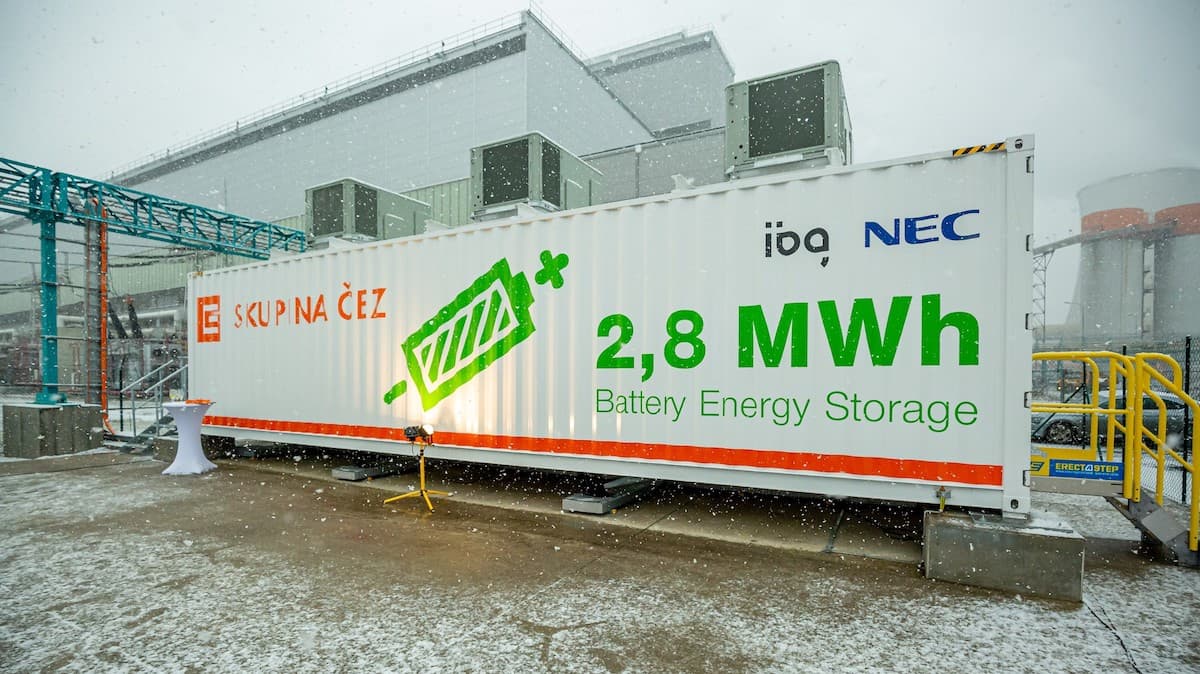
Battery at the Tušimice power plant, Source: ČEZ
The lack of legislation is a significant obstacle for investors. Since there is not yet even a draft of the legislation, they cannot be certain of the obligations that will be associated with operating storage in the future. It is therefore no surprise that only a handful of facilities have so far been built in the Czech Republic.
Storage as a type of energy-sector business activity was already envisaged in government documents in 2020, together with the activity of a flexibility aggregator. At least, this was envisaged by the policy outline for the Energy Act. However, there has been no significant progress since then: the regulation was last updated at the end of 2020, and a full draft legislative text has never been published.
The adoption of the necessary legislation is reportedly approaching, however. Although the Czech Republic is currently at least two years overdue in adopting the necessary legislation, the Ministry of Industry and Trade will reportedly begin preparing the amendment only after the so-called LEX OZE II is adopted.
The effects of the lack of storage in the Czech Republic are often visible. This year's Easter Monday is an example, when photovoltaic power plants had to be disconnected for the first time ever due to surplus capacity in the system, in the areas of two distribution systems. Approximately 400 MW of installed capacity was affected in total. Operators of plants affected by the disconnections will be compensated.
Translation disclaimer
This article is a machine translation of the Czech original and has not yet been fully reviewed. In case of any doubt, please refer to the Czech version.
Sdílejte článek prostřednictvím:
You might also like

24 September 2026, 11:23

24 September 2026, 10:30
24 September 2026, 06:56