22 September 2026, 14:20
Loading...
EUROSTAT: Energy poverty rises in Europe
Klára Čeperová
27 July 2023, 11:26
The energy crisis triggered by the war in Ukraine is taking its toll on citizens of EU countries. According to Eurostat, 9.3 % of the population was unable to keep their homes adequately warm in 2022, a sharp increase from 6.9 % in the previous year. Energy poverty also affects Czechia.
Low-income households, single-parent families, immigrants, people with disabilities and seniors all face a statistically higher risk of suffering from energy poverty. In the European context, young people and women are also more likely to be exposed to the phenomenon.
Energy poverty in Europe is increasing in connection with the sharp rise in energy prices, the European Economic and Social Committee (EESC) stressed at its third annual conference on the subject, held last Wednesday, according to Euractiv.
Measures introduced during the crisis have failed to address the problem, which has been further exacerbated by Russia's war in Ukraine, said the EESC, an EU body bringing together civil society organisations, employer groups and trade unions.
The European Commission's REPowerEU plan, presented last May, was intended to protect households from energy shortages and successfully reduce Europe's dependence on Russian energy commodities, particularly natural gas.
However, problems in bringing down prices persist, said Adéla Tesařová, a senior official from the European Commission's energy department, speaking at the EESC event. Household electricity prices are falling, but given their level, there remains considerable scope for further declines; see current electricity supplier offers.
According to Tesařová, who heads a dedicated unit dealing with energy consumers and issues surrounding the fair transition of the European economy, more measures are needed on energy efficiency and consumer empowerment.
The Czech dimension
Countries typically struggling with energy poverty include Bulgaria and Portugal. However, in a 2022 factsheet, the Association for International Affairs stated that around 300,000 people in Czechia suffer from energy poverty, equivalent to 2.7 percent of the population. This represents the share of respondents in the EU-SILC survey who answered no when asked whether they could afford to heat their home adequately. The share of such people is higher across the EU as a whole.
However, there are many more indicators by which energy poverty can be identified. The range of households facing energy poverty in Czechia is somewhere between 2 and 25 %. The variation is caused by the differing severity of cases.
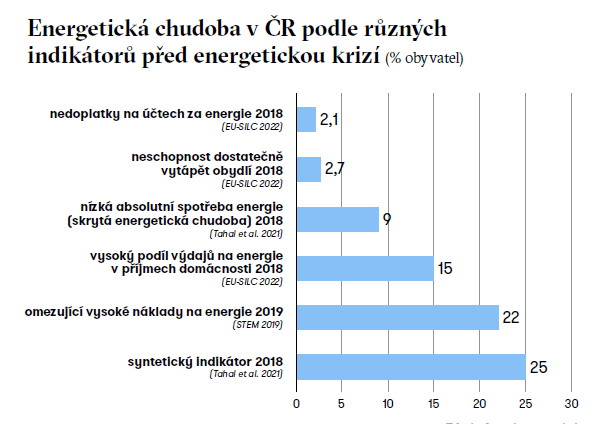
Energy poverty in Czechia. Source: AMO
High energy bills? Insulate
Good insulation is key to keeping homes warm in winter and protecting consumers from rising energy bills, but the renovation rate in Europe is currently too low to make a substantial difference.
European consumer organisation BEUC argues that increasing the renovation rate must remain a key objective of the ongoing revision of the Energy Performance of Buildings Directive, with high ambition for minimum energy performance standards.
According to Massimiliano Mascherini of the European Foundation for the Improvement of Living and Working Conditions (Eurofound), an EU agency, communication also needs to be improved and awareness of the benefits of renovations increased. However, renovations are primarily a way to prevent energy poverty. For those already living in it, the situation is far more complicated.
Who is affected by energy poverty?
For example, research conducted in the Czech context shows that, even before the energy crisis, energy poverty most often affected pensioners and people in low-income groups.
Research conducted by the Friends of the Earth Czech Republic, the University of Ostrava and the Housing Initiative shows that almost half of people suffering from energy poverty live in rented accommodation.
The study's lead author, Jan Klusáček, sees two reasons for this.
"There are two explanations concerning people in rented housing. It may surprise many people that the energy performance of this housing is genuinely very poor. Rental flats are in buildings that are mostly not insulated, meaning their energy consumption is genuinely high. The second point is that these people have lower incomes, so their energy bill takes up a large part of their budget in relation to their low income. It is therefore genuinely a case of poverty,"he explained to Radiožurnál late last year.
Mascherini similarly commented on the situation, noting that sustainable housing is essential to meeting the EU's climate targets, but measures adopted at EU and national level should prevent inequalities from deepening.
Kieran Pradeep, coordinator of the Right to Energy coalition, also commented on the issue, warning that "energy poverty is a structural and systemic problem requiring political decisions".
Secondary impacts
According to speakers at the EESC conference, transport poverty – the lack of access to affordable public or private transport – is also emerging as a side effect of the energy crisis. The issue made headlines in 2018 during the "yellow vest" protests in France, which were triggered by rising fuel prices.
Lack of access to affordable public transport can worsen quality of life, said Mari Martiskainen, a professor at the University of Sussex Business School.
Andrés Barceló Delgado, chair of the EESC's permanent energy group, stressed that "decision-makers should take into account the fact that energy is a public service, and the upcoming reform of the electricity market design must, on the one hand, guarantee sustainable and reliable supplies and, on the other, citizens' right to energy".
Translation disclaimer
This article is a machine translation of the Czech original and has not yet been fully reviewed. In case of any doubt, please refer to the Czech version.
Sdílejte článek prostřednictvím:
You might also like
22 September 2026, 12:50
22 September 2026, 06:09
21 September 2026, 15:25