
23 October 2026, 14:38
Loading...
New conditions for second hydrogen auction: more money, less China
Veronika Jurcová
13 November 2024, 11:04
European Commission President Ursula von der Leyen presented the terms of the second hydrogen auction at the Renewable Hydrogen Summit in Brussels on 7 November. The auction will take place on 3 December 2024. Compared with the first auction, the funding allocation has increased from 800 million to 1.2 billion EUR and the requirements have been refined, including a higher level of project maturity, a revised price cap and 200 million EUR earmarked for projects in the maritime sector. The share of Chinese technologies has also been capped at a maximum of 25 % of electrolyser capacity, which is intended to support European technology manufacturers, reportsthe website H2 view.
The auction, the European Hydrogen Bank’s (EHB) main instrument, will provide financial support to producers of hydrogen that meets the criteria for renewable fuels of non-biological origin (RFNBO). It is scheduled to open on 3 December 2024, with an allocation of up to 1.2 billion EUR – 1 billion for renewable hydrogen production projects and 200 million for projects with offtakers in maritime transport. The support has increased by 400 million EUR compared with the pilot auction.
The Commission published the terms and timetable on 27 September. Drawing on experience from the pilot auction, it added new requirements for resilience, security, cybersecurity and support for European industrial leadership, helping to advance the objectives of the Net-Zero Industry Act.
Winning bidders will receive a fixed premium in EUR per kilogram of renewable hydrogen produced for ten years. The auction is funded from the European Emissions Trading System through the Innovation Fund and aims to cover the gap between production costs and the price that offtakers are willing to pay for renewable hydrogen.
Pilot auction
More than 132 projects applied for the first auction, but only seven were selected. Over ten years, they are expected to produce up to 1.58 million tonnes of renewable hydrogen, with a total electrolysis capacity of 1.48 GW. The winning projects received subsidies of between 0.37 and 0.48 EUR per kilogram of hydrogen, with total support ranging from 8 to 245 million EUR. The pilot auction thus awarded a total of 720 million EUR.
The auction also highlighted differences in hydrogen production costs per kilogram across European countries: projects in Sweden, Greece and Spain have the lowest costs (approximately 5–6 EUR/kg), while those in Germany, Austria and Denmark have the highest (11–13.50 EUR/kg). These differences are driven by local conditions, the amount of installed renewable energy capacity and the number of hours with negative electricity prices. Project size, in terms of economies of scale, is also a factor.
Second hydrogen auction: support for European companies
The terms of the second auction include new resilience requirements, under which projects will be assessed against the criterion of "ensuring the security of supply of critical raw materials and strengthening the leadership and competitiveness of European industry". The Commission is also introducing specific security and cybersecurity requirements to support secure production processes in Europe.
The maximum possible operating subsidy has also been adjusted and reduced to 4 EUR per kilogram of hydrogen, payable over 10 years. A new restriction for renewable hydrogen producers limits the share of electrolysis capacity that can use Chinese technologies to 25 %.
European Commission President Ursula von der Leyen also emphasised this at the Renewable Hydrogen Summit in Brussels on 7 November.
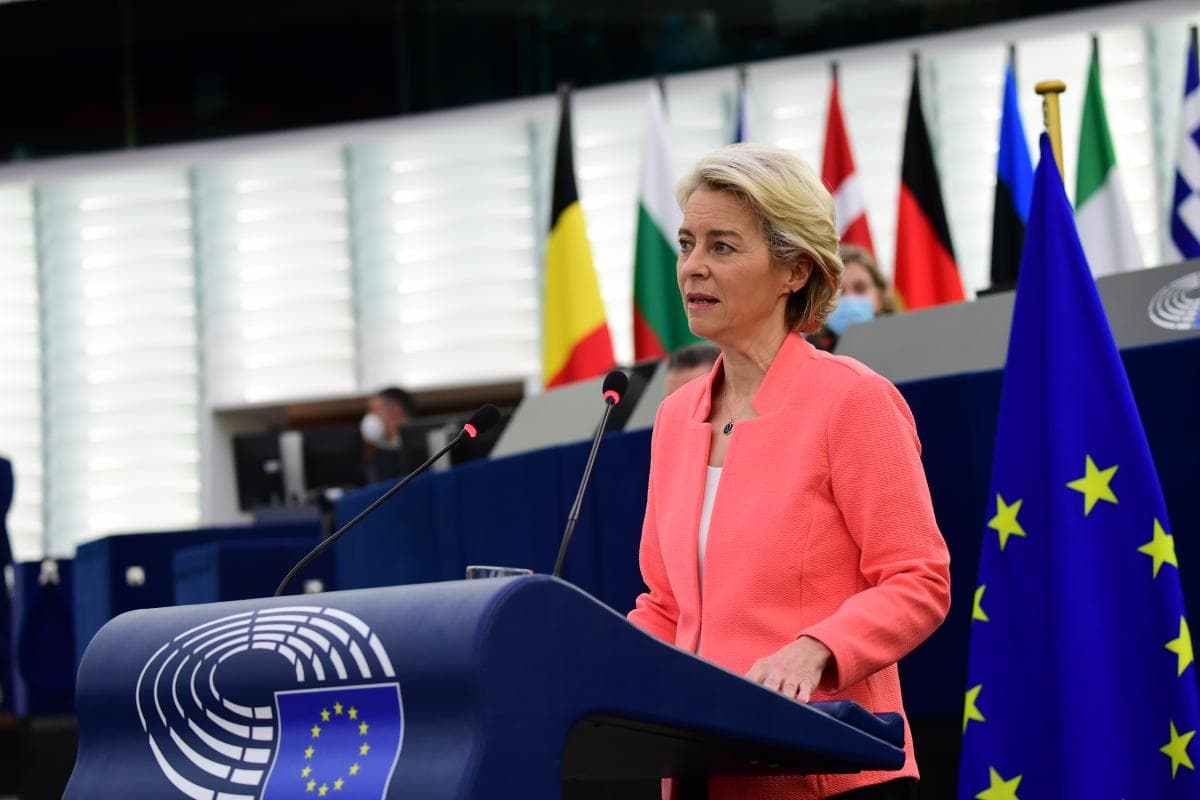
Ursula von der Leyen. Source: European Commission
"Because these are the same innovators who pioneered renewable hydrogen technology. This ensures Europe’s energy independence and creates good jobs here in Europe," von der Leyen said.
The Commission president also expects investment in Europe’s hydrogen sector to rise by 140 % in 2024, with Europe accounting for almost a third of global investment in electrolysers. She said support for the sector is also key to the new Clean Industrial Deal being prepared by the Commission.
"It will be a key part of the Clean Industrial Deal that the new European Commission will present in its first 100 days. We want to prioritise the infrastructure needed to connect large-scale hydrogen projects with end users. We will harness Europe’s enormous renewable energy potential and bring it to our industries to help them decarbonise," von der Leyen said.
Hydrogen development would lower not only the prices of clean steel, cement, fuel and plastics, but also those of fertilisers, glass and a range of other hard-to-decarbonise sectors. The competitive benefits for European industry could be enormous.
Involvement of Czech projects
The Czech Hydrogen Technology Platform HYTEP does not expect Czech projects to be interested in participating in the auction, particularly because it is aimed primarily at achieving the lowest possible subsidy requirement. HYTEP considers the current auction system unsuitable for Czechia, even if the "auction as a service" model were used, under which a member state would fund from its own resources projects that failed to secure support. This is due to strict conditions that, among other things, limit a member state to receiving a maximum of three times the price awarded to successful projects.
However, if the rules were changed to allow member states to receive the full amount of support, up to 4 EUR per kilogram, the Hydrogen Bank would become a suitable support instrument, particularly thanks to the swift access to the auction.
Translation disclaimer
This article is a machine translation of the Czech original and has not yet been fully reviewed. In case of any doubt, please refer to the Czech version.
Sdílejte článek prostřednictvím:
You might also like


23 October 2026, 11:01


23 October 2026, 06:34