12 October 2026, 10:27
Loading...
South Korean Saeul 3 reactor receives operating licence, commercial operation set to begin in August

Jiří Puchnar
12 January 2026, 10:38
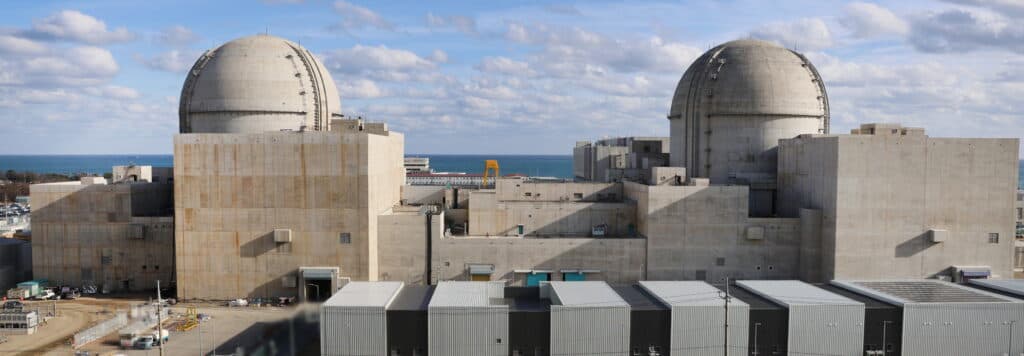
South Korea’s Nuclear Safety and Security Commission (NSSC) has issued an operating licence for Unit 3 of the Saeul nuclear power plant, previously known as Shin Kori 5. It is an APR1400 pressurised water reactor with an installed capacity of 1 400 MWe and a design life of 60 years.
Korea Hydro & Nuclear Power (KHNP) said it now plans to begin loading nuclear fuel into the reactor core. This will be followed by around eight months of testing, including a gradual increase in power, with the aim of starting commercial operation of the unit in August.
KHNP received the initial construction permit for the unit in 2016 and subsequently began construction. The company applied for an operating licence in August 2020.
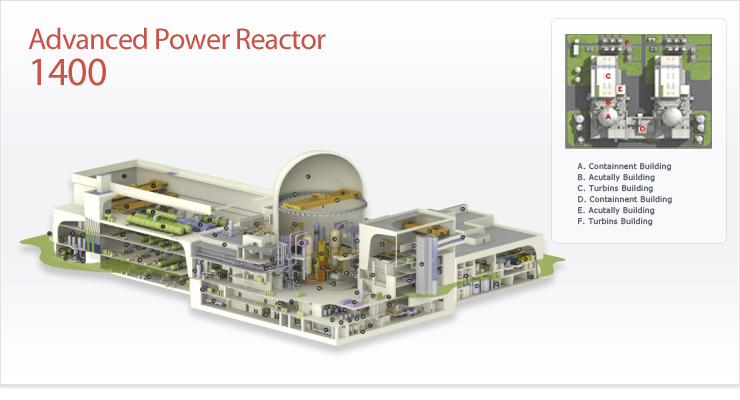
APR-1400 reactor design. Source: KHNP
The project’s progress was affected by South Korea’s earlier policy of gradually moving away from nuclear power.
In 2022, KHNP announced that Units 3–6 of the Shin Kori plant in Busan (in the country’s southeast) would be renamed Saeul 1–4. The names Shin Kori 1 and 2, the two units with OPR-1000 reactors that entered service in 2011 and 2012, respectively, remained unchanged.
Safety as one of the main criteria
KHNP acting president and CEO Jeon Dae-wook said the company would conduct commissioning tests and inspections rigorously, prioritising safety and quality assurance.
NSSC Chairman Choi Won-ho added that Saeul 3’s safety had been thoroughly verified in accordance with legal procedures and on the basis of scientific and technical evidence. He also said safety would continue to be examined in detail during pre-operational inspections carried out during fuel loading and commissioning after the licence was issued.
The new unit incorporates a range of enhanced safety features, including:
- Reinforced structures: reactor building walls have been strengthened by 15 cm and the walls of auxiliary buildings thickened by 30 cm to increase resistance to external events, including an aircraft impact.
- Additional earthquake protection and improved preparedness for loss of off-site power, including backup generators.
- Increased spent fuel storage capacity, designed to meet the unit’s entire 60-year design life.
Industrial and regional impacts
KHNP said around 760 companies were involved in the construction of Saeul 3. According to the company, the project created jobs and supported activity in related sectors, particularly equipment manufacturing, construction and maintenance. KHNP also expects direct and indirect job creation throughout the unit’s operating life.
Once it enters commercial operation, the unit is expected to account for approximately 1.7 % of South Korea’s total electricity generation and around 37 % of electricity consumption in the city of Ulsan.
South Korea and APR1400 reactor exports
South Korea is one of the world’s leading nuclear power countries. It operates 26 power reactors, which account for around one-third of the country’s electricity generation. Nuclear power is viewed as a strategic priority in Korea, and the nuclear phase-out policy introduced after President Moon Jae-in was elected in 2017 was reversed in 2022 by incoming President Yoon Suk-yeol.
Four APR1400 units are currently operating in Korea: Saeul 1 and 2 (formerly Shin Kori 3 and 4) and Shin Hanul 1 and 2. Three APR1400 reactor units, Saeul 3 and 4 and Shin Hanul 3, are at various stages of construction. Four APR1400 units have also been built at the Barakah nuclear power plant in the United Arab Emirates, and all are in commercial operation.
Translation disclaimer
This article is a machine translation of the Czech original and has not yet been fully reviewed. In case of any doubt, please refer to the Czech version.
Sdílejte článek prostřednictvím:
You might also like

12 October 2026, 07:40

11 October 2026, 20:09

11 October 2026, 08:24