23 October 2026, 14:38
Loading...
Nuclear energy in 2025, part 1: Nuclear renaissance begins in Europe and the US
Vladimír Wagner
10 January 2026, 07:47
This year has seen a number of key breakthroughs. In China, the first conventional small modular reactor, ACP100, is nearing completion, while a test reactor with liquid fuel has for the first time implemented the thorium-uranium cycle. In Canada, construction has begun on the first Western small modular reactor, BWRX300. The pace of nuclear energy development is accelerating worldwide. In Europe, this is so far predominantly in the area of preparatory work, but nuclear units are being built intensively in Asia. Annual nuclear electricity generation in 2024 surpassed the previous record level from 2006.
European energy systems are increasingly showing the problems caused by their ideological shaping. Huge surpluses of generation, and conversely dramatic shortages, arising unpredictably due to changes in weather, have a very strong impact not only on electricity prices but also on the security of supply. A dramatic illustration of the negative effects of promoting the dominance of uncontrollable renewable sources and shutting down stable, weather-independent power plants was seen in the blackout in Spain and in Czechia. The precise causes can be debated, but the very strong influence of the surplus and dominance of renewable sources, intensive cross-border flows of their electricity, and the lack of stable inertia-providing sources at the time is indisputable.
It can also be seen that countries using a combination of nuclear and renewable sources, such as France, Sweden, Switzerland and Slovakia, bring stability to Europe’s energy system, while countries relying purely on renewables, such as Germany or Denmark, bring extreme instability. The transition to electric mobility, let alone the production of green hydrogen, has failed to meet expectations. It is therefore not contributing to electricity demand growth as strongly as expected. However, the unforeseen development of artificial intelligence and internet traffic is instead leading to rapidly growing electricity consumption in data centres.
Growing demand for stable energy sources is contributing to rising demand for nuclear energy. The nuclear renaissance is already under way intensively in Asia, but a change in attitudes towards nuclear power can also be seen in Europe and the US. This year clearly demonstrates these trends, which we will analyse in detail. A very important step was the World Bank’s decision to lift its longstanding ban on financing projects related to nuclear energy. First, however, let us look at the overall statistics and then at details of the development of nuclear power around the world last year.

In 2025, the Doel 1 and 2 reactors were shut down after fifty years of operation (source: Engie Electrabel).
Statistical overview
The current overview of nuclear energy developments over the past year is the seventeenth in the series and follows articles from previous years. The latest set of overviews is from 2024 (part 1, part 2, part 3 and part 4). At the beginning of December 2024, there were 441 reactors with a capacity of 399 GWe, and at the beginning of December 2025, 438 with a capacity of 397 GWe (data from the World Nuclear Association and the PRIS database). There are 72 units with a capacity of 79 GWe under construction. At the end of 2025, eight more reactors were under construction than a year earlier, which is a very positive trend.
A total of five nuclear units were shut down during 2025. The shutdown of Canada’s Pickering 4 reactor on 2 January 2025, following Pickering 1, was already covered in the previous overview. Canada is refurbishing most of its CANDU heavy-water reactors, although it has shut down some of them.
In mid-February 2025, Belgium’s oldest reactor, Doel 1, was shut down after fifty years of operation. Its twin, Doel 2, was shut down at the end of November. Tihange 1 stopped generating electricity as early as 30 September. Belgium is thus left with only Doel 4 and Tihange 3 in operation. These were also due to be shut down this year. However, given the situation in Europe’s energy system, it was decided to extend their operation by another ten years, until 2035. Belgium is also considering building new nuclear reactors.
The final reactor shut down in 2025 was Taiwan’s Ma-an-shan (Maansham) 2, which had supplied electricity for forty years. Taiwan thus completed its withdrawal from nuclear energy on 17 May. The previous overview already noted that Taiwan might change its attitude to nuclear power. The reason is its extreme dependence on imports of coal and other fossil fuels, which makes Taiwan vulnerable to a naval blockade. The government therefore commissioned a study into which nuclear power plants could be restarted. It found that this was no longer possible at the oldest plant, Chinshan. Its two units were shut down more than five years ago and decommissioning has already advanced significantly. By contrast, it is possible to restore operation at the two other two-unit plants, Kuosheng and Ma-an-shan. A final decision could be made in 2026.
During December 2025, three reactors at the Bilibino plant in Chukotka were shut down. These are very specific water-cooled, graphite-moderated EGP-6 reactors with a capacity of 12 MWe. Of the plant’s four reactors, the first was shut down in 2018. The remaining three were shut down in December 2025. This plant was fully replaced by the floating nuclear power plant Akademik Lomonosov. The plant operated for 50 years in the permafrost region. However, this shutdown will be included only in the statistics for the next overview.
Only two reactors entered operation in 2025. In India, Rajasthan 7 began operating in March, although its fission chain reaction had already started in September of the previous year. It is a domestic IPHWR-700 heavy-water reactor. This is already the third unit of this type to be commissioned. Rajasthan 8 is expected to enter operation in 2026.
In China, towards the end of November, a Hualong One (HPR1000) reactor, the second unit of the Zhangzhou plant, began supplying electricity to the grid. It then entered commercial operation at the beginning of January 2026. The site is ultimately expected to host six such reactors. Official construction of the unit began in September 2020, so it was completed within five years.
At the end of 2025, a fission chain reaction began at the first VVER-TOI reactor of the second phase of the Kursk plant, and it supplied its first electricity on 31 December 2025. Its start-up will therefore also be included in the statistics of the next overview.
Construction began on ten reactors, considerably more than were commissioned in the previous year. The start of construction of Chashma 5 in Pakistan was already covered in the previous overview. It is a Chinese Hualong One reactor.
At the end of February, concrete was poured for the nuclear island of Lufeng 1. This is the Chinese version of the Westinghouse CAP1000 reactor. A total of four such units are planned there. Two Hualong One reactors are already under construction at the plant as units 5 and 6. At unit 5, the outer containment dome was installed at the end of October 2025. The inner containment dome was installed at unit 6 in July.
In mid-March, construction began on the fourth unit of the second phase of the Leningrad nuclear power plant. It is a VVER1200 reactor. Construction of the preceding unit began a year earlier. These units are expected to enter operation in 2030 and 2032.
At the beginning of May, construction started on the second unit of the Shidaowan plant. It is a Hualong One reactor.
On 20 May, concrete pouring began for the nuclear island of an APR1400 reactor, the third unit of South Korea’s Shin Hanul plant. Completion is expected in 2032.
In June 2025, concrete pouring began for the nuclear island of the third unit of the Taipingling plant, a Hualong One reactor.
In the first half of August, construction began on the first unit of the Jinqimen plant in Zhejiang province, where six Hualong One units are to be built gradually.
In September, concrete pouring began for the nuclear island of Zhangzhou 4, a Hualong One reactor.
In mid-November, official construction began on the third unit of the San’ao plant, a Hualong One (HPR1000) reactor. The site is ultimately expected to have six such units.
In mid-November, concrete pouring began for the first unit of the new Zhaoyuan plant in Shandong province. This site too is ultimately expected to host six Hualong One (HPR1000) reactors.
In mid-December, concrete pouring began for the nuclear island of Ningde 6, a Hualong One reactor. The year 2026 then got off to a brisk start. First concrete for the nuclear island was poured at the beginning of January for the first unit of the Bailong plant and the second unit of the Lufeng plant. These are CAP1000 reactors. However, these three units already fall into the statistics of the next overview.
Nuclear electricity generation reached 2 667 TWh in 2024. Compared with 2023, when 2 602 TWh was generated, it rose by 65 TWh. The longstanding record from 2006 was finally surpassed. The positive trend is continuing, driven in part by the resolution of problems in the French nuclear fleet, the gradual restoration of Japanese nuclear plants, and the commissioning of new Chinese nuclear power plants. It can be expected that the positive trend and record generation will continue in the coming years.
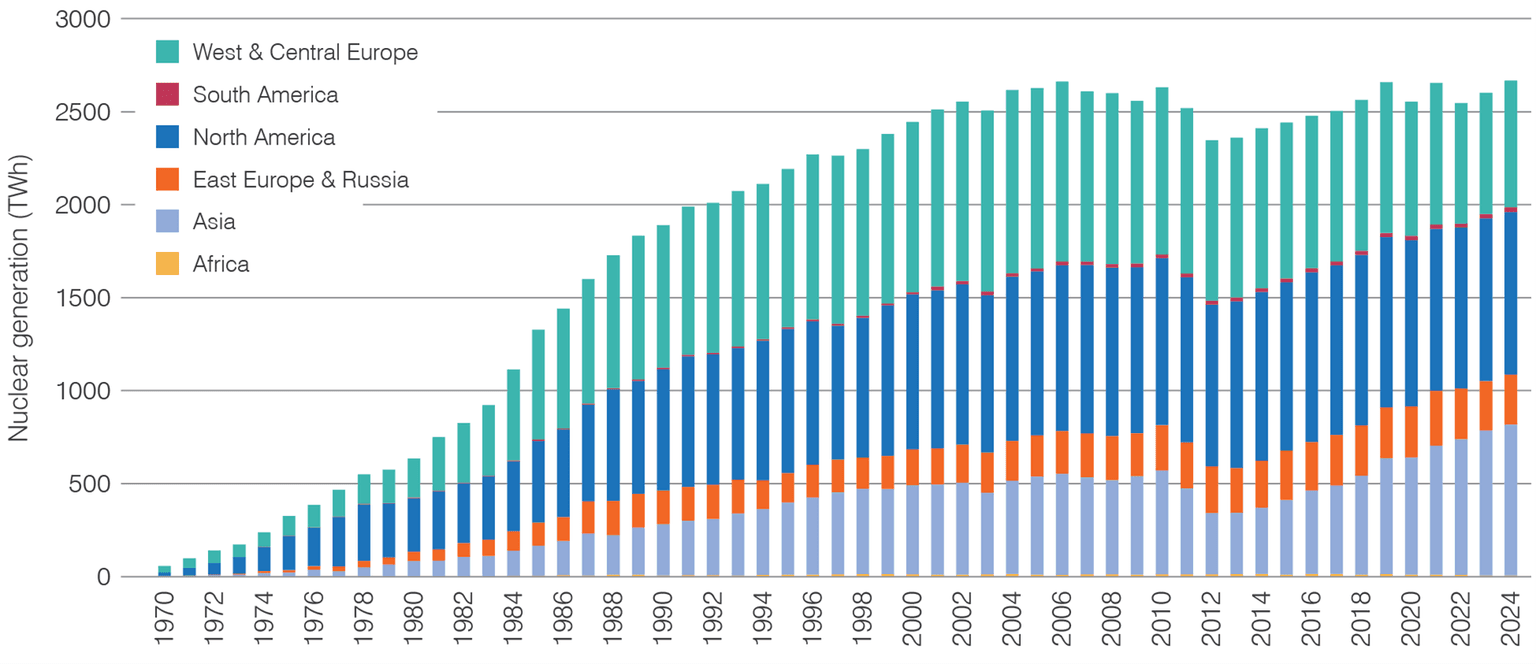
Development of electricity generation from nuclear sources. The year 2024 became a new record, finally exceeding the 2006 generation figure (source: WNA).
Czechia has chosen intensive nuclear energy development
In 2025, Czechia increased the share of nuclear generation by two percentage points to nearly 44 percent. This was helped by record output at the Temelín and Dukovany plants, among other factors due to fewer planned outages.
Czechia also wants to rely on nuclear energy in the future. It therefore needs to build new nuclear capacity. Following key decisions last year, work on implementing new nuclear sources in Czechia has begun in earnest. Two fundamental issues remaining from last year were resolved, concerning the construction of large reactors at Dukovany and the selection of a small modular reactor for Czechia.
Regarding the construction of new large reactors in Czechia, the conclusions I reached in the previous overview were confirmed: objections by EDF and Westinghouse would not prevent the successful launch of the project. On 7 May 2025, an interim measure by the Regional Court in Brno prevented the signing of the contract between ČEZ and KHNP. However, it was signed on 8 June immediately after the Supreme Administrative Court overturned that interim measure. In the end, the Regional Court in Brno dismissed all objections by EDF and Westinghouse against the Dukovany tender.
Timely signing of the contract was very important. Geological surveying of the construction site for the two new units was thus able to begin in 2025, involving 300 boreholes, some up to one hundred metres deep. Archaeological research is also under way, while roads and bridges are beginning to be upgraded to allow the transport of oversized loads, as are modifications to the Slavětice transformer substation and other grid works needed to evacuate power. The project is also being modified in view of the fact that the old and new Dukovany units will operate together for a relatively long time. It is therefore necessary to ensure sufficient cooling water. This will primarily be supported by savings achieved through the cooling system to be used for the new units.
A new administrative building began to be constructed at Dukovany as early as January 2025, and work on the necessary infrastructure, including transport infrastructure, started even before the contract was signed. The administrative building for nearly 200 employees should be completed by the end of 2026 and should also serve KHNP staff.
The ownership structure was adjusted and the Czech state now owns 80 % of EDU II. EU notification for the second Dukovany unit is being negotiated intensively. Contracts with future suppliers have also begun to be signed gradually. As early as 7 May, KHNP signed a number of agreements with Czech companies, including Škoda JS, ÚJV Řež, Metrostav, OSC, ZAT, Nuvia and I&C Energo. The turbine will be supplied by Plzeň-based Doosan Škoda Power, while Czech companies will deliver the entire turbine island. The company is now discussing possible supplies with more than 150 Czech firms. The number of project staff is growing on both the Korean and Czech sides. KHNP has begun training Czech employees of EDU II for APR1000 reactors.
At the beginning of December 2025, the Prague Municipal Court dismissed lawsuits by ESHG and the Děti Země association against the Ministry of Industry and Trade’s zoning decision for the new nuclear source at Dukovany. So far, everything is proceeding according to plan. Construction of the nuclear island is expected to start in 2029 and the first unit should begin operation in 2036.
The second key decision was made in the United Kingdom. There, Rolls-Royce SMR was selected in June 2025 as a key supplier of small modular reactors. At the end of the year, it was also decided that the first three units would be built at the prepared nuclear site of the Wylfa plant. Their number there could later increase to as many as eight. Rolls-Royce selected Siemens Energy’s UK subsidiary as turbine supplier for the first units. The reactor’s three steam generators will be developed and prepared by BWXT.
ČEZ was therefore able to fully enter the company and increase its stake to the planned 20 %. In August 2025, Škoda JS signed a memorandum of cooperation with Rolls-Royce SMR on preparing the manufacture of components for the Rolls-Royce reactor fleet. More and more Czech companies, research institutions and universities are joining cooperation on the project.
The first Rolls-Royce reactor in Czechia will be built at Temelín and could enter operation as early as 2034. In 2025, additional geological boreholes to depths of 50 to 200 m were drilled at the future site. They supplement data obtained during geological surveys before construction of the current Temelín units.
Another site for these reactors should be the existing Tušimice coal-fired power plant, which should operate until 2030. After the site is converted for nuclear use, construction of the first reactor should begin there, with operation commencing in 2038. Two further units could be completed in 2042. By 2050, seven such reactors could be operating at ČEZ facilities.
A number of other sites where these reactors could appear are also being considered. In addition to the existing coal-fired plants at Dětmarovice, Počerady, Prunéřov, Ledvice and Mělník, these could include industrial sites requiring stable supplies of relatively high output. These include, for example, SUAS Group at Vřesová, or Orlen Unipetrol and Synthos. The latter two companies are Polish-owned and plan to use BWRX-300 reactors.
Work is under way to improve the existing Dukovany units. Their output is also being gradually increased. Overall, they now deliver 300 MW more than at the beginning of their operation. They should remain in service for up to 70 years. Securing fuel is important for their long-term operation.
The first fuel assemblies from Westinghouse for both the Temelín and Dukovany plants arrived in Czechia in 2025. In the following year, France’s Framatome should also deliver fuel assemblies for Temelín. The new fuel must meet the strictest safety requirements. Acceptance was therefore preceded by five years of analyses and testing. Assemblies from the new supplier meet the requirements for longer fuel cycles. These will now last 16 months at Dukovany and 18 months at Temelín. According to ČEZ estimates, this should increase average annual nuclear generation after 2030 from the current roughly 30 TWh to 32 TWh. Westinghouse will also supply fuel for VVER440 units to Hungary’s Paks plant.
Rising demand for Western nuclear fuel not only in Czechia but across Europe has led Urenco to expand its uranium enrichment plant at Almelo in the Netherlands. Urenco is now also expanding capacity at Eunice in the US and Gronau in Germany. Overall, it aims to increase production by almost 15 %.
An important step towards implementing a deep geological repository was the rejection of appeals by municipalities from the Březový potok site in the Klatovy region and Janoch near Temelín against the designation of exploration work. In my expert opinion, it would not be necessary to build this repository for many decades yet, but since anti-nuclear activists pushed this requirement into the European notification, the state must address it.
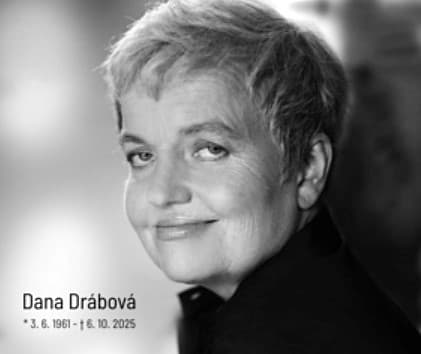
Dana Drábová will remain with us not only in our memories
Dana Drábová has left us
In 2025, Dana Drábová, the long-serving chair of the State Office for Nuclear Safety (SÚJB), died. She had led the authority since 1999. She was a very strong and independent personality, with immense authority among both experts and the public. She gained it not only through her broad knowledge, but above all through critical perspective and respect for reality in a field that is often highly controversial.
She was born in 1961. She chose to study at the Faculty of Nuclear Sciences and Physical Engineering of the Czech Technical University. She gradually earned enormous respect even among politicians, including those with a rather negative attitude towards nuclear technologies. Under her leadership, SÚJB became a truly independent guarantor of the safety of nuclear technology use and work in radioactive environments in Czechia. Her perspective was never one-sided, and she always presented both positives and negatives. She was able to explain even highly complex technical issues to the general public. Her distinctive voice and manner of presentation will never disappear from my memories and will always inspire me.
I met her at a number of professional events and public meetings where issues related not only to nuclear energy were explained. We attended many final examinations together, where I admired her human approach to students. I will always remember her annual participation in the Summer School of Nuclear Engineering, organised for many years by colleagues from the Czech Technical University in Prague and Brno University of Technology. She always gave the opening lecture there. She arrived early in the morning and had arranged pickled fish and a small beer for breakfast. It was wonderful to watch the amazement and respect with which students arriving for breakfast gradually observed her. I wrote a longer tribute on our institute’s website.
As a proper senior manager, Dana Drábová sought to train her successors with the necessary professional and managerial background. A sound technical foundation is crucial for the position of SÚJB chair. I was therefore unpleasantly surprised when the new government cancelled the ongoing tender for the role and reduced the expertise requirements in the newly announced one. I sincerely hope this is not because it already has a chosen political nominee it wants to install. Turning this post into a purely political position, in which people would rotate according to election results, would in my view have catastrophic consequences. It is clear that when Dana Drábová was appointed, it was by no means certain that she would become such a respected figure. However, a purely political nominee will have an extremely difficult, if not impossible, path to gaining the respect of the authority’s employees and both the expert and general public.
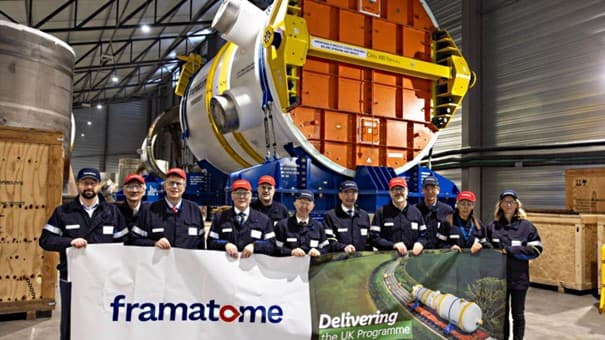
Reactor vessel for the second unit of the Hinkley Point C plant (source: EDF).
Changes in attitudes towards nuclear power are accelerating in the European Union
Belgium has abandoned its nuclear phase-out, while Denmark and Norway, for example, are considering the possibility of using nuclear sources. The Italian government has embarked on a path that would enable the use of nuclear energy. Completion of the legislative changes should take place in 2027. This is critically important for Italy because gas-fired sources provide more than 40 % of its electricity generation. At the same time, it is critically dependent on electricity imports, mainly from French nuclear power plants. Following the blackout, Spain is also considering reversing its nuclear phase-out. The country has seven reactors, which it intended to shut down gradually by 2035. As part of the change in approach, an application was submitted to extend the operation of two units at the Almaraz plant by three years. The plant could thus operate at least until 2030. Although the plant has a licence from the nuclear safety authority until 2030, Spain’s approved nuclear phase-out rules require it to close in 2027.
Even Norway is preparing nuclear construction. It wants to build a plant with a total capacity of 1,5 GWe comprising several small modular reactors in the Taftøy industrial park on the border of the Aure and Heim municipalities in the south-western part of the country. Rolls-Royce reactors are being considered, as are Korean i-SMRs.
Germany is also changing its view of the importance of nuclear energy. This particularly concerns Bavaria, whose energy system had a high share of nuclear sources. It is probably not possible to expect new nuclear reactors to be built in Germany. However, Bavaria’s neighbour is Czechia, where nuclear sources are planned. Bavaria and Czechia could thus complement each other. This could lead to Germany not protesting against the construction and use of nuclear reactors in Czechia.
Slovakia is doing very well on its path towards low-emission electricity generation. At Czechia’s eastern neighbour, the fourth unit of the Mochovce plant is nearing completion. At the end of March 2025, hot hydrostatic tests of this VVER 440 reactor began after cold tests were completed. The Slovak government also approved an intergovernmental agreement with the United States on the construction of AP1000 units at Jaslovské Bohunice.
France can once again rely on nuclear sources in its energy system. These are to a significant degree saving Europe’s energy system; in Italy’s case, this applies literally. However, existing problems, particularly in the construction of new reactors, still cannot be overcome. The previous overview covered the start-up of Flamanville 3 at the end of 2024. Its output was gradually increased. However, a number of delays occurred during various tests, and it only reached 100 % of nominal capacity at the end of 2025. The tribulations of the first EPR units are finally drawing to a close, with Flamanville 3 following Olkiluoto 3.
What is important is how lessons will be learned from previous projects and how construction of further reactors of this type will proceed. In this respect, the implementation of the two EPR units at Hinkley Point C is sending mixed signals. Construction is progressing relatively well, but delays are growing and the current commissioning date is 2030. Costs are also continuing to rise, not only because of the aforementioned delays.
In July 2025, steam generators began to be installed gradually at the first unit. In July 2025, a large gantry crane was placed inside the containment of the second unit, to be used for installing heavy components and later for fuel loading. Subsequently, the world’s largest crane, Big Carl, placed the containment dome’s 245-tonne internal structure at the top of the containment, while installation of the external structure was completed at the end of November 2025. By the end of 2025, the reactor vessel for this unit had been assembled. Two of the four required steam generators for this second unit have also been completed. To bring the operation of existing AGR nuclear reactors as close as possible to the commissioning of the new units, the operation of Heysham 1 and Hartlepool was extended by one year, until 2028.
The Sizewell C project is also expected to comprise two EPR units. In preparing them, EDF wants to avoid the uncertainties that occurred in previous projects. Efforts are therefore being made, based on all previous experience, to draw up the most accurate possible estimate of financing and timelines in order to avoid delays and cost increases. The project reached a key moment in 2025. It was given the green light, its financing model was developed, the necessary funding of £38 billion was secured, and it is moving into the implementation stage.
The model used may serve as an example for attracting private investors. The state remains the largest shareholder with a 44,9 % stake, but the project’s other shareholders will be Canadian pension fund La Caisse, UK energy company Centrica, French power group EDF and UK infrastructure investment company Amber Infrastructure. Supplier chains are being established in parallel. Suppliers of turbines and turbine islands, as well as fuel, have already been contracted. Initial site preparation and construction work began as early as January 2024, and so far everything is proceeding according to plan.
Construction of six EPR reactors is still being considered at Jaitapur in India. With a capacity of 9,6 GWe, it would be the world’s largest nuclear power plant. We will see whether concrete steps on this project are taken in the coming years.
France itself needs to address two basic key challenges. The first is extending the safe operation of existing units for further decades. An important step in 2025 was the decision by the French nuclear safety authority ASNR that 1300 MWe reactors can also operate for more than 40 years. The decision followed authorisation for operation beyond 40 years for older 900 MWe reactors.
The second challenge is finalising the EPR2 project, a version of the EPR reactor intended for domestic construction. The first phase plans to build six reactors in pairs at the Penly, Gravelines and Bugey plants, followed later by another eight units. A decision on financing the first six EPR2 reactors should be made in 2026, while construction of the first should begin in 2027. Completion of the first unit at Penly is expected in 2035. However, detailed finalisation of the project and an accurate cost estimate are still lacking.
Among the few reactors currently under construction are two VVER1200 reactors in the second phase of the Paks plant. There was a further delay there. First concrete for the nuclear island of the first unit will therefore only be poured in 2026. On 30 January 2025, two corners of one part of the excavation collapsed. Work therefore had to be suspended to investigate the effects of the event. The nuclear safety authority authorised the resumption of earthworks in the second half of June. Measures were also implemented to reinforce unstable parts. At the end of the year, a permit was issued to begin construction of the nuclear island, with concrete pouring planned for February 2026. Manufacture of the reactor vessel for the plant’s second unit began in April 2025, while core catchers have already been manufactured. The core catcher for the first unit is already at the construction site. In France, production of the Arabelle turbine for the first unit has begun. Siemens will supply the control system, and other supplies will come from a number of European countries.
At the end of 2025, the European Commission approved support for financing the construction of Poland’s first nuclear power plant. This was another key step towards implementing three AP1000 units on the Baltic coast near Lubiatowo-Kopalino. As in the case of the Czech notification for the first new reactor at Dukovany, Poland agreed to reduce the duration of price guarantees from 60 to 40 years and to place 70 % of production on the public market, or energy exchange. Permission was also issued for site preparation work, including land modification and archaeological research.
Financing is also being clarified for Poland’s second nuclear power plant, which will have two Korean APR1400 units.
In Bulgaria, an application for a permit to site the second new unit at the Kozloduy plant was submitted in February 2025. A total of two AP1000 reactors are to be built there. Both units are planned to enter operation between 2035 and 2037.
Romania is working on the refurbishment of the first heavy-water unit at the Cernavodă plant and is also preparing completion of the third and fourth units, which could begin operation in 2030 and 2031.
Slovenia is continuing work on expanding the Krško plant. Geological and environmental assessments of the site are under way. An EPR or AP1000 unit is being considered.
The Netherlands wants to operate its only nuclear power plant, Borssele, with its single 515 MWe pressurised water reactor for more than 60 years, meaning beyond 2033 and until 2053. It also wants to build two new large units at the same site, choosing between the EPR, AP1000 and APR1400. It is also considering small modular reactors for other sites.
It is clear that preparations for construction of new units in Europe are gathering pace, and the 2030s could be very busy here as well.
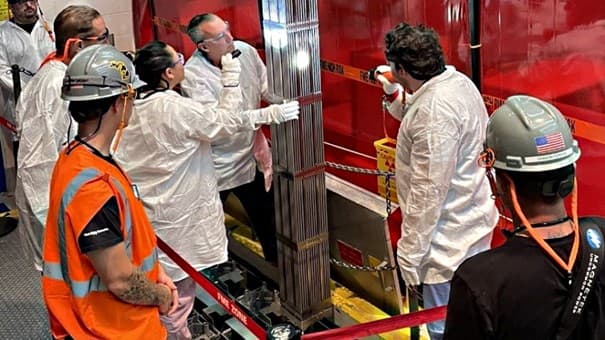
Fuel was delivered for the restart of the Palisades plant (source: Holtec)
Artificial intelligence is making nuclear energy necessary in the US
Energy sector developments in the United States are being significantly influenced by the development of artificial intelligence. The required high-capacity server farms need stable supplies of large amounts of power. An increasing number of nuclear facilities are therefore receiving licences for 80 years of operation. In March, the Oconee plant received such a licence. It has three pressurised water reactors with a total electrical capacity exceeding 2500 MWe, which entered operation in 1973 and 1974. In June, V.C. Summer 1 received an 80-year operating licence. Point Beach 1 and 2, which entered operation in 1970 and 1973, have also held this licence since September. In mid-December, the three boiling-water units at Browns Ferry received it, enabling them to operate until 2053 to 2056. At the end of 2025, Dresden 2 and 3 in Illinois received such licences, and should therefore operate until 2049 and 2051.
In the United States, a new reactor receives an operating licence for forty years and then applies each time for a further twenty years of operation. In 2025, a total of thirteen reactors applied to the US nuclear safety authority NRA for licences for another twenty years of operation, meaning total operating periods of sixty or eighty years.
Holtec’s work to restore operation at the Palisades plant in Michigan is continuing. The facility underwent a full refurbishment, including turbine tuning. In August 2025, its status was also changed from a plant under decommissioning to an operating facility. In October, 68 fresh fuel assemblies were delivered to the site. Everything is heading towards restarting the plant. For now, the plant will have its existing operating licence until 2031. In 2026, Holtec plans to apply for a further 20-year licence, until 2051, meaning a total operating life of 80 years.
Work is also accelerating on restarting the first unit of the Three Mile Island plant. It could return to operation a year earlier than expected, in 2027. This is because reconnection to the electricity grid, enabling power export, has been accelerated.
The 615 MWe Duane Arnold nuclear power plant in Iowa could also restart in 2028. Its sole boiling-water reactor entered operation in 1974. NextEra Energy is working on its refurbishment. In this case, new cooling towers need to be built.
Completion of the unfinished V.C. Summer nuclear power plant is again being considered. The site is currently owned by Santee Cooper, which is beginning preparations for its possible completion. In 2026, a completion plan, the costs of its implementation and the schedule should be presented. This also corresponds with the US government’s effort to support the construction of AP1000 units in the United States as part of the nuclear renaissance. Westinghouse expects construction to begin on ten units by 2030. Georgia Power, which operates the Vogtle nuclear power plant, is also considering new nuclear reactors. Fermi America also plans to build four AP1000 units in Carson County, Texas. The company plans to build one of the largest energy hubs to supply AI-related computing centres.
Construction of AP1000 units is also being considered in the Canadian province of Alberta. Canada plans relatively broad cooperation with Westinghouse on the use of its AP1000 design and the planned AP300 small modular reactor.
Canada is refurbishing its CANDU heavy-water reactors. In 2025, work was carried out on the third, fourth and fifth units at Bruce and Darlington 4. In November, the refurbishment of Pickering B, with four reactors, was approved and should begin in 2026. Refurbishment will extend reactor lifetime by 30 to 35 years. An important role of heavy-water reactors is also the production of cobalt-60 and other radionuclides. In Alberta, which currently has no nuclear power plants, construction is being prepared for two to four new CANDU Monark heavy-water units. Energy Alberta is working on the project in the Peace River area of northern Alberta.
Ontario plans to expand the Bruce plant with the four-large-unit Bruce C phase and build a new nuclear power plant at Wesleyville, Port Hope. The nuclear renaissance is therefore also being prepared on the North American continent.
Lecture for Dominikánská 8 on the current state of nuclear energy:
https://www.youtube.com/watch?v=IbmlYKj382I
Thoughts on how to use nuclear energy and survive in the shadow of nuclear weapons:
Translation disclaimer
This article is a machine translation of the Czech original and has not yet been fully reviewed. In case of any doubt, please refer to the Czech version.
Sdílejte článek prostřednictvím:
Topics:Opinion
You might also like
23 October 2026, 11:01
23 October 2026, 06:34