23 October 2026, 14:38
Loading...
Outlook for European energy four months after the start of Russia’s invasion of Ukraine
Vladimír Wagner
30 June 2022, 13:58
Winter is long behind us and Russia’s invasion of Ukraine has now lasted more than four months. It is therefore possible to analyse the impacts of the energy crisis now under way and look at possible scenarios for future developments.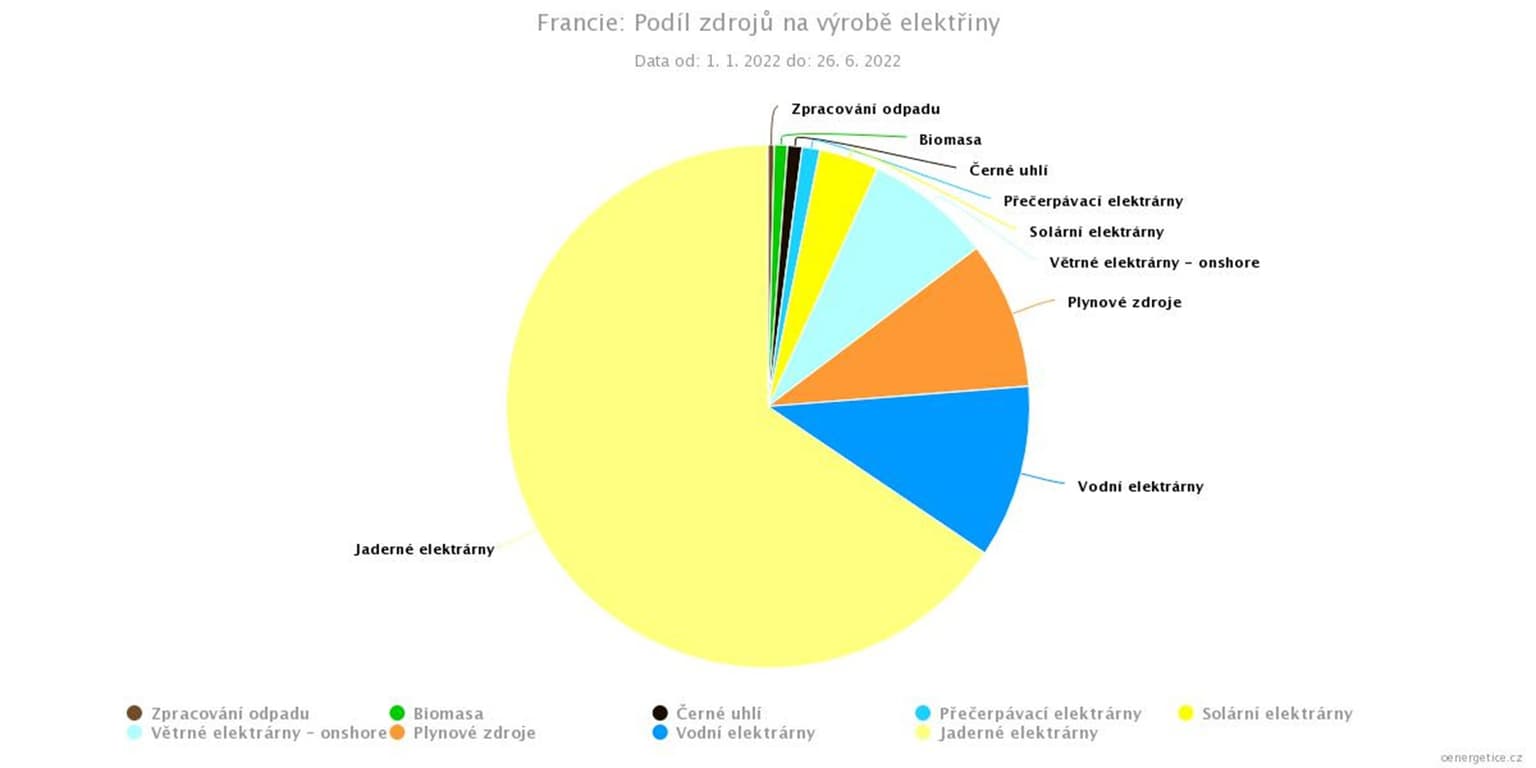
In a recent article, I examined the impacts of the past winter and Russia’s invasion of Ukraine on European and Czech energy, as well as the causes of the energy crisis they brought about. The war has now been under way for more than four months, making the emerging trends increasingly clear. This is particularly evident in Germany, where their fundamental characteristics are clearly apparent. In discussions with green activists, I stressed that, as a result of the Energiewende, Germany would not transition to low-emission energy, but merely transform one combination of fossil and low-emission energy into another. I predicted that low-emission nuclear sources would be removed and replaced by renewable sources, while coal-fired sources would be replaced by natural gas.
Before the events of this winter and Russia’s invasion of Ukraine, this reality could be concealed by pointing to reductions in carbon dioxide emissions from electricity generation resulting from the shift from coal to natural gas. Given methane emissions from the extraction and transport of natural gas, this was not entirely correct, but at least it looked good in the charts. However, gas supply problems following the start of Russia’s war revealed the reality of the Energiewende clearly, and it could no longer be concealed. Germany, Austria and other countries that abandoned nuclear power are returning to the use of coal. Examples of countries that, thanks to their use of nuclear energy, are returning to coal in electricity generation only to a minimal extent include the already mentioned France, Sweden and neighbouring Slovakia. Although in France, for reasons we will return to, they may place one coal-fired unit back on standby during this winter season.
The share of individual sources in electricity generation in France during the first half of 2022 shows that coal is used only minimally and that electricity generation in this country, based on a combination of nuclear and renewable sources, is already low-emission (source: Energostat).
Let us look at how the difference between France and Germany is reflected in electricity generation in specific figures (using data from Energostat).
In the first half of 2022, France generated only 0.9 % of its electricity from coal and 9.1 % from gas, meaning that fossil sources accounted for just 10 % of its electricity overall. In the first half of 2021, 0.6 % of electricity came from coal and 6.6 % from gas, meaning that fossil sources accounted for just 7.2 % overall.
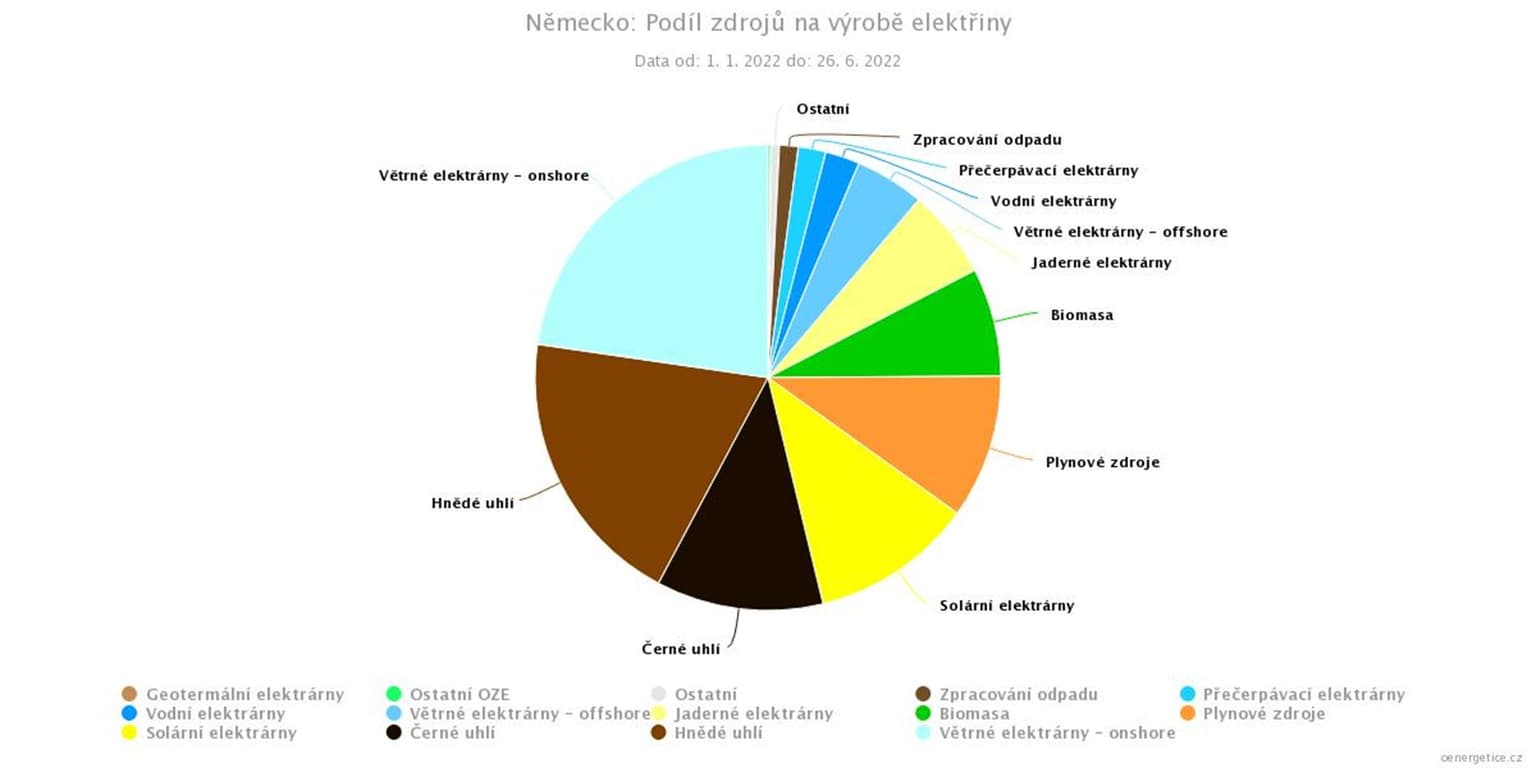
In Germany, 31.1 % of electricity was generated from coal and 10.0 % from gas in the first half of 2022. Fossil sources thus accounted for 41.1 % of electricity generation overall. In the first half of 2021, coal’s share was 26.7 % and gas accounted for 11.8 %. Overall, fossil fuels accounted for 38.5 % of electricity generated in Germany at that time.
It should also be recalled that fossil fuels, particularly natural gas, are used extensively for heating in Germany. In contrast, a large share of heating in France is electric, so gas in that country is used predominantly only in industrial sectors where it cannot yet be replaced.
The share of individual sources in electricity generation in Germany in the first half of 2022 shows that coal remains the largest source there. Fossil sources supply around 40 % of generated electricity (source: Energostat).
Moving away from domestic fossil sources only where a replacement exists
In Germany, the Energiewende is thus proving to be more a transition from one fossil source to another. The plan was for imported gas to be used as the dominant replacement for both domestic and imported coal. This was also why the Nord Stream I and II pipelines were built. Germany thereby created an extreme dependence on Russian gas. This was a highly problematic step even from the perspective of reducing CO2 emissions. While burning gas produces half as much of this gas as coal, the shift from coal to gas is not a major gain if methane leaks, from the extraction and transport of natural gas, are included, as methane is a far more potent greenhouse gas.
Following Russia’s invasion of Ukraine and the need to reduce the European Union’s dependence on fossil sources from that country, Germany is returning to coal. This clearly shows that the planned Energiewende is a fossil-fuel pathway. For us, it is a huge problem that high electricity prices, caused by gas-fired plants being the marginal plants in Germany, spill over from Germany to the Czech market. And our population is certainly not as affluent as the German population.
Germany is promoting an extreme increase in efforts to build renewable sources. Wind turbines, for example, are supposed to cover 2 % of Germany’s territory. However, how successfully it will actually replace fossil sources with renewables, and at what cost, remains a very open question. With such coverage of Germany’s territory by wind turbines standing well over one hundred metres high, it will often be the case that they can be seen in every direction. The question is to what extent residents will be able to accept this.
Likewise, growing environmental impacts from such intensive use of wind turbines will increase opposition to the construction of new wind power sources. Even now, opposition from local communities is strong, especially in Bavaria. Laws are being planned to overcome such public resistance, but their effectiveness is uncertain. It is equally uncertain how successfully high-voltage transmission links will be built from highly centralised offshore wind farms to industrial facilities and urban areas in southern Germany.
In my view, a pathway to a low-emission mix based solely on renewable sources cannot be implemented in Germany. The same applies to other countries that do not have conditions as uniquely favourable as Norway, for example. This does not mean that renewable sources are not a very useful and important part of the energy mix. However, they should be built at a share and in a manner corresponding to the geographical and other conditions of the given region. In Czechia, this means focusing on decentralised renewable sources. Given our geographical location, our possibilities in this area are limited.
The use of biomass is already increasingly reaching limits at which it begins to compete with food production and the environmental function of the landscape. Even now, not only waste but also dedicated crops such as maize are used for biogas production. Conditions for wind turbines are also limited here. They need to be used efficiently, but there is little point in covering areas of tourism and environmental importance with wind turbines that can hardly compete economically with large turbines on the coast.
The greatest potential is probably in photovoltaics, but it is very important to ensure its efficient integration into the grid. When using European subsidies in this area, one of the key conditions must be the parallel development of storage and grid balancing capabilities. Building new renewable sources, rebuilding the grid and strengthening its balancing capability also takes quite a long time. In this respect, the situation will not be much better at the required scale than it is in the case of building new nuclear sources.
Not only in Germany, then, the current principle should be that coal-fired sources are shut down only when a corresponding low-emission replacement is already available, capable of ensuring not only total electricity generation but also supply as needed at every moment. It is therefore necessary to retain coal-fired power plants and the ability to mine sufficient coal until replacement capacity is available in nuclear and renewable sources.
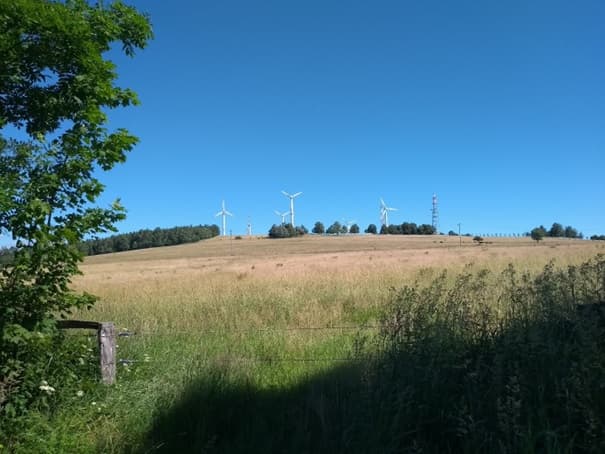
The Modernisation Fund is only one of the sources available to support renewable sources in Czechia. All these sources need to be used efficiently and make a genuine contribution to reducing emissions and improving the efficiency of our energy sector (photo: Vladimír Wagner).
Nuclear energy
The Western world experienced a similar situation and the problems we are now feeling at the beginning of the 1970s, during the oil crisis. At that time, OPEC countries reduced production and declared an embargo on oil exports to certain Western countries because of their support for Israel in the Yom Kippur War. The response was a change in the energy policies of a number of countries. France subsequently completed its transition to low-emission electricity generation using nuclear energy in roughly twenty years.
Following current events, at least France is returning to intensive use of nuclear energy supplemented by renewable sources. The remaining problem that needs to be addressed is the loss of expertise that has occurred in this field in the European Union and the United States.
In the second half of the last century, the European Union and the United States were at the forefront of nuclear energy development. They were able to build nuclear units quickly and efficiently. An intensive campaign by green anti-nuclear movements led to a halt in nuclear reactor construction and restrictions on research into advanced nuclear technologies. At the same time, there was very strong pressure to end the operation of existing nuclear units. Two opposing trends were thus occurring in parallel.
On the one hand, it became apparent that the service life of nuclear units was longer than originally anticipated. In particular, it proved possible to limit the effect of neutron-flux damage to reactor vessels, a critical area. The operation of existing units could therefore be extended, and for many of them a lifetime reaching or exceeding sixty years can now be considered. On the other hand, the campaign by anti-nuclear activists led to the premature closure of safe reactors in very good technical condition. This can be seen, for example, in Germany, where the last reactors will be shut down at the end of this year.
In recent months, voices have emerged even in Germany, particularly in Bavaria, calling for the shutdown of the remaining nuclear units to be postponed. This would be possible from a technical and safety perspective: the units are relatively new and modern, having operated for around thirty years. The problems are more economic, political and legal. Operators had planned for the shutdown of the units. They adjusted their fuel orders, maintenance schedules and staffing accordingly.
New fuel supplies, the necessary permits from the nuclear regulator, and appropriate maintenance and personnel would therefore have to be secured. This would entail corresponding costs, not only financial ones. Economically, it would make sense if operations were extended by ten years or more. However, this would require a clear declaration and support from political leaders. Discussion that operation might perhaps be extended by a few years is not enough; a clear decision to use them for at least a decade would be needed. This cannot be expected from the current German government. An extension of operation at Germany’s remaining units is therefore very unlikely.
A very unclear stance towards nuclear energy has also strongly affected the sector in France. In recent decades, there has been a constant campaign against nuclear energy there. Support for the sector and assumptions about its future have thus changed frequently. Plans were announced to exit nuclear energy, to soon reduce its share in electricity generation from 75 % to 50 %, and to shut down all units after forty years of operation. Financial and other support for the use of nuclear reactors was therefore also restricted. This did not encourage support and investment in the long-term operation of existing units. As a result, the neglect of care for operating units is now having very negative consequences.
Several problems occurred that led to forced, unplanned outages at various reactors. More recently, they have been linked to the discovery of undesirable corrosion in certain welds. These problems and their origin should provide a clear lesson for us as well. It is necessary to clearly declare that we want to operate the Dukovany nuclear units for 60 years and provide appropriate care for these reactors.
New nuclear units
In the second half of the last century, Western Europe and the United States were at the technological forefront of nuclear energy development, both in the reactors being built and in the development of fast reactors and the closed fuel cycle. It should be recalled that the reactors now being shut down in Germany are still at the highest technological level. France also advanced far in the development of fast sodium reactors, as demonstrated by the Phénix and Superphénix projects.
However, the intensive campaign by green anti-nuclear activists and the subsequent shift by European politicians away from strategic security and efforts for scientific and technological development towards green ideology, which blocked almost all nuclear energy development and led to a nuclear exit in a number of countries, dramatically changed the situation. Today, the peak of nuclear energy development is in Russia and China, in the fields of Generation III reactors, small modular reactors and Generation IV reactors (described in greater detail, for example, in an overview of the current state of nuclear energy). Nuclear energy development in Europe has frozen and a range of necessary expertise has been lost. This also contributes to the problems encountered here in building new capacity.
After Russia unleashed war and given its conduct towards nuclear facilities in Ukraine, it is clear that cooperation with that country in the nuclear field is not possible. As described in the previous text, nuclear energy cannot be dispensed with on the path to carbon neutrality. The European Union therefore urgently needs to build its own production capacity for Generation III nuclear reactors, small modular reactors and Generation IV reactors. An essential prerequisite is restoring the necessary expertise in the field. This does not concern only nuclear specialists, but also construction workers and highly skilled welders, for example. Problems with welds are precisely the biggest issue that caused delays, including in the completion of the Flamanville 3 unit.
Looking at the current situation in Generation III reactors, pressurised water reactors in this category are offered, besides China and Russia, by French companies, Westinghouse and South Korea. These are the EPR, AP1000 and APR reactors. These models are also participating in the ongoing tender for the construction of Dukovany 5. It should be recalled that one of the tender conditions is a unit capacity of up to 1200 MWe. This condition follows from the available cooling capacity for the joint operation of this unit with the existing units at the site. It should also be noted that smaller units fit the Czech electricity system better. The AP1000 reactor meets this requirement. For the EPR reactor, whose units currently under construction have a capacity of around 1700 MWe, a smaller variant will be offered. The same will be true of the South Korean APR1400 reactor. Selecting the EPR or APR reactor would thus mean building the first downsized variant. However, if the current situation leads to a renaissance of nuclear energy in the European Union and elsewhere, downsized variants of these reactors will certainly also be built in greater numbers.
A number of European countries are preparing to build new nuclear units. Achieving low-emission energy and carbon neutrality will require a relatively large number of them to be built, which also means establishing a sufficient nuclear industry base. If we look at supply chains, they are interconnected and interchangeable. Czech companies could therefore participate in building all three of the Generation III reactor types mentioned. In my personal view, however, it might be best for the European Union to build its nuclear energy renaissance on a European foundation of EPR units. This does not mean that selecting the other two reactor types would not be possible and appropriate. Each has its advantages and problems.
If the Czech Republic wants to transition to low-emission energy, it will need to implement not only one unit at Dukovany but also a second new reactor at the plant. Two reactors with capacity of around 1000 MWe would ultimately replace the ageing VVER440 reactors. It will also be necessary to build two large Generation III units at Temelín, which would replace part of the current coal-fired capacity. Space for the construction of large Generation III units is prepared at both Temelín and Dukovany. If these units are built with the aim of ensuring reliable and cheap electricity supplies over the long term, and if a suitable financing model is selected for this purpose, waiting for small modular reactors will bring no advantage.
Small modular reactors
For the Czech Republic, a major benefit of introducing small modular reactors would be the entry of nuclear energy into decentralised generation and district heating. However, this possibility requires two key conditions to be met. The first is that a commercial offering of small modular reactors must exist. The second is the need for a specific approach to licensing small modular reactors that takes account of their specific safety parameters. For now, they must meet the same conditions as large reactors. If the licensing process does not take their different safety parameters into account, it will not be possible to use them as replacements for medium-sized and smaller fossil-fuel power plants and heating plants.
It is very good that the Czech Republic is participating in the development and preparation of small modular reactor deployment. Four different projects for these facilities are under way in Czechia. Two projects focus on conventional reactor types that envisage using existing VVER fuel assemblies: Teplátor and the David system. Two further projects by ÚJV a.s. in Řež focus on innovative types. They are the liquid-salt-cooled Energy Well reactor and the helium-cooled high-temperature HeFASTo reactor. If at least one of them reaches the prototype stage, it will be a major success. In any case, they will contribute to developing the necessary expertise among students, research organisations and Czech industry. The Czech Republic and ČEZ are involved in a number of promising international small modular reactor projects.
ČEZ recently earmarked an area within the Temelín nuclear power plant site, near the location prepared for two large units, for construction of the first small modular reactor prototype in Czechia. The company wants to be among the first in Europe to deploy a small modular reactor. The site was selected because it is a nuclear site and does not require a specific approach to licensing. The first deployed small modular reactor could help develop a new permitting process for these facilities. At the same time, it would serve as a training and preparatory facility enabling the broad deployment of small modular reactors in our decentralised energy sector.
It is highly likely that small modular reactors will be manufactured by companies supplying large Generation III reactors, and it is important that Czech industry also joins the relevant supply chains.
Conclusion
The past winter alone showed, and Russia’s invasion of Ukraine only highlighted, that the anti-nuclear campaign by green activists has made the European Union extremely dependent on fossil fuels, a large share of which are imported from Russia. Instead of ensuring energy needs securely over the long term and developing science and industry, emphasis was placed on ideological green goals and short-term economic parameters. In Czechia, ideological anti-nuclear green activists and lobbyists interested only in their own short-term private gain have joined forces in an intensive campaign against nuclear energy.
At present, green activists are once again awarding the Ropák anti-award. From the outset, its organisers succeeded in completely discrediting it. At the turn of the century, this award was presented mainly to those who sought to complete construction of at least the first two units at the Temelín nuclear power plant and advocated the use of nuclear energy. Even then, for example, I wrote in this contribution that the future would show that the views of those receiving the Ropák anti-award were far more correct and environmentally sound than those of the people who bestowed it on them. In the case of Temelín and the importance of nuclear energy for low-emission energy, this has been fully confirmed.
I wrote that it might in the future emerge that green anti-nuclear activists would be the main culprits if humanity failed to deal with rising emissions in time. I did not expect that developments in Germany’s energy sector, against the backdrop of developments in France as well, would confirm my prediction so soon. It should be recalled that we will also have the opportunity in the future to compare the results of two possible different scenarios for electricity sector development—efforts to achieve low emissions using nuclear energy and those based solely on renewable sources—again through the examples of France and Germany.
It is very sad that even after current events, which clearly show how deeply mistaken they were about the need for nuclear energy and the disruption these movements caused in European energy by effectively obstructing, rather than supporting, the path to carbon neutrality, no self-reflection has occurred among them. They continue to fight intensively against nuclear energy. The question is whether they will succeed in blocking nuclear energy development even now, or whether their opposition will be overcome and Europe will repeat France’s success in transitioning to low-emission energy in the final quarter of the last century.
Self-reflection and a shift towards a rational view of energy based on scientific and technical knowledge are also scarcely visible among European politicians, where pure green ideology likewise prevails. An example is the fight against including nuclear energy in the taxonomy of sustainable energy sources. We will see whether, even under these far from favourable conditions, it will ultimately be possible to ensure energy security, economic and social affordability, and low emissions.
Translation disclaimer
This article is a machine translation of the Czech original and has not yet been fully reviewed. In case of any doubt, please refer to the Czech version.
Sdílejte článek prostřednictvím:
You might also like
23 October 2026, 11:01
23 October 2026, 06:34