What to do in Czech energy now? – Part two
The shutdown of German nuclear power plants and the closure of a number of coal-fired units in neighbouring countries are approaching. At the same time, the Czech Coal Commission is discussing recommended dates and conditions for closing coal-fired power plants in the Czech Republic. Pressure is mounting in the European Union to transition to low-emission energy, while emissions allowance prices are rising. Czech energy must therefore finally begin building sources to replace coal-fired generation and ageing nuclear and photovoltaic sources.
This is the second part of the article – the first is available at this link.
When to close coal-fired plants and how to use them until then?
In twenty years, the only certain low-emission component of the Czech energy mix will be the two units of the Temelín nuclear power plant. Had the Greens, then led by Martin Bursík, Greenpeace, then led by Jakub Patočka, Hnutí Duha and other green activist organisations succeeded in the 1990s and at the beginning of this century, these units would not be standing. Dukovany would also already have been shut down. Together with their Austrian partners, these organisations fought intensely for the earliest possible shutdown of these older nuclear units. And instead of seeking to replace fossil sources with low-emission ones, they still focus predominantly on fighting nuclear energy. Yet without it, building a low-emission energy system is impossible in our geographical conditions. Nor have these organisations contributed to faster deployment of decentralised renewable sources. They advocated, and to a considerable extent still advocate, unrealistic notions of an almost immediate full replacement of nuclear and coal-fired electricity generation with photovoltaics, wind and biomass. Let us recall their ideas, promoted together with Austrian colleagues during the campaign to halt Temelín's construction, that a photovoltaic power plant should be built on the site instead to replace it.
In the Czech Republic, the dominant part of the political spectrum agrees that our transition to low-emission sources should be based on a mix of nuclear and renewable sources. The Czech Republic already has the aforementioned energy strategy for transition in this direction. However, to implement it, financial models and an approach to delivery must be designed that would make it possible to fulfil it in the heavily distorted environment of the European energy market. Naturally, a range of different options is possible. None is ideal; each has its negatives and positives, and a certain compromise must be reached in selecting them. The problem is that the dominant part of the political scene does not focus on solving the real problems of the energy sector, but rather prioritises the political struggle for power. They are therefore willing at any cost to throw a spanner into any solution being pursued by a political opponent. At the same time, it is advantageous for them to do nothing and, during a campaign, promise as many voters as possible, in vague terms, that even contradictory wishes will be fulfilled, regardless of how realistic they are. An example is the current pre-election statement on energy by the TOP 09 party. On the one hand, it claims to support the development of nuclear energy. On the other, a key figure in the party, Luděk Niedermayer, states that nuclear development is not needed.
The combination of the described high level of activity by green activists against the state energy strategy and politicians' rather minimal effort to implement it has resulted in a situation in which almost nothing has been done to build low-emission sources, both nuclear and renewable, and to ensure elements enabling smart grid regulation. The estimated date when coal-fired sources will be replaced is therefore highly uncertain.
Reliable and affordable supplies are crucial to the standard of living and competitiveness of Czech society. We inherited a relatively very robust and well-functioning system and thus had a very good opportunity to prepare for and implement a transition to a low-emission mix, as planned in the state energy strategy and its updates. For the reasons mentioned, however, we unfortunately failed to use this opportunity. Closing sources in a way that would lead to the loss of the ability to ensure the required output and regulation throughout the year, even in worse weather and other conditions, is unacceptable. The importance of ensuring sufficient energy for the further development of our society is also recognised by the founders of the Equilibrium Institute, which has therefore devoted its second conference, to be held on 30 September 2020, to this very issue.
The closure and decommissioning of coal-fired units should therefore proceed at the same pace as replacement low-emission, or other fossil-fuelled (gas-fired), sources are commissioned. This is particularly important at a time when it is certain that there will be no surplus capacity in our surrounding region when the sun is not shining and the wind is not blowing.
It is, however, very important that these power plants are used as capacity reserves and participate in regulating our power grid. In other words, they should not be intended to generate electricity when low-emission sources can supply it domestically or it can be imported from low-emission sources elsewhere. Sources that use our coal, with the impacts of mining at home, and emit CO2 that is counted against us should certainly not be used to solve problems with insufficient sources beyond our borders.
They will thus be operated to a limited extent, but will fulfil a very important role for our electricity system. It is therefore necessary to find a suitable financial model that ensures the economics of their limited operation for their owner. Opinions are often heard that it is simply not possible to restrict generation from a source and the sale of electricity from it to anyone abroad. In this case, however, this is a specific matter. If we want to reduce emissions and curtail coal-fired electricity production as quickly as possible while not jeopardising the electricity system, we must allow these sources to operate for longer, but solely for security reasons to ensure capacity adequacy. It would even be appropriate for future larger gas-fired sources to be allowed to operate under such a regime. It would be absurd if, while striving for carbon neutrality and low emissions, we replaced electricity with power generated by burning Russian gas imported via Germany and increased emissions to address Germany's shortage of electricity sources.
What could a low-emission mix look like?
As can be seen from the preceding analysis, two key conditions must be met to ensure reliable and sustainable electricity supplies. The first is to ensure total annual electricity demand and the sources to meet it. The second, no less important, is to ensure that supply and consumption are aligned at every moment. In the 2040s, the only currently operating low-emission sources will be hydropower plants and the nuclear units at Temelín. If it is possible to secure sixty-year operation of Dukovany against pressure from Austria and Germany, they will be approaching shutdown at that time. If we want to pursue a path to low-emission energy, we therefore do not have much time not only to replace those that close, but also to build new sources to replace coal-fired units.
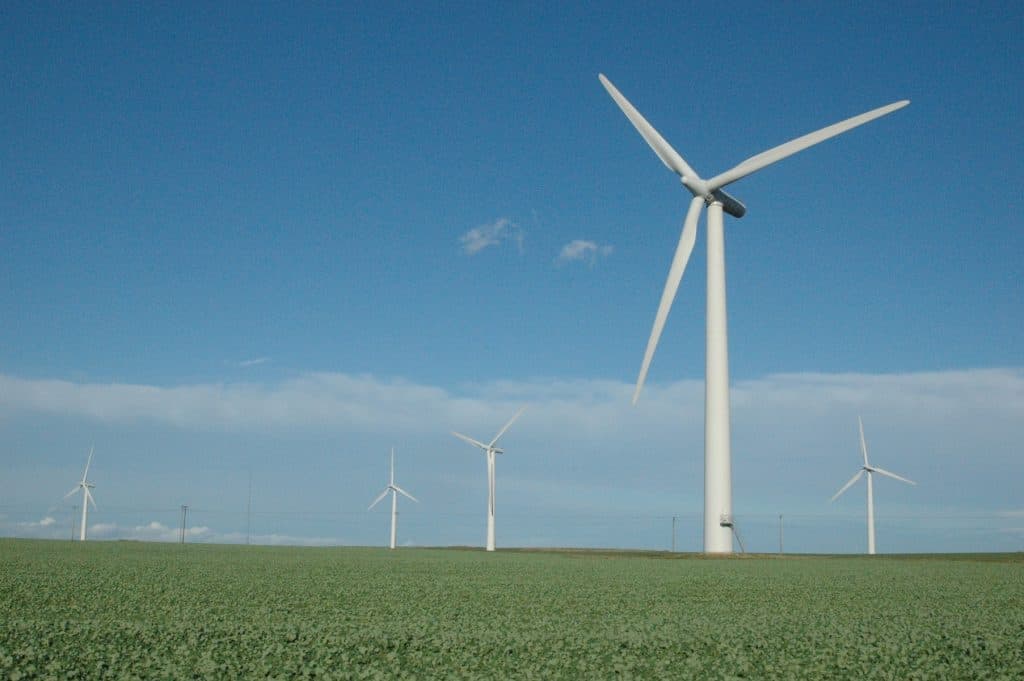
Experience with the construction of wind turbines in the Czech Republic and in similar geographical conditions, for example Bavaria, shows that preparation times tend to be quite long because of public opposition and the time needed to obtain the required permits. Developments in the Czech Republic demonstrate this as well. Of course, an individual turbine or group of them can, under a favourable combination of circumstances, be built relatively quickly in a few years. However, the notion that wind capacity equivalent to the generation of a Temelín reactor can be built more quickly than a new nuclear unit is beyond reality. Especially in the Czech Republic, where sites for new nuclear units have been selected, environmental impact assessments have been conducted and a number of necessary reviews have already been carried out. Moreover, construction of new units at these sites enjoys relatively broad support among local residents. By contrast, projects for new wind turbines will first have to obtain all permits and public support.
There is truly extreme pressure in Germany to build wind capacity. Bavaria has roughly 2.5 GW installed. Taking into account developments to date, it cannot be expected that we would manage to install more in the Czech Republic. The annual capacity factor of wind turbines here is between 20 and 25 %. Wind generation in the 2040s could therefore be around 5.5 TWh.
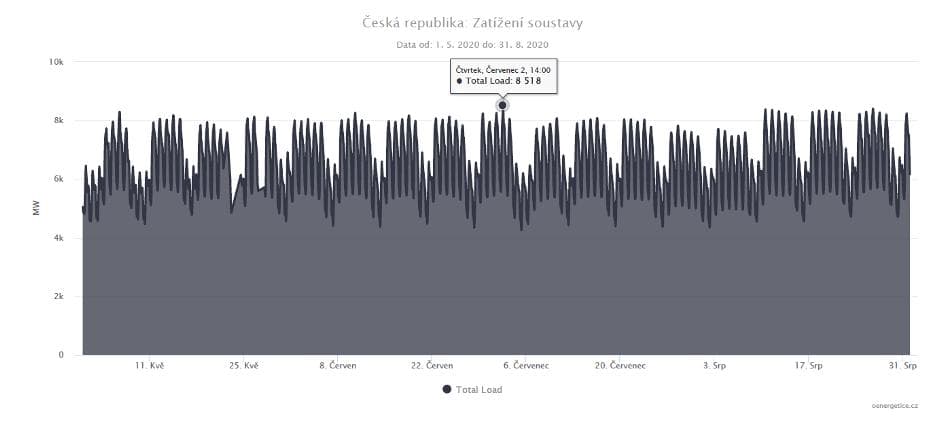
As for photovoltaic sources, once installed capacity exceeds maximum summer demand at noon, our requirements for regulation or storage will begin to rise dramatically. This demand is just under 9 GWp and the corresponding supply, in our geographical conditions where annual utilisation of installed capacity is roughly 11 %, means approximately 8.7 TWh. This figure can be improved through the described development of storage, the aforementioned distribution of daily production by diversifying panel orientation, and the deployment of smart grids at decentralised level, but not dramatically. We can see this in Germany as well, where installed capacity is already close to summer peak demand. Photovoltaics there still supplies only around 9 % of electricity. It is optimal when installed photovoltaic capacity covers daytime summer peaks. Daily fluctuations at that time range from just under 5 GW to slightly more than 8 GW, thus capacity of between three and four GW. As storage options and other means of compensating power surpluses increase, the optimal level of installed photovoltaic capacity rises. The example of Bavaria, which had 11 GW of photovoltaic capacity installed in 2017, shows that these capacities can in principle be built within a relatively reasonable period. The rapid installation of 2 GW in the Czech Republic at the end of the previous decade also demonstrates this.
Let us recall that annual consumption in 2018 was 73.9 TWh. If total production remains roughly the same, photovoltaics will provide approximately 12 % and wind turbines 7.5 %. Hydropower plants will provide roughly the same as now, which is slightly more than 2 TWh. Realistically, these sources will thus generate roughly 13.2 TWh, which is 18 % of our needs. It is very unlikely that storage conditions will change so dramatically in the coming decades that these sources could be used to a dramatically greater extent.
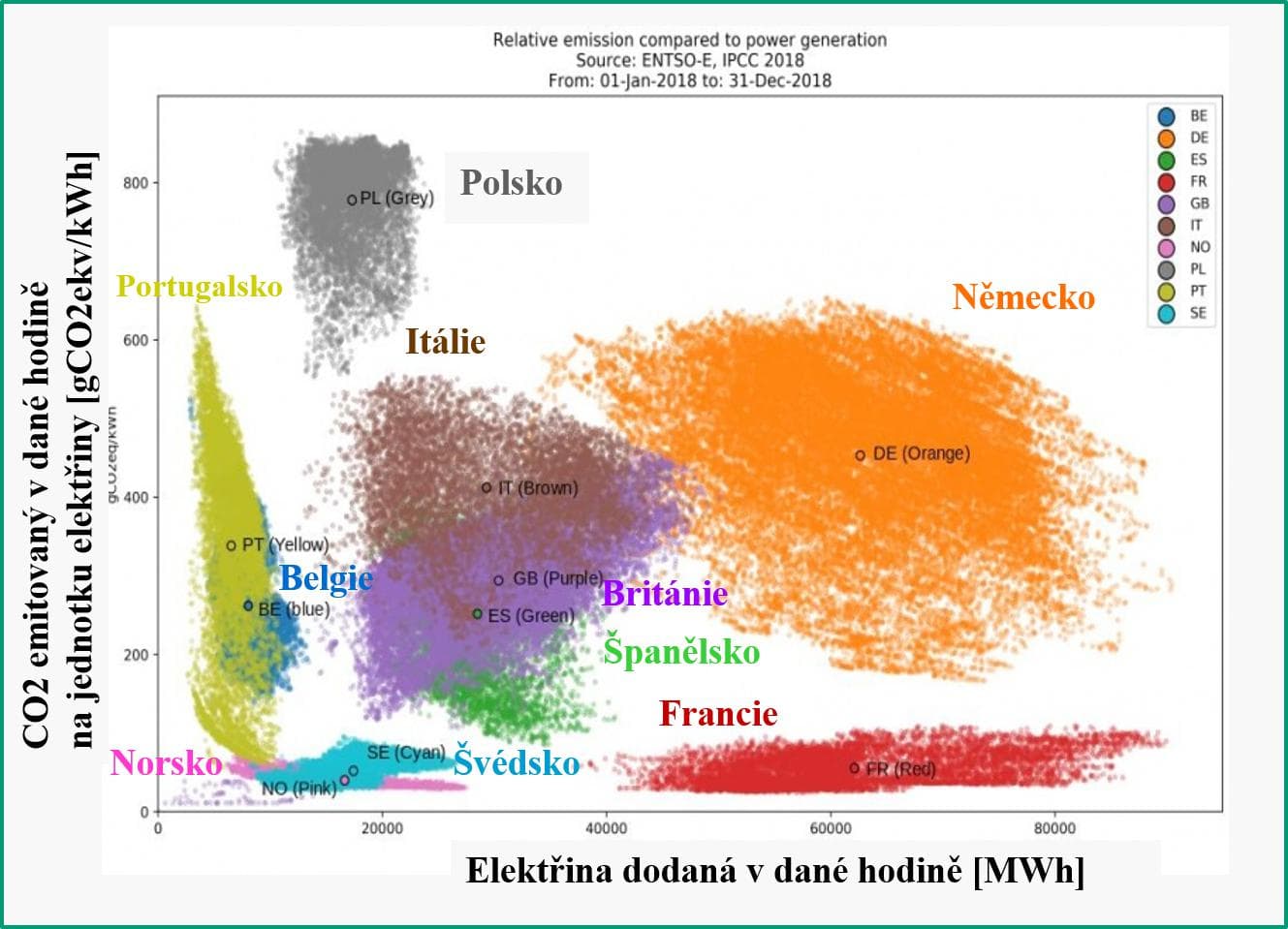
The Temelín nuclear power plant is capable of supplying around 16 TWh annually, representing nearly 22 % of consumption. Without additional nuclear units, low-emission sources will therefore cover nearly 40 % of demand – less than half. If we want a low-emission mix, the remaining part must be supplied by new nuclear sources. If units with capacity of roughly 1.2 GW are built, each will supply approximately 9 TWh annually. The four units under consideration – two at Dukovany and two at Temelín – could theoretically provide the dominant part of the remaining 40 TWh. Without them, fossil-fuelled sources will have to be used. As can be seen from the chart, gas offers no advantage over coal in terms of emissions per unit of energy produced.
Meeting total annual electricity demand does not, however, mean that we have won. The second condition must also be fulfilled: ensuring sufficient capacity at every moment to meet demand. This is also why it is necessary to build a cooperating mix with intensive involvement of low-emission sources in regulation.
Conclusion
There are, naturally, ideas, especially among green activist organisations, that the Czech electricity sector can be built predominantly on photovoltaic and wind sources without constructing new nuclear units. A recent study prepared by German organisations promoting the Energiewende and their scenario for the Czech Republic can serve as an example. However, their coal-free scenario envisages 20 GW of photovoltaics and 8 GW of wind turbines in 2040, which is far removed from reality. It refers to a potential theoretical technical capacity of 223 GW for photovoltaics and 76 GW for wind. However, this does not take into account human settlement of the landscape and its other functions, let alone the real possibility of construction. I would also note that the scenarios mentioned assume Dukovany remains in operation – although, unless it has already been closed, it will be preparing for shutdown – as well as a significant share of gas, and therefore CO2 emissions.
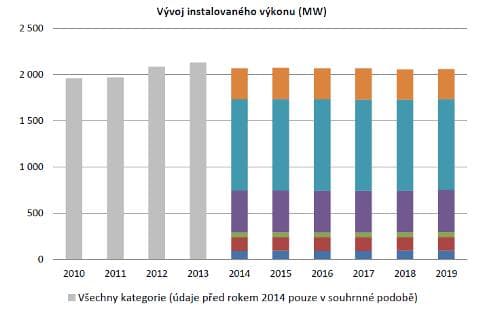
It is clear that there is no agreement on the potential of individual sources or the possible pace of their deployment. For the stated reasons, the construction of new low-emission sources has stagnated for a very long time. After a rapid rise to 2 GWp, installed photovoltaic capacity has stagnated or even declined for ten years. Construction of new wind sources has essentially stagnated in the Czech Republic for many years, and only recently did installed capacity exceed 300 MW. Nuclear units currently have combined capacity of 4.2 GW. Let us recall that upgrades to Dukovany were completed in 2011 and increased its capacity by roughly 280 MWe. The Temelín upgrade added another 164 MWe. Together, this is 444 MWe, more than the total capacity of wind power plants.
If we want to build a low-emission energy system in the Czech Republic by mid-century, we must ! together ! build at least 4 GWp, and preferably 9 GWp, of photovoltaics (including replacement of the current 2 GWp), roughly 3 GW of wind capacity, and at least two nuclear units, though preferably four. Photovoltaic sources should mainly be decentralised, on buildings or industrial sites, and combined with smart storage and consumption, potentially supplemented by small flexible gas-fired sources. Our assumptions do not take into account growth in electricity consumption resulting from electromobility and electrification of other sectors. There will therefore also be a great need and scope for savings. There is certainly also sufficient room for using waste and biomass combustion, especially waste biomass. However, recycling should take priority for waste, while food production and the ecological function of the landscape should take priority for biomass.
Each area individually represents a huge challenge. When we take into account developments to date, especially in the Czech Republic, this appears almost unattainable. Therefore, instead of fighting other sources, each sector should focus on demonstrating that it can effectively build its own sources and create its part of the low-emission mix. A suitable financial model must be found for each area, and barriers to implementing specific sources and their effective integration into a jointly functioning mix must be removed. I recently described in detail what such a demonstration of capabilities in individual areas should look like. Capabilities should be demonstrated through the first megawatts of effective combinations of decentralised photovoltaic and wind sources with storage and smart consumption, and the first nuclear unit at Dukovany. Recent developments in the deployment of Generation III reactors show that sufficient experience will be available when selecting a specific model.
Based on experience from these projects, every effort should then be directed towards a gradual and safe transition to a low-emission mix. This will also require the effective use of gas-fired and coal-fired sources, which must ensure sufficient electricity and, above all, the system's balancing capability until they can be replaced by low-emission sources. We must remember that we need an effective cooperating mix, not maximisation of the share of any particular source. If we fail to find agreement and finally begin genuinely working on the transition to a low-emission mix, very serious problems may arise not only in the energy sector. Society, its economic competitiveness and, consequently, its standard of living are vitally dependent on reliable and inexpensive electricity supplies.
Written for Oenergetice, Osel and Ekolist.
Translation disclaimer
This article is a machine translation of the Czech original and has not yet been fully reviewed. In case of any doubt, please refer to the Czech version.