11 October 2026, 08:24
Loading...
Germany to abolish gas transit charge after bowing to Austrian and Czech pressure

Marek Kršák
4 June 2024, 14:51
Germany will abolish a controversial surcharge on gas transiting the country. It announced the move at the end of May. The country is responding to a wave of criticism from other member states, which argue that such measures only make the shift away from Russian gas supplies more expensive.
When Germany purchased natural gas in 2022 to fill its storage facilities, the vast majority of the volume purchased cost almost five times more than it does today. To ensure a return on these investments, Berlin began charging a surcharge on all gas transit using its transmission system.
In 2022, Germany's Trading Hub Europe (THE) purchased approximately 50 TWh of gas at an average price of around EUR 175/MWh. The gas was intended for storage. Around 12.5 TWh of this gas was sold during the winter of 2022/2023, at an average sale price of EUR 77.50/MWh. Sales of the remaining gas volume began at the start of the winter of 2023/2024, and the volumes have now been fully sold at an average sale price for all gas of around EUR 48.50/MWh. THE also recently announced that, from July, the charge for neighbouring countries would increase by a further 34 % to EUR 2.50 per MWh.
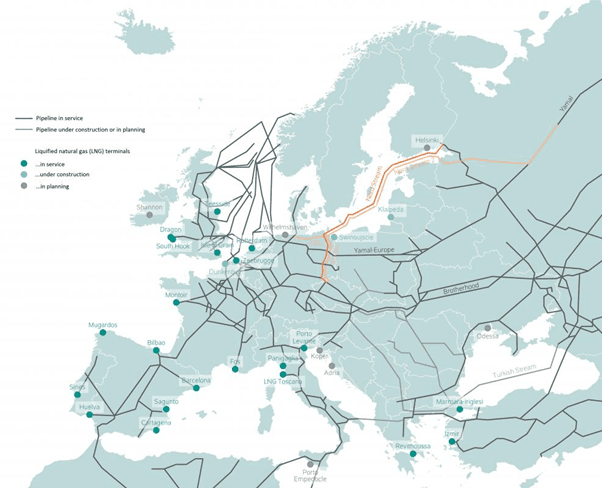
Schematic representation of the existing network of European gas pipelines and LNG terminals. Source: Clean Energy Wire
Austria and Czechia push back
European landlocked countries argue that the German charge is a major obstacle to moving away from Russian gas. The charge adds almost 10 % to the wholesale gas price. Austria and Czechia rely on gas imported through German territory and have strongly opposed any form of charge.
Following pressure from neighbouring countries, German State Secretary Sven Giegold said at the end of May that the charge would be abolished from 1 January 2025.
This unexpected move came after months of Germany continuously defending its decision, before effectively reversing it overnight. Austria, Czechia, Hungary and Slovakia submitted an agenda item at a meeting of energy ministers to repeatedly raise the issue.
Unless there are legal changes, all costs of maintaining high gas stocks will now likely fall on German consumers rather than on other EU countries.
2025 as a milestone
For Eastern European countries, the beginning of 2025 is a key date, as the gas transit agreement between the Kremlin and Ukraine expires – which could mean an interruption to gas supplies to Austria, Hungary, Slovakia and Czechia.
Following the abolition of the gas transit charge, gas imported from Western Europe via Germany should cost roughly the same as supplies from Russia – making it easier for these countries to move away from Russian supplies.
Translation disclaimer
This article is a machine translation of the Czech original and has not yet been fully reviewed. In case of any doubt, please refer to the Czech version.
Sdílejte článek prostřednictvím:
You might also like

10 October 2026, 13:19
10 October 2026, 07:37
10 October 2026, 07:02