What next? European and Czech energy at a crossroads
Recently, the individual trends in European energy policy and their current and future impacts have gradually begun to become clearer. This naturally also concerns Czech energy. First of all, after eighteen years of the German Energiewende, it can be clearly said that it has failed, particularly in reducing emissions, and its future prospects do not look very good either. Although Germany has managed, through intensive construction of wind farms in the north, to increase the share of electricity generation from renewable sources to more than 30 %, most of their potential was exhausted in replacing nuclear units being shut down. And nuclear sources still generate around 13 % of German electricity. While Czech energy has achieved a 40 % reduction in carbon dioxide emissions compared with 1990, Germany will not meet its target of reducing emissions by 40 % by 2020, even though a significant part of the reduction was helped by the economic downturn and restructuring in the newly incorporated eastern part during the 1990s.
It is becoming clear that Germany must replace the nuclear units being shut down largely with fossil fuels. It is failing to build connections in time between northern Germany, with its large number of wind farms, and the industrial south, where nuclear units are being shut down. Its only chance of at least partly fulfilling its declarations on emissions reductions lies in switching from coal to gas. The major question, however, is how to implement this transition. One option based on a high carbon allowance price is discussed by well-known investor and minority shareholder in ČEZ, Michal Šnobr, in his German dawn. However, this runs into a number of problems, caused mainly by the fact that gas also produces carbon dioxide emissions, albeit half as much as coal. As the price of carbon allowances rises, so does the price of electricity from gas. Therefore, if Germany truly wants, following Michal Šnobr's idea, to use market mechanisms to shut down coal-fired power plants by raising the carbon allowance price to a level at which electricity from coal becomes more expensive than that from gas, allowance prices would have to be very high, especially in the case of lignite. I wrote a more detailed analysis of the problems surrounding Michal Šnobr's ideas in the following article.
The price of electricity from domestic lignite has so far contributed significantly to slowing the rise in electricity prices in Germany during the Energiewende. Even so, electricity prices for consumers there are now the highest in Europe. The question is how Germans will react to a further dramatic increase when they were initially told that prices would rise due to the deployment of renewables, but only moderately and temporarily. Cheap renewables would then ensure ample low-cost electricity. Moreover, Germany would be at the forefront of emissions reductions and an environmental leader in Europe. None of these promises has been fulfilled, and the largest part of the costs of the Energiewende still awaits Germany in the coming years.
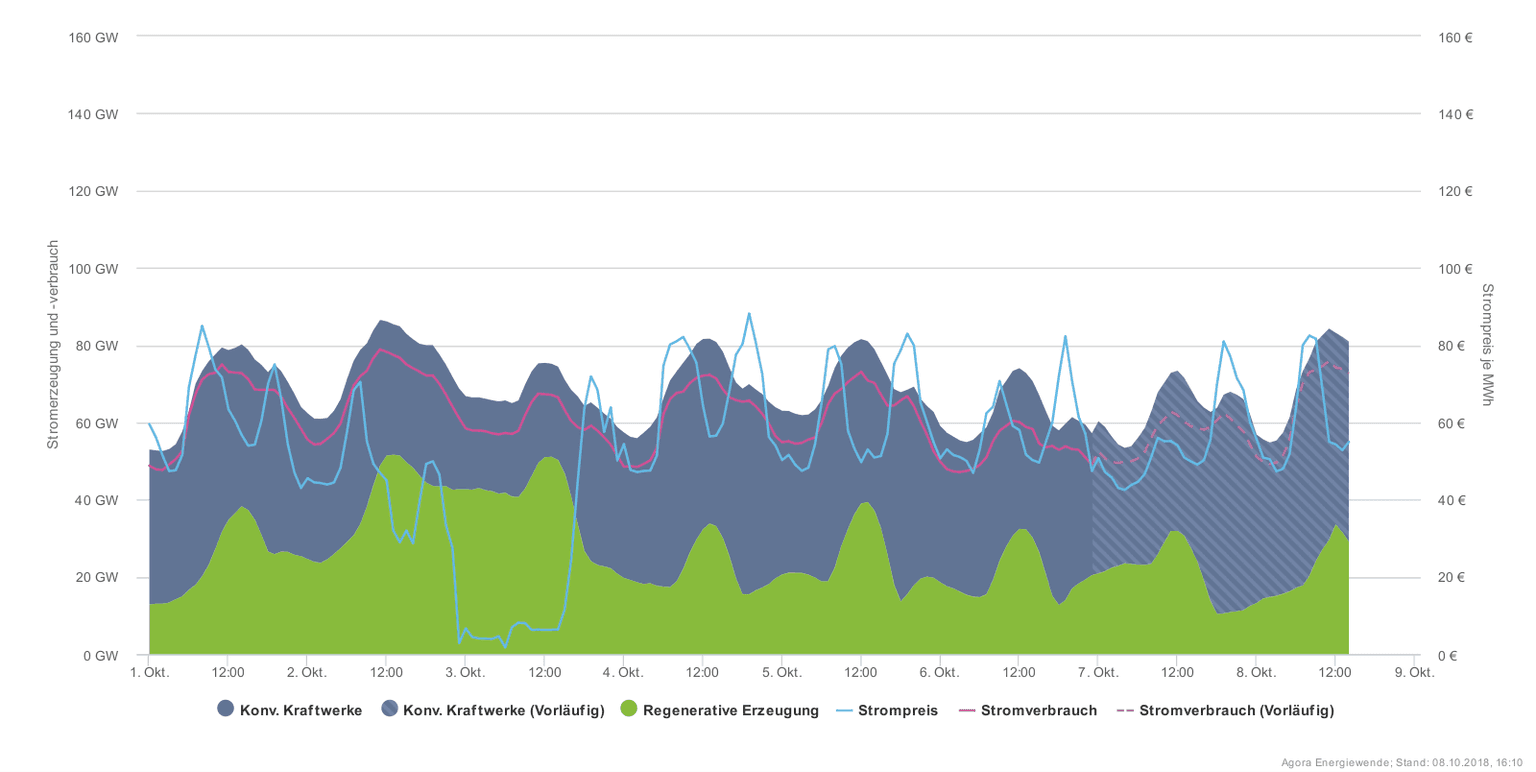
A number of proponents of the German Energiewende assumed that, with falling renewable technology prices and rising prices for carbon allowances and fossil fuels, subsidies for renewables could be abolished. This would be the case where installed capacity is at a reasonable level and does not reach the level of the region's demand. For example, where the capacity of solar units covers daytime peak demand. However, in Germany, installed wind and photovoltaic capacity can each already cover total demand on their own. At times when wind conditions and/or sunshine in the region are ideal, the market price of electricity approaches zero or even becomes negative. New sources of this type will therefore continue to require subsidies in the future. At the same time, the difficulty of integrating new capacities of these sources into the grid is increasing dramatically, as are redispatch costs.
In reducing carbon dioxide emissions, Germany relies predominantly on wind power from the North Sea coast and gas-fired sources to replace coal plants. This route is very expensive and, moreover, Czech conditions do not permit comparable use of wind resources. The path to low-emission energy in the Czech Republic could therefore be achieved mainly through nuclear units.
Costs of nuclear generation
A recent article analyses the cost at which Generation III nuclear units are currently being built, while another compares construction costs for other low-emission sources. It shows that, when differing service lives and corresponding annual capacity factors are taken into account, the costs of nuclear sources are comparable and, considering Czech geographical and other conditions, they are among the lowest here. The costs of renewable sources will certainly fall. However, the costs of Generation III nuclear units should also decline. The units currently being completed are first-of-a-kind prototypes. As the number of completed and under-construction units gradually increases, accumulated experience and optimised supply chains will take effect. In this respect, Russia's Rosatom with its VVER1200 model and Chinese companies with the Hualong One model have a major advantage, as they have been building nuclear units continuously for a long time.
Rosatom already has two years of experience operating the first Generation III+ unit at the Novovoronezh plant, has recently started another, and is completing several more. Two units at Belarus's Ostrovets plant are due to be commissioned next year, giving it reference units abroad. It also has a number of reactors under construction in Russia and several other countries. The first Hualong One reactors are preparing for commissioning as Fuqing units 5 and 6, the first of which should start up as early as next year. If successful, this will be four years after construction began. These reactors are also already being built abroad. China aims eventually to reach a pace of up to ten construction starts of reactors of this type annually. In both cases, there are thus beginning to be sufficient numbers of units for lower costs and overall prices to become apparent.
For the Czech Republic, however, the disadvantage of both suppliers is that they have no reference unit in Europe. Rosatom is relatively close to achieving this. Construction is being prepared for two units of this type at Hungary's Paks 2 plant and one at Finland's Hanhikivi plant. Hungary's foreign minister recently stated that the licence could be issued this year and construction of the Paks 2 reactors would begin immediately afterwards. In Finland, by contrast, the licensing decision appears likely to be delayed until 2020. It will be of interest to follow the development of these projects, not least because Czech companies are involved in them. For China, a key milestone will be the development of the Bradwell B project in the United Kingdom, which is planned to use Hualong One reactors. Work is underway there to obtain a European licence for this type.
However, what has an especially strong influence on the cost of investment in a nuclear source is the financing model used. A nuclear reactor involves a large one-off investment, takes a long time to build and has a long operating life. At the same time, it is exposed to the possibility of political decisions that may undermine operating conditions or even ban the use of nuclear energy during construction or before the end of its total service life. It is therefore highly sensitive to the level of loans, the overall cost of money and the coverage of investment risks. There is a major difference between a nuclear unit construction project guaranteed and backed by the state and one merely ordered from an investor that bears all associated risks. If the investor is the state or a state-owned company, or if the state fully backs construction, the cheapest loans can be obtained and risks during construction and future operation are significantly reduced. Such a financing model is then substantially cheaper. If the state merely procures a service from an investor and leaves all financing and potential risks to it, the model is far more expensive. At the same time, the state can afford not to rush the payback period for an asset with a long service life; for a private investor, rapid payback is essential.
The impact of financing models on the overall cost of investment and the electricity generated can also be seen, for example, in the difference between the expected electricity price from the planned new Paks II units and the price under the “Contract for diference” for the Hinkley Point C project. The Hungarian project is essentially an intergovernmental agreement, whereas the British project transfers financial backing and all risks to a private investor. This explains the high guaranteed price demanded by the investor. It should be recalled, however, that this does not apply only to nuclear sources. Precisely because of the financing model used, the guaranteed “Contract for diference” prices for the recently commissioned Walney Extension offshore wind farm in the United Kingdom, with capacity of 659 MW, are 150 pounds/MWh, considerably more than the 100 pounds/MWh for Hinkley Point C. Let us recall that expected electricity prices from the Paks II project are between 50 and 60 EUR/MWh.
There are, of course, other models based on private investors that can reduce the cost of money and risk insurance. These include the regulated asset base model – RAB – being considered by the United Kingdom, for example. So far, however, they have not been used for nuclear unit construction. An interesting analysis by Jan Žižka was published in his recent article on the oenergetice website.
What affects the ability to efficiently operate and build nuclear units?
Nuclear energy is not the only area in which it is very clear how negative an impact the ideological promotion of strategies detached from reality has on energy development, ensuring its long-term security and an effective path towards low emissions. In Belgium, the Greens' campaign to close ageing nuclear units without a realistic possibility of replacing them with low-emission sources has created fundamental uncertainty for their operator over how long it may use them. It does not know whether to proceed with modernisation and plan for another ten to twenty years of operation, or whether they will be shut down as soon as possible. In 1999, Guy Verhofstadt's government adopted a decision that nuclear units should cease operation after 40 years. For the oldest unit, Doel 1, which began supplying electricity in 1974, this was to have been in 2014. The relevant law banning construction of new units and limiting existing ones to 40 years was adopted by the Senate on 31 January 2003. Gradually, however, it became clear that nuclear power would have to be replaced by fossil sources, and in 2009 the government decided to extend the lifetime of the oldest units to 2025, i.e. 50 years. In exchange, the owners were to pay substantial sums that could be used for renewable energy subsidies. Angela Merkel made a similar arrangement with German nuclear unit operators in 2010. She then revoked it after the Fukushima accident.
In Belgium, the government ended in 2010 before it could adopt the necessary legislative changes. This was followed by a period of political instability and the aforementioned Fukushima I accident. In July 2012, the new government decided that only Tihange 1 would have its lifetime extended to 2025, while Doel 1 and 2 were to close in 2014 and 2015. The remaining units were to close between 2022 and 2025. Deadlines for further steps were not met and, in 2018, the government decided to close nuclear plants in 2025 and began preparing the necessary legislation. It is therefore no surprise that the operator did not rush investments in unit modernisation and maintenance. This is now being reflected in problems with concrete structures and prolonged outages, leading to a risk of an inability to ensure capacity balance during this winter and significant rises in electricity prices for the coming winter period. Due to necessary unplanned repairs, the operation of nuclear units in Belgium will be limited this winter, and in November only one of them will be operating (see here). In practice, this shows where the closure of nuclear sources in Belgium would lead.
Let us recall that Sweden also passed a law to phase out nuclear units which was revoked after it was found that they could only be replaced by fossil sources. Even afterwards, there were several waves of denying the need for nuclear sources and subsequently acknowledging the real situation. This too had significant effects on the operator's approach to modernising and maintaining operating units.
An example of complete disarray caused by the ideological struggle of green activists and the use of energy issues for political conflict by individual political parties is the construction of the Belene nuclear power plant in Bulgaria. In 1989, its VVER1000 units were at a much more advanced stage of construction than Temelín was. Yet, after a series of reversals, precisely due to the use of energy issues for political conflict, the units have still not been completed. Another attempt to complete them is currently getting under way. It is true that Bulgaria's economy suffered a far worse decline than the Czech economy and, even now, does not have an extremely urgent need for new capacity. On the other hand, unlike the Czech region, southern Europe has suffered and continues to suffer from a shortage of installed capacity.
Change in the attitude of Czech green organisations towards nuclear power
In this respect, the latest evolution in the views of Czech environmental activists on nuclear energy is highly important for Czech energy. Green organisations are currently undergoing a rather dramatic change in their attitude towards nuclear energy. This was reflected, for example, in an appearance by Greenpeace climate and energy campaign leader Jan Rovenský in an interview with Martin Veselovský on DVTV. In the interview, held shortly after ČEZ's shareholder meeting (Greenpeace is also a minority shareholder), Jan Rovenský strongly advocates operating existing nuclear units for as long as possible. He would also like Dukovany to remain in operation for a total of 60 years. Acknowledging the necessity of using nuclear sources in the Czech Republic and maximising the value derived from their service lives is a truly radical change in the energy policy of these previously radically anti-nuclear organisations. Let us recall their intensive campaign against construction of the Temelín nuclear power plant and for the rapid closure of Dukovany in the 1990s. Under their energy policy at the time, the Czech Republic should now already have been entirely without nuclear power. Even under Greenpeace's still valid Energy [R]evolution, drawn up following the German model, Dukovany should already be shut down and Temelín should remain in operation for only 30 years in total.
It is clear that this change in fundamental assumptions took place precisely on the basis of the failure of the German Energiewende described in the previous sections. While no parts of settlements or significant environmental features have been destroyed in the Czech Republic for decades, this continues in Germany. Czech activists are therefore travelling to protest in Hambach Forest. They too are beginning to understand that the difference between the situations in the Czech Republic and Germany is predominantly due to the different approaches to nuclear energy in these countries. Just as Czech green activists initially admired the German Energiewende and presented it as a model for the Czech Republic, today they see that Germany has turned from a leader in combating emissions and environmental protection into one of the countries with the highest emissions and shares of coal-fired electricity, as well as a significant advocate of extending intensive use of fossil sources.
Proposed scenarios
Let us now look at the scenarios recommended for Czech energy by various groups. The first could be called the speculative investor scenario. It is best described by the aforementioned Michal Šnobr, Czechia's best-known and most successful investor focused on speculative short-term gains. It should be said that he is highly successful in this field and built extensive wealth precisely through short-term share speculation. He is a minority shareholder in ČEZ and leads a group of speculative investors associated in Cypriot companies. They focus on quick profits and rapid appreciation of shares bought for the short term. They therefore have no interest in long-term investments that yield benefits only over a longer horizon. They are thus also opposed to the construction of new nuclear units. Instead, they are interested in extracting the maximum possible value from ČEZ's existing assets, or in the prospect of doing so, which would lead to a rise in its share price. This is why Michal Šnobr advocates the longest possible use of nuclear units, including achieving a 60-year lifetime at Dukovany. Likewise, he is interested in extending the use of other existing sources as much as possible, including coal-fired ones. Among new projects, he recommends rapidly implementable decentralised investments in subsidised renewables and gas. This also relates to his advocacy of the closest possible alignment with Germany and its energy sector. As Michal Šnobr very knowledgeably explains in his continuation of the German dawn description, this will involve a very intensive transition to Russian gas. Rapid changes and fluctuations in allowance, gas and electricity prices under such an energy scenario in the region promise enormous potential for speculation precisely in allowance, gas, electricity and energy company prices. And thus potentially major profits for the speculative investors associated in Cypriot companies under his leadership. It should also be remembered, however, that electricity consumers will pay these speculators' profits. If this scenario is implemented, there is indeed a high likelihood that his predictions and expectations will be fulfilled.
The second is the environmentalist activist scenario. As described, this has undergone the greatest changes. Now, at least in Jan Rovenský's presentation, it too hopes for the longest possible operation of existing nuclear units. At the same time, green organisations advocate the fastest possible move away from coal and a focus on decentralised renewable sources. As in Germany, they believe gas should replace coal and nuclear power. In principle, their scenario is therefore very similar to that of the speculative investor. They merely demand a much faster coal exit. However, this scenario does not make it possible to meet their principal objective of dramatic and rapid cuts in carbon dioxide emissions. Replacing coal with gas halves carbon dioxide production, but replacing nuclear power with gas increases it. Carbon dioxide production would therefore decline, but not dramatically.
Both the first and second proposed routes essentially lead towards a “Second Bavaria” scenario, namely an energy system based on the dominance of gas and imports of wind power from northern Germany, as described, for example, here.
The third is the scenario of the updated State Energy Policy. This too recommends operating the existing nuclear units at Dukovany and Temelín for as long as possible. It relies on the most efficient possible use of renewables in a decentralised form and increased use of decentralised gas-fired sources. It also places emphasis on strengthening the grid and its ability to integrate renewable sources. It intends gradually to replace coal sources with nuclear ones and thus envisages new reactors at both Dukovany and Temelín. Over the following few decades, a transition to a low-emission combination of nuclear and renewable sources would take place. This scenario is described in detail in the update of the State Energy Policy adopted in mid-2015. The scenario and its context are also described in detail in the recently published book Czech energy at a crossroads, prepared on the basis of a study by a group of authors for the Czech Chamber of Commerce. Participants at the Energy 2018 conference also recently endorsed it in their conclusions.
Conclusion
It is very interesting and positive that all three scenarios described agree on two points. The first is the emphasis, including for Dukovany, on 60 years of operation. This is a very promising area of agreement that could enable joint action by the dominant part of Czech society in this direction. This is very important because very strong political pressure from Germany and Austria, particularly to close Dukovany, can be expected. Green activist movements could help here above all by explaining to their partner organisations in those countries that long-term operation of Dukovany is in their interests as well. This could avoid situations in which, for example, German green activist organisations intensively campaign against the operation of Belgian nuclear units, including through fake reports of invented accidents (for more detail see here). A joint declaration by all political and activist parts of society would give the operator a strong assurance that it can safely operate the units for the said 60 years. At the same time, it would create pressure for intensive operator care in the maintenance and modernisation of nuclear units, ensuring safe and efficient operation throughout that period.
The second area of agreement is support for developing decentralised use of renewable sources, mainly for self-consumption. This chiefly involves creating an environment with minimum bureaucracy, easily securing grid connections where grid stability is not threatened, and easily establishing independent islands combining different renewable sources, batteries and other control elements. This area and its importance in addressing grid regulation issues are also described in the aforementioned book Czech energy at a crossroads.
In these areas, strong agreement across society could already be reached now, and matters could move forward at least in this respect. In particular, support from green activist organisations could help significantly in ensuring the long-term operation of Dukovany. I was originally very sceptical about the possibility of its operation beyond 50 years, mainly in view of the position of Austria and Germany. But in the event of a change in the attitude of Czech green activists, I would see this much more optimistically.
If the Czech Republic decided to implement the scenario of the updated State Energy Policy and build new nuclear units, it would need to decide on a financing model and select a supplier. Most important, however, is securing broad and long-term support for the choice made. As described, the cost of a nuclear source depends very strongly on the chosen investment model, which determines the cost of money and financing for investment risk insurance. If the state guarantees construction, the lowest possible cost of the required loans can be achieved, while investment risks and thus the cost of insuring them are also reduced. Securing stable support for nuclear energy and for specific new reactor projects across the broadest possible political and social spectrum reduces risks to the construction and operation of the completed asset in the event of political change in the country. In the Czech Republic, support for building new nuclear units is very broad among political parties and in society. Among political parties, only the Green Party is opposed. However, selecting a specific financing model and reactor type is another matter. Each has its positives and negatives, and none is ideal. It is therefore necessary to ensure support for the adopted model and project throughout the construction period, including from actors that preferred other options. It should be achieved that nuclear energy and implementation of a particular construction option are not used in political conflict. Agreement and joint pressure from all actors in the political and social sphere are another factor enabling suppliers to be directed towards rapid, high-quality and efficient construction. Above all, this would prevent events similar to those occurring during construction of the Belene plant in Bulgaria.
Both scenarios based on using gas and the one using nuclear power are feasible. Each has its advantages and disadvantages. A turning point could occur if the dominant influence of anthropogenic carbon dioxide production on the climate and the need for truly rapid cuts in its emissions were confirmed (see, for example, the recent UN statement). In that case, rapid reduction in the use of gas for electricity generation would also be needed, not only because carbon allowance prices would then most likely rise dramatically. An energy system based on gas scenarios would then be a dead end.
Finally, it is important to analyse one further aspect of the scenarios described. In the case of the gas-based ones, there would be a dominant dependence on Russian gas, even if it were imported via the Nord Stream pipeline through Germany. Let us assume that the Czech Republic decided to build Russian VVER 1200 units. What would Czech dependence on Russia look like in this case? All Czech nuclear units are of Russian origin, but their operation, maintenance and all upgrades are carried out independently of Russia. Fuel can be purchased and stored years in advance, and it is also supplied by companies outside Russia. A large share of components and technologies for potential new units would be supplied by Czech companies with extensive experience of these reactors. Completion of two Russian VVER440 reactors at Slovakia's Mochovce nuclear power plant is being carried out independently of Russia. The separation and independence of Ukraine's nuclear energy sector from Russia is progressing much faster than the reduction of its dependence on Russian gas. It will be interesting from this perspective to see whether the completion of the VVER1000 units under construction at Ukraine's Khmelnytskyi nuclear power plant using Czech companies, as has been considered, is implemented.
Creating a successful energy policy and, above all, enforcing it depends very strongly on the abilities of a country's political representation. On the other hand, what else but ensuring the long-term security and sustainable prosperity of their country should be politicians' task? Ensuring long-term secure and sustainable supplies of environmentally produced and economically affordable energy is one of the essential basic elements.
Written for the oEnergetice and Osel websites.
Featured image: Construction site of the VVER1200 Hanhikivi 1 unit in Finland (source: Fennovoima)
Translation disclaimer
This article is a machine translation of the Czech original and has not yet been fully reviewed. In case of any doubt, please refer to the Czech version.