10 September 2026, 15:21
Loading...
Electricity prices again fell into negative territory over Easter in Czechia
Daniel Grecman
4 April 2024, 16:49

Last year, during Easter, the operator of the Czech electricity transmission system, ČEPS, had to disconnectphotovoltaic power plants (PV) with a capacity of approximately 400 MW for two hours in order to maintain system balance. This drew widespread public attention, as the disconnection occurred at a time when electricity prices on the spot market would normally exceed 150 EUR/MWh. During last year's Easter, however, prices fell into negative territory despite the above-mentioned circumstances – there was an energy surplus as a result of lower consumption during the holidays. And the situation was repeated this year – there was an energy surplus on the market and spot prices again fell into negative territory.
Renewable generation curtailment
Last year, the disconnection of PV plants with a capacity of approximately 400 MW for two hours during Easter caused a stir. Spot electricity prices were normally above 150 EUR/MWh at the time, and Europe was anxiously awaiting the coming winter. Concerns focused in particular on sufficient supplies of natural gas, which is also burned to generate electricity. The disconnection of PV plants therefore came as a surprise to many.
Some market participants, as ČEPS stated at the time, incorrectly estimated PV generation (underestimated it), while others incorrectly estimated customer consumption (overestimated it). Similar situations were occurring in neighbouring countries, meaning that cross-border assistance could not be relied upon to a sufficient extent. This combination resulted in a significant electricity surplus on the market for two hours.
If conventional sources, primarily coal-fired power plants in Czechia, were disconnected, however, the plants would not be able to ramp down and then quickly ramp back up when they were needed again. Their ramp-down and ramp-up rates are precisely determined. Renewable sources, such as PV plants, on the other hand, can be disconnected from the grid very quickly and brought back online just as quickly. Albeit at the cost of compensation for the affected generators. However, this is not yet standard practice, but rather an exception.
The curtailment of renewable energy sources (RES) is relatively common in countries that are ahead of Czechia in renewable deployment. One only needs to look at neighbouring Germany and the curtailment of offshore wind generation. As renewable sources continue to expand, supply will increase during hours when the sun is shining or the wind is strong, while the question will be the level of demand at the time. Easter, when electricity consumption falls compared with ordinary days, may therefore offer a window into the future.
Will renewable generation curtailment increase further?
In Czechia, PV generation can reach around 2000 MW around noon at the current installed capacity (installed capacity is approximately 3.6 GW including small PV systems), but a few hours later it will be just 200 MW. This is one of the reasons why gas-fired power plants are being promoted – their ramp-up and ramp-down rates are substantially shorter than those of coal-fired power plants, making them better suited to complement variable renewables.
System load, or consumption, in Czechia may be around 6.5-7 GW during Easter, see the chart below. Solar power plants in Czechia can supply approximately 2 GW to the grid at noon. This naturally varies from day to day. Nuclear power plants, which are more difficult to regulate, provide a stable output of up to 4 GW. Lignite-fired plants account for another 1 GW; again, they cannot be completely shut down within a short time window, although their output can be reduced.
The result is that if the weather is good during holiday periods, there will always be electricity surpluses. An energy surplus on the market then means negative prices, while prices rise sharply as soon as PV generation "leaves" the market. After all, 2 GW is already a considerable amount of capacity, and dispatchable sources that may have been pushed out of the market precisely because of PV generation must ramp up.
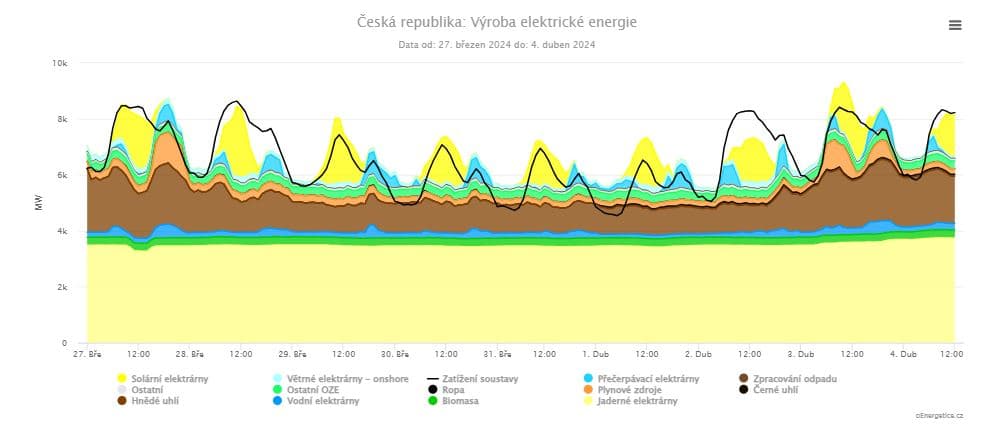
Electricity generation in Czechia between 27 March and 4 April this year. Source: Energostat
There are several possible scenarios for the future – 1) renewable sources being disconnected to an ever greater extent; 2) the installation of fast dispatchable sources that can ramp down and up within the required timeframe, with renewable curtailment occurring only rarely; 3) more battery storage installations, which would make it possible to reduce fluctuations in renewable generation for the required period, thereby ensuring compatibility with some existing sources as well.
However, the energy market is significantly distorted as a result of subsidies, whether operating or investment subsidies. The market is therefore losing some of its ability to respond to market signals, and external intervention is needed to steer it in the intended direction. This external intervention means state intervention, which should clearly define the future direction, again through subsidies. These go hand in hand with the development of renewable energy sources.
Translation disclaimer
This article is a machine translation of the Czech original and has not yet been fully reviewed. In case of any doubt, please refer to the Czech version.
Sdílejte článek prostřednictvím:
You might also like

10 September 2026, 10:37

9 September 2026, 15:05
9 September 2026, 13:24