
23 October 2026, 14:38
Loading...
Natural gas storage facilities in Czechia
Dian Hrozek
8 May 2022, 06:18
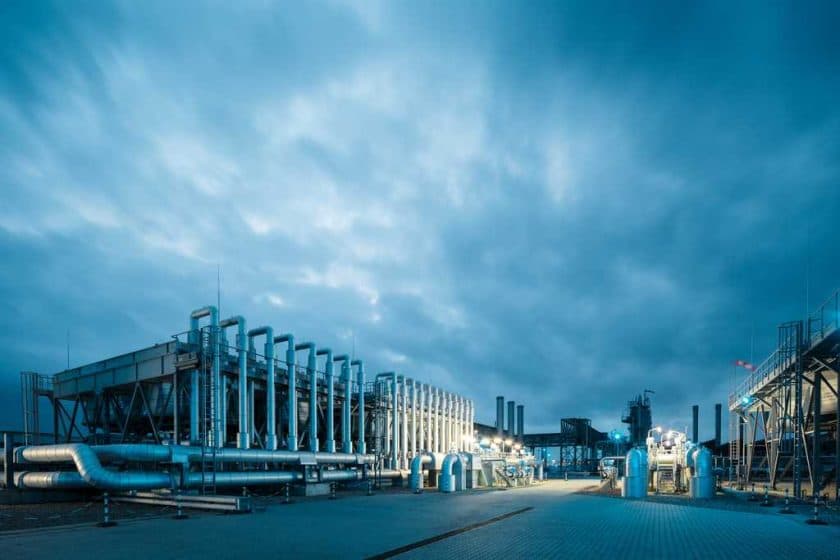
Underground natural gas storage facilities have been part of the Czech gas industry for several decades. They have a significant impact on ensuring natural gas supplies at affordable prices, particularly during the winter months. Unlike electricity, natural gas makes it possible to store large amounts of energy. This takes advantage of the physical property of gases—their compressibility—which makes it possible to store significant amounts of energy in a small volume. Several underground gas storage facilities (UGS) currently operate in Czechia, with the aim of balancing seasonal fluctuations in gas consumption, safeguarding security of supply and helping to stabilise prices of this valuable commodity.
Technical design
According to the definition in ČSN EN 1918, an underground gas storage facility (UGS) comprises all subsurface and surface installations necessary for gas storage. In most cases, natural or artificially created underground spaces located between geologically impermeable layers are used. An underground gas storage facility may therefore, for example, be an old depleted oil/gas field or a purpose-built space. During part of the year (usually in summer), gas is injected underground so that it can be extracted again when needed (most often in winter) and returned to the gas transmission network.
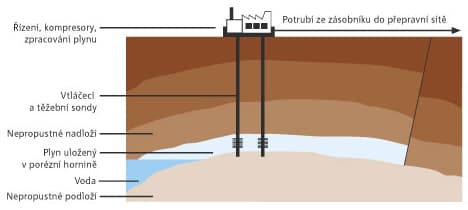
Storage facilities are divided by type into:- Porous storage facilities
These are depleted oil and natural gas fields. Storage takes place in small pores and fractures in solid rock. Gas is thus returned to places where it was originally located. A specific type of such storage facility is an aquifer, an underground water reservoir. By displacing water to greater depths, these spaces can be filled with gas, which can then be extracted again when needed.
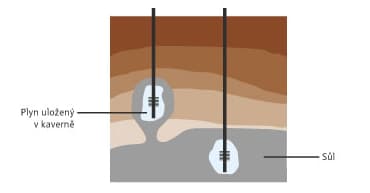
- Cavern storage facilities
These are artificially created storage facilities. They may be former salt or, for example, coal mines. The advantages of cavern storage facilities are ease of control and high injection and withdrawal rates.
Purpose
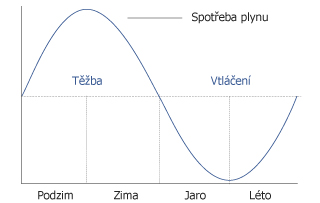
Historically, the primary purpose of UGS facilities was to optimise the use of the gas system. Gas consumption is uneven throughout the year, and if infrastructure were sized for peak consumption (during winter), the entire network would not be fully utilised for most of the year, resulting in inefficiency. UGS facilities were built to balance seasonal differences in gas consumption.
However, the purpose of UGS facilities has gradually changed over the past two decades. During market liberalisation and unbundling, their main purpose became financial hedging against high gas prices during winter. Energy suppliers purchase gas during the summer, when lower consumption makes it cheaper than during winter. They then store this so-called "summer gas" in UGS facilities for winter, when they would otherwise have to buy gas on the market at a higher price. Another advantage of UGS facilities is the possibility of using stored gas at short notice to cover peaks, eliminating the need to buy expensive gas on the spot market in the short term.
Underground gas storage facilities are often referred to as an energy security "insurance policy" in the event of an interruption to gas supplies to Czechia. This applies particularly during the winter period, when underground storage facilities are full. Interest in UGS facilities traditionally increases during autumn, when debates commonly arise about the potential impact of an interruption to natural gas supplies to Czechia.
Storage facilities in Czechia
Currently, all companies operating underground gas storage facilities in Czechia must hold a licence from the Energy Regulatory Office (ERÚ). This licence authorises them solely to store gas and prohibits other activities, such as energy trading. At the beginning of 2022, there were four UGS operators in Czechia licensed by the ERÚ:
- RWE Gas Storage CZ, s.r.o.,
- MND Energy Storage a.s.,
- Moravia Gas Storage a.s.,
- SPP Storage, s.r.o.
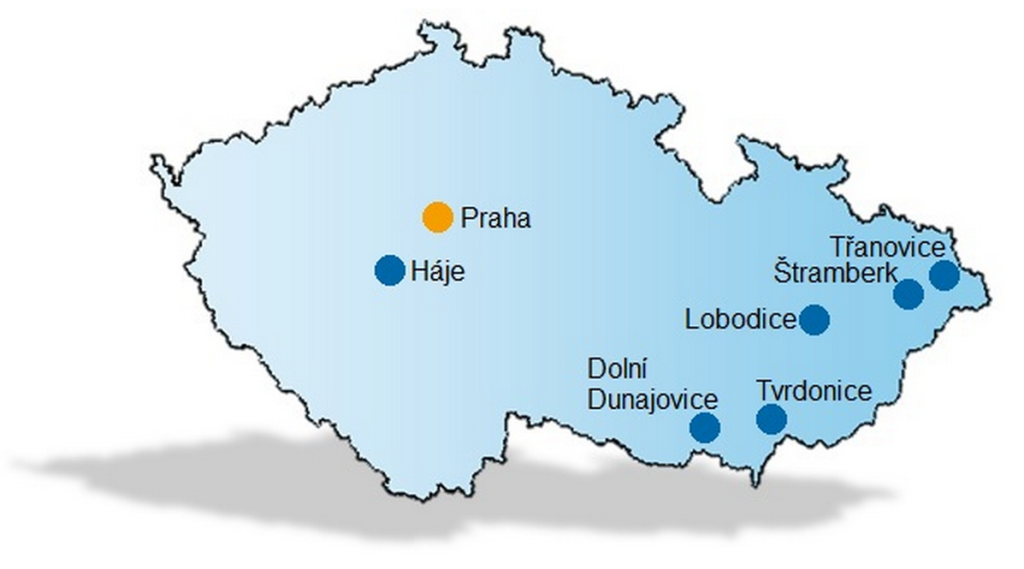
These operators run nine UGS facilities in Czechia. However, it should be noted that the Dolní Bojanovice facility, operated by SPP Storage, is not directly connected to the Czech gas system but forms part of the Slovak gas network. Consideration is currently being given to connecting this UGS facility to the Czech network as well.
The capacity of UGS facilities connected to the Czech gas network is 36,9 TWh, which, for 2020, for example, represented around 40 % of annual natural gas consumption across Czechia. In recent years, gas consumption in Czechia has been around 8,5 billion cubic metres per year (approximately 90 TWh). The following table summarises the technical parameters of gas storage facilities in Czechia.
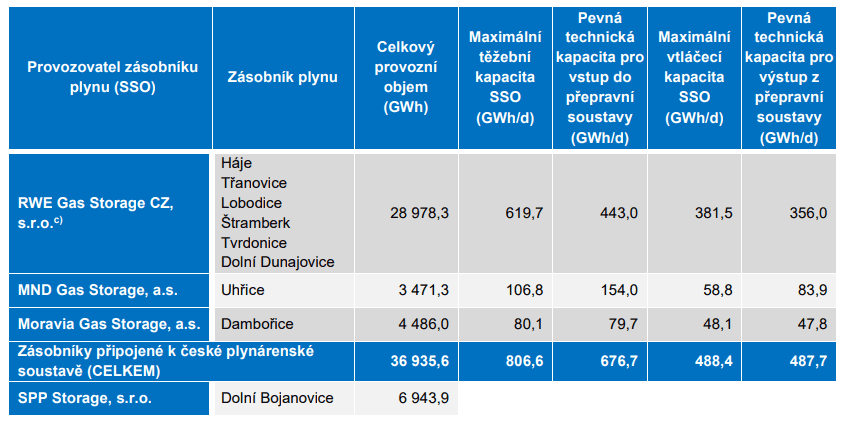
The largest underground gas storage capacity is held by RWE Gas Storage CZ, which operates storage facilities with a capacity of almost 29 TWh. These are six facilities which together form one virtual storage facility. Technically, they comprise 4 gas fields, one aquifer (the Lobodice UGS facility) and one rock cavern (the Háje UGS facility).
Storage economics
Thanks to gas market liberalisation, gas can be stored not only in Czechia but in any EU country. Storage prices are governed by market mechanisms, and parties seeking to store gas can purchase available storage capacity in regular electronic auctions. Auction reserve prices are based on wholesale gas prices on the exchange, with the difference between the so-called "summer and winter gas price", known as the SW spread (Summer-Winter spread), serving as an important indicator.
Legislation and regulation
Storage operators are private companies acting in their own economic interests. The operation of storage facilities is governed by market principles, and legislation sets only a few conditions that operators must meet. One such condition is, for example, the publication of storage facility outage plans on their websites, as well as the obligation to publish current UGS fill levels and daily values for certain technical parameters.
Storage operators also comply with the Equal Treatment Programme, which aims to ensure the non-discriminatory position of market participants. The Energy Regulatory Office (ERÚ) therefore determines what information must be announced to interested parties in advance before storage capacity is sold at auction. Auction terms are published online, and the ERÚ monitors and assesses them.
Gas storage operators are also indirectly affected by legislative and regulatory interventions by other energy market players. Since 2012, for example, a decree on emergency situations in the gas sector has been in force, requiring gas suppliers to ensure the so-called security standard for protected customers. It requires at least 30 % of planned annual gas consumption to be covered by gas stored in UGS facilities (in Czechia or in other EU countries). This decree thus also indirectly affects gas storage operators.
Translation disclaimer
This article is a machine translation of the Czech original and has not yet been fully reviewed. In case of any doubt, please refer to the Czech version.
Sdílejte článek prostřednictvím:
You might also like
23 October 2026, 11:01

23 October 2026, 06:34