23 October 2026, 14:38
Loading...
A turning point in Czech energy: how realistic is Fakta o klimatu’s view?
Vladimír Wagner
29 September 2024, 08:39
The adverse effects of the energy policy pursued in the European Union are becoming increasingly apparent. It is becoming clear that renewables alone cannot deliver the transition to low emissions and that a stable low-emission source in the form of nuclear power is needed. Yet studies by the Fakta o klimatu organisation still claim that we can immediately shut down coal-fired plants and do not really need nuclear sources either, because cheap electricity from photovoltaics and wind turbines will provide everything. Let us look at the facts showing that this is more a case of Climate illusions
In an article published when Germany’s last nuclear units were shut down, Oldřich Sklenář presents the idea that Germany’s path towards low-emission energy is the right one and should be followed. He is an analyst at the AMO Research Center, who also works in energy for the Fakta o klimatu organisation. The same organisation has published a number of studies promoting the idea that Czechia’s path to cheap electricity lies in installing the largest possible photovoltaic and wind capacities as quickly as possible. Its current study is Electricity generation in Czechia without coal. It too seeks to advance the idea that we can simply shut down coal plants immediately and import the missing electricity. At the same time, in its longer-term visions, the organisation argues that we should not rush to build nuclear sources and should instead manage without them, following Germany’s example. Let us look in more detail at why its models and ideas are, in reality, flawed and illusory.
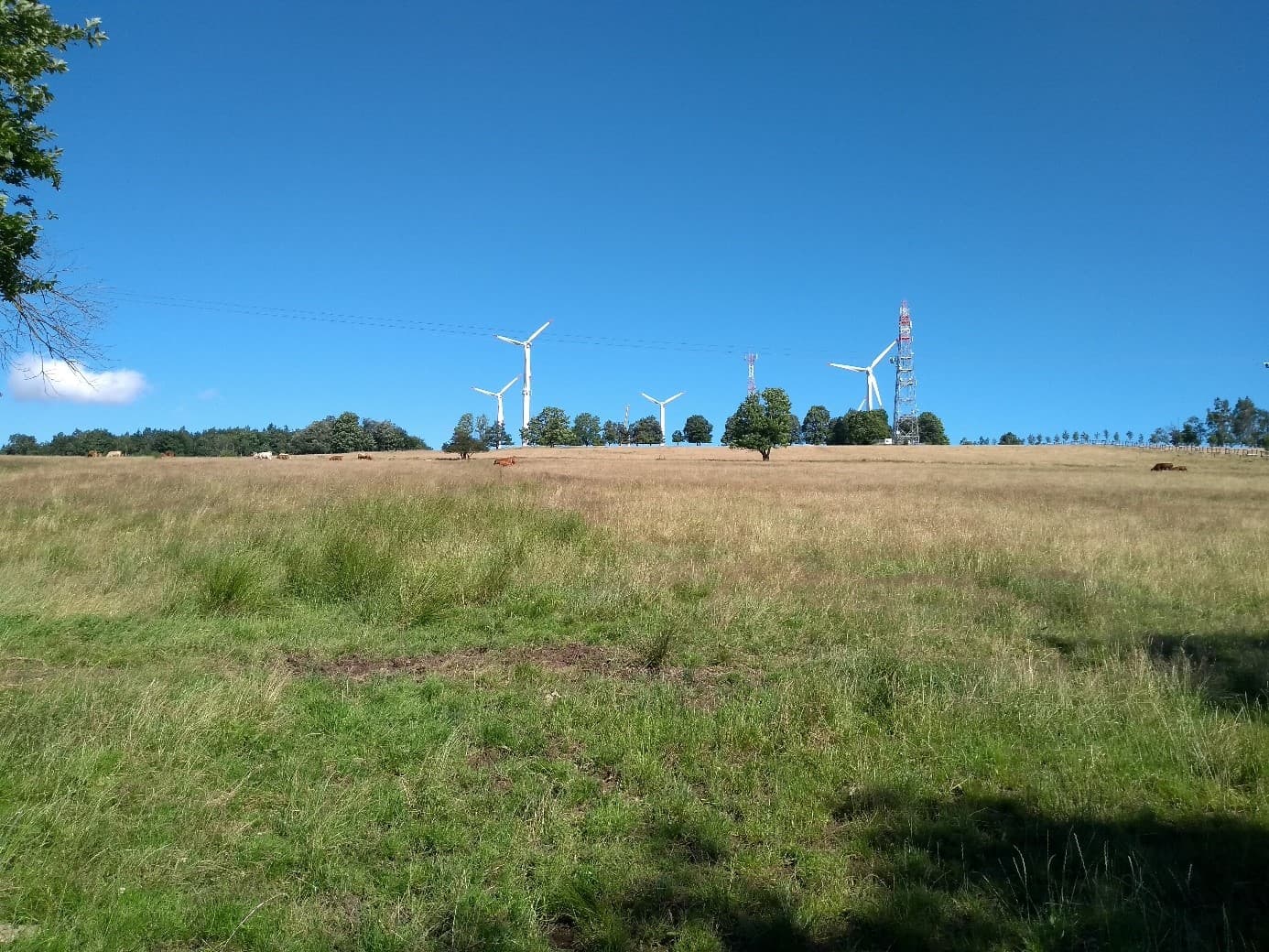
Will massive wind turbine construction help us achieve cheap electricity, as the Fakta o klimatu organisation claims? (Author’s photo).
Will electricity from photovoltaics and wind really be cheap?
Fakta o klimatu starts from the notion that at present, when the costs of building photovoltaic and wind capacity are relatively low, low prices can be achieved through their massive deployment. This is not true, however. These sources can realistically contribute to lowering electricity prices only if their share of total generation is relatively limited. Only up to the point where they do not begin to dramatically affect the grid and do not need to be curtailed. In principle, this upper limit is roughly a share of total electricity generation equal to the annual capacity factor of the installed capacity. In Czechia, this is around 10 % for photovoltaics and around 20 % for wind turbines.
The more this limit is exceeded, the more frequently generation exceeds demand and part of the output must be shut down; conversely, ever greater capacity of replacement sources must be kept on standby to start up when the sun is not shining or the wind is not blowing. In such a case, the costs of grid and balancing services begin to rise, dramatically so as the limit is exceeded further. At the same time, the costs of operating subsidies for these renewable sources rise.
Let us consider the problem with price formation in the Fakta o klimatu model. It includes only the price of wholesale electricity. In reality, however, as the share of variable renewables grows, the price of grid and balancing services and the costs of operating subsidies for renewable sources rise ever faster. This regulated component then accounts for an ever larger share of the total electricity price paid by the customer, while the wholesale electricity price accounts for an ever smaller share.
The study’s authors determine the price according to the system used to form the spot price on the exchange. It should be recalled that only a small portion of electricity is actually traded on the spot market. Above all, stable sources that do not depend on weather and whose output is predictable over the long term sell a large share of their production years in advance through forwards, as baseload cover. We will return to this in greater detail later.
Now let us imagine a period of ideal sunny conditions, when excess capacity leads to very low, even negative, wholesale electricity prices. Let us recall why negative electricity prices occur. They arise because photovoltaics receive operating subsidies, and if the magnitude of the negative price is smaller than this operating subsidy, it remains worthwhile for the photovoltaic plant operator to keep the plant running. If this electricity is bought by consumers in the country that provides the operating subsidy, customers will not see any reduction in the total electricity price, because the saving on the wholesale electricity price is paid through the part of the regulated component determined by the cost of operating support for these photovoltaic sources.
A different situation arises when this photovoltaic electricity is imported, for example when Czechia imports it from Germany. In this case, consumers here genuinely see a reduction in the total price. Their wholesale electricity price falls, while they do not pay subsidies for operating support of this photovoltaic source through the regulated component; German residents pay those. Since conditions for renewable sources are generally similar at a given time in Czechia and Germany, or among other neighbouring countries, the proper way to reduce electricity prices is not to build large photovoltaic and wind capacities at home, but to import photovoltaic and wind electricity from neighbours where they have intensive operating subsidies and plan to build very large capacities.
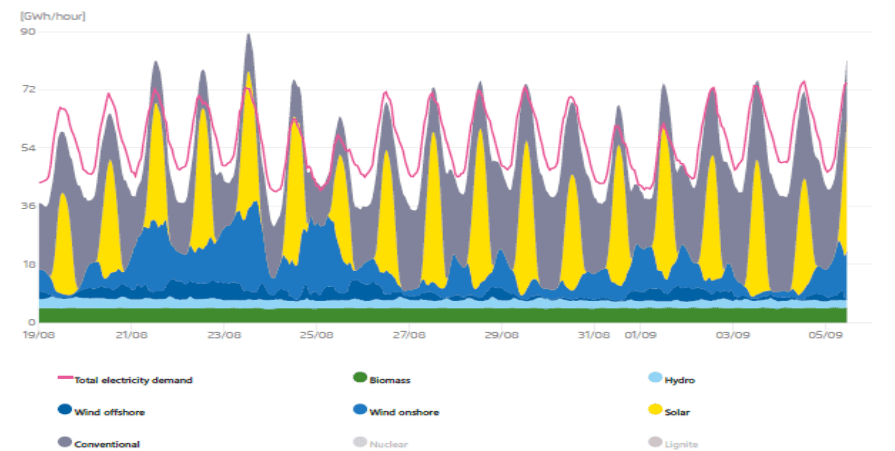
Germany from 19 August to 5 September 2024, at the end of summer. Even when there is plenty of sunshine and wind as well, conventional sources must run to provide balancing and be ready for periods without sunshine. Germany exports at such times. Conversely, it imports intensively when the sun is not shining. The grey area is fossil sources, yellow is solar, blue is wind turbines, dark blue is offshore wind turbines, very light blue is hydro and green is biomass; the light purple line is consumption. (Source: Agorameter).
That even supporters of renewable construction in Czechia are aware of this reality is evident from their increasingly strong pressure for Czechia too to adopt operating subsidies. They and the banks understand that, at the planned enormous installed capacities, their projects without operating subsidies will be cannibalised by the subsidised ones in Germany. If we also provide operating subsidies to large photovoltaic parks, they will cannibalise the unsubsidised small sources built to date, which will then be able to expect almost no revenue from supplying the grid.
If Germany plans to install enormous photovoltaic and wind capacities, then it makes sense in Czechia to build these sources only to a limited extent, in decentralised form and well integrated into the grid. It makes sense here to build sources with stable, weather-independent generation that can also support balancing. In other words, a complement to the German mix, not a copy of it.
Among low-emission sources, nuclear plants are such sources. They need not be threatened by cannibalisation by subsidised renewable sources either. This is because their output is independent of weather and can be reliably forecast. They therefore generate even when the sun is not shining and the wind is not blowing. Their electricity can thus be sold far in advance, and customers requiring stable supplies at a stable and guaranteed price are happy to buy it ahead of time. Data centres are one example, and this is also why the US is currently considering restarting shut-down nuclear units. Even now, ČEZ sells most of its nuclear output years in advance at an appropriate price.
This cannot be done with wind or photovoltaic sources. If the wind does not blow or it is cloudy, you must buy the electricity needed to meet your commitments in a tight market and at a high price. You can combine wind turbines with, for example, a biogas unit or hydropower plant to create a system that guarantees the same stability as a nuclear plant and covers baseload, but this is not possible with the very large installed wind and photovoltaic capacities advocated by the authors of the Fakta o klimatu study.
Fakta o klimatu looks only at the wholesale electricity price and does not take account of the real situation in which a large share of baseload electricity is sold far in advance. If it applies this approach to a mix with an extreme share of weather-dependent photovoltaic and wind plants and ignores its effect on the regulated price in the form of balancing costs and operating subsidies, it obtains utterly nonsensical results on the benefits of this path for customers, as happened in its study. This is not about facts, but merely illusions. Until large-scale storage becomes a real possibility, this path cannot lead to a positive outcome. After all, even now we do not see countries with a high share of photovoltaic and wind plants having low electricity prices for customers.
Can we really shut down coal plants without consequences?
In the mentioned study, Fakta o klimatu claims that we can already shut down all coal-fired plants without risking an electricity shortage. Yet here too, its reasoning and modelling neglect certain key points. There are two fundamental ones. The first is that it does not take into account the need for grid balancing and stability, and assumes a priori that ČEPS will always solve everything. That may not be true in a situation where all coal plants are shut down and replaced by large photovoltaic and wind capacities.
The study also relies on imports to solve any electricity shortage. However, it does not take account of the physical and technical possibilities for transporting electricity across Europe. Let us recall that Germany currently cannot, and will not be able for at least several more years, to transport the necessary volume of electricity from northern to southern Germany. Therefore, if there is an inversion weather situation in our region, our neighbours will not help us because they will have problems themselves. Nor will it help us if the wind is blowing in Spain, Norway or southern Italy.
Such periods can of course be overcome. I experienced a period of changing weather and extreme frost around the turn of 1978 and 1979, when frozen coal had to be dug out of frozen wagons with pickaxes and jackhammers. Industry came to a standstill and coal holidays were declared. That crisis, as well as several other smaller ones that I also remember, was overcome. Floods and their consequences can also be overcome. And situations involving electricity shortages under the concept proposed by Fakta o klimatu would probably be overcome in a similar way.
The real problem arises when there are too many such events, when industry cannot rely on even somewhat longer-term stability of electricity supplies. And studies by ČEPS show that such periods of supply shortfalls will become more frequent here. Multi-day and even multi-week inversion periods are not really that exceptional. It should also be recalled that ČEPS relies in its models on data reported by individual countries. Germany’s ideas about the potential of its energy mix are painted rosy, just as in the mentioned Fakta o klimatu study. The physical and technical problems of electricity transport are also not fully included.
An even more dramatic problem that will arise if coal plants are shut down concerns our district heating sector. It is still, and will remain for many years, heavily dependent on coal. If coal-fired power plants are shut down, however, coal demand will fall dramatically, and coal of poorer quality in particular will no longer be purchased at all. Mines will thus become unprofitable and their operators will close them. Much of district heating and many households will be left high and dry. The study’s authors at least partly realise this. They therefore propose state support to keep at least one mine in Bílina and one power plant in Ledvice. District heating plants should also become much more involved in electricity generation to improve their economics. I will not pretend to be a district heating expert, but according to those I know from the sector, this will not be enough.
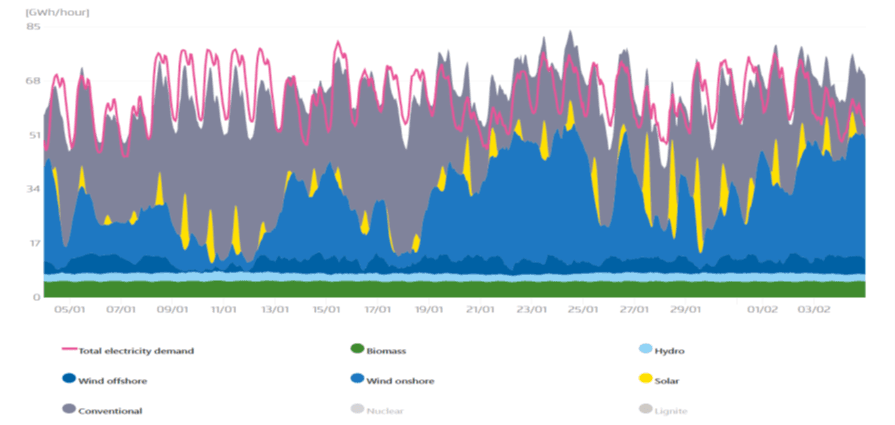
January 2024 in Germany: the grey area is fossil sources, yellow is solar, blue is wind turbines, dark blue is offshore wind turbines, very light blue is hydro and green is biomass; the light purple line is consumption. Will Germany really supply us with electricity when there is no wind for several days? (Source: Agorameter)
In this part of the study too, this is not really about facts and reality, but only illusions. And extremely dangerous ones. By declaring that it is possible to let (almost) all coal plants close now without any impacts, Fakta o klimatu is sending politicians a very dangerous signal. It tells them they need do nothing to preserve coal sources until a low-emission replacement is available. And politicians like doing nothing best. We could thus find ourselves in a situation in which we shut down our coal plants within a few years while Germany continues using its own for decades. We might then import Germany’s expensive coal-fired electricity during adverse weather.
The Germans, like the Poles, negotiated capacity payments for their coal plants and the possibility of continuing their operation. Our politicians, partly as a result of being persuaded by groups such as Fakta o klimatu that leaving coal is easy, neglected this. Now the same groups are persuading them that it can no longer be negotiated because the EU now takes a different view. In my opinion, if our politicians, with the support of society as a whole, submitted a well-designed plan for capacity payments or another mechanism and clearly justified the need to operate coal units, they could secure its approval from EU bodies. A number of failures surrounding forcibly promoted unrealistic visions, not only in energy but also, for example, in the automotive industry, are already becoming apparent, so the EU might be far more receptive to such a proposal.
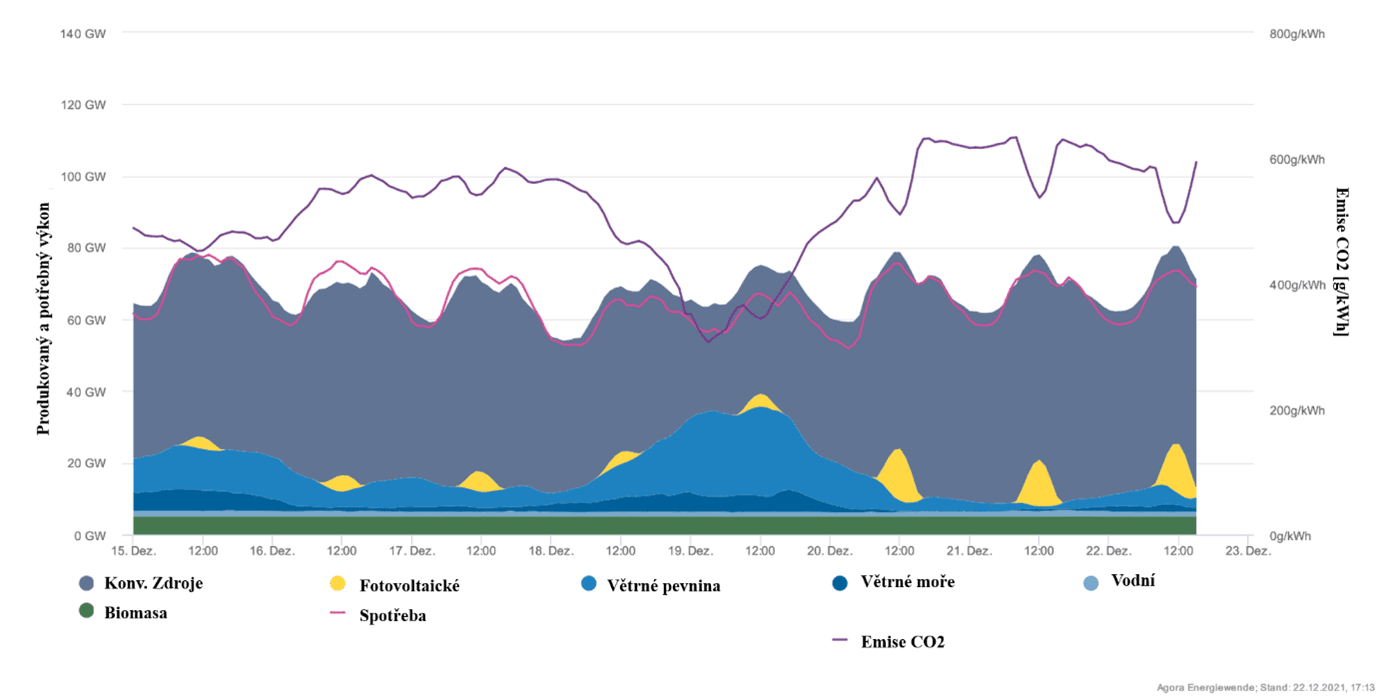
This is what an ordinary winter week in Germany can look like as well (the week before Christmas 2021), and it is not even a dramatic inversion. The grey area is fossil sources, yellow is solar, blue is wind turbines, dark blue is offshore wind turbines, very light blue is hydro and green is biomass; the light purple line is consumption and the dark line emissions. (Source: Agorameter).
Will the path proposed by Fakta o klimatu really lead to low-emission energy?
We will not manage without approval of capacity payments or another instrument for operating natural-gas power plants if, following the recommendations of the Fakta o klimatu study, we seek to replace coal plants by building gas-fired plants. We still have no idea of the instruments for financing them, such as capacity payments. We do not know how long they can operate or when they will need to be shut down or converted to use hydrogen. No investor will undertake their construction until these issues are resolved.
Massive use of gas to replace coal has other snags as well. Its use in heating has a clear environmental rationale and has dramatically contributed to cleaner air in gasified municipalities. Its expansion into large-scale district heating also makes sense. However, its massive use for electricity generation does not make much sense here. Natural gas will now reach us predominantly via Germany, including liquefied gas from the United States.
Methane, an even more potent greenhouse gas than carbon dioxide, is released during extraction, especially fracking, liquefaction, regasification and transport. If the European Union begins to take this factor into account when setting the number of emissions allowances, natural gas may not be much better off than coal was. The following question is also pertinent: if coal plants close, where will the European Union get the money from emissions allowances that it wants to use for renewable subsidies and addressing the social impacts of the energy transition?
It is also questionable whether, with intensive use of gas for electricity generation, we will have sufficient transport capacity to bring it here. As I mentioned, the main routes run through Germany, which will itself need enormous amounts of gas. Our gas experts are therefore sceptical about whether the necessary volumes will reach us.
The current Fakta o klimatu study concerns the coming years, but its other studies look to more distant periods. They place enormous hopes in seasonal storage through hydrogen. This is also the vision behind Germany’s transition to low emissions. However, it should be recalled that it is entirely unclear whether and when this option can be implemented on a larger scale. Almost all hydrogen is still produced from natural gas, and economically viable construction of the infrastructure needed for massive energy storage in hydrogen remains unimaginable.
In this area too, the visions of the Fakta o klimatu study are highly illusory and resemble a mirage more than anything else.
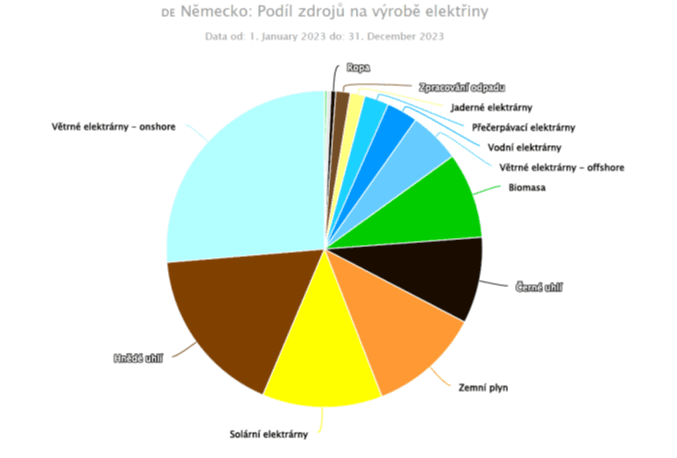
According to Oldřich Sklenář, Germany should be our model on the path to low emissions; it had a 40 % share of fossil sources in 2023. Personally, I would take inspiration from France, which had well over 90 % low-emission sources last year (source: ENERGOSTAT oEnergetice).
Conclusion
More than a quarter of a century ago, I took part in discussions in which I challenged Martin Bursík and other anti-nuclear activists from Greenpeace, Hnutí Duha and Děti Země who were fighting against the Temelín nuclear power plant. They argued that neither Temelín nor Dukovany was needed and that coal could be replaced purely with renewables. I told them at the time that it would eventually become clear that their anti-nuclear campaign would cause the greatest damage and delay to the transition towards low emissions. I told them it would become clear that politicians such as Miroslav Gregr and others, whom they awarded the Ropák prize and who helped secure construction of at least two Temelín units, had done more for decarbonisation and the environment than they had. And it would be these green activists and their colleagues in Austria, Germany and other European countries who would cause coal sources to operate far longer than would have been the case with the development of nuclear energy.
More than a quarter of a century later, the situation not only in Germany, and its comparison with France, Sweden and Slovakia, shows that I was entirely right. Coal sources are used intensively in Czechia and Germany. Anti-nuclear activists now blame Křetínský and Tykač. The reality, however, is that if these “coal barons” did not exist, someone else would have to operate the coal sources, or German and Czech energy systems would already have very serious problems.
In my view, Czechia’s path to low-emission electricity requires building four large nuclear units: two at Dukovany and two at Temelín. The two at Dukovany are essentially replacements for the existing units. At the same time, however, we should seek to operate the existing Dukovany units safely for as long as possible. The new units will therefore run alongside the existing ones for some time and help replace coal units. In this respect, the Czech Republic has taken an important step through its tender decision. As I described in a recent article, the bid of a Korean supplier was selected.
It would also be good to build small modular reactors at certain sites where larger coal power plants and district heating plants now operate. These would operate in cogeneration mode and replace part of the coal-fired power and heating plants. Here too, a key step has already been taken, with the Rolls-Royce small, or rather medium-sized, modular reactor selected as the project in which to participate. I discussed this need in detail shortly before the final decision in a recent article.
The implementation of nuclear projects, and perhaps their financing as well, could be helped by the changing view of this part of the energy sector apparent in the approach of European Union bodies. I also wrote about the beginning of a nuclear energy renaissance in the EU in this year’s overview of the sector’s state (here, here, here and here).
Grid flexibility and resilience, as well as storage options, should be strengthened on an ongoing basis. Interconnectivity with our neighbours should be reinforced. New renewable sources should be built mainly on a decentralised basis and certainly should not greatly exceed the aforementioned limits at which they begin causing grid problems. Large photovoltaic and wind farms should rather not be built, so that we can use cheap surpluses of solar and wind electricity from Germany. I explained in more detail the reasons why it is not appropriate to build large wind and photovoltaic farms in this article.
It is important to implement a gradual transition of district heating to low-emission sources. Here, I would also consider the use of gas in cogeneration mode meaningful, including for strengthening grid flexibility. The essential point, however, is that coal sources should not be shut down before an equivalent low-emission replacement is available, not only in total electricity and heat production but also in balancing and supporting grid stability.
In my analysis, I have sought to show that the authors of the Fakta o klimatu study neglect key aspects and problems in their models, simulations and reasoning. Their conclusions that massive installations of photovoltaic and wind plants will ensure low electricity prices for customers and that coal plants can be safely shut down within the next few years are therefore unrealistic and illusory. The idea of Oldřich Sklenář and his colleagues that Germany’s path to low-emission energy is the best one is not only illusory but dangerous. Not only industry but society as a whole depends on reliable electricity supplies. Transport and industry are currently undergoing intensive electrification, as is district heating through heat pumps. Data centre consumption will also grow, not least in connection with the use of artificial intelligence. Electricity consumption can therefore be expected to grow despite the use of energy-saving potential. I wrote in a more extensive article about how, without reliable energy sources, we can hardly defend our security, standard of living and democracy. Unfortunately, Fakta o klimatu, perhaps more aptly named Climate illusions, is following in the footsteps of its green predecessors, whose pressure on society and politicians laid the groundwork for the current enormous problems in European, and especially German, energy and consequently industry, not only the automotive sector. Let us hope that they will no longer be able to reverse the change in attitudes towards energy and the use of nuclear sources now emerging in the European Union.
Interview on the situation in our energy sector for the Vysoké napětí podcast:
https://www.youtube.com/watch?v=5wiOqFuXU-g&list=PLGLb3t59V9EZGvSEoPBOvY-kIfYce5bRG
Translation disclaimer
This article is a machine translation of the Czech original and has not yet been fully reviewed. In case of any doubt, please refer to the Czech version.
Sdílejte článek prostřednictvím:
Topics:Opinion
You might also like
23 October 2026, 11:01
23 October 2026, 06:34