
12 October 2026, 12:20
Loading...
Ember's 2025 review: Renewables generate over a third of electricity, surpass coal for the first time
Vojtěch Kříž
25 April 2026, 13:49

British think tank Ember has published a review of developments in the power sector over the past year. For the first time, renewables surpassed coal and were also able to meet all growth in demand. Of that increase, 75% could have been covered by solar power alone.
The more than 100-page document contains plenty of data worth examining. As mentioned, the authors say that zero-carbon sources (including nuclear power) were able to meet all new growth in electricity demand. What else does the report say about the increases?
- Solar power was by far the biggest gainer, adding 636 TWh last year. About half of the increase took place in China (+336 TWh). The US (+85 TWh) and EU (+60 TWh) also saw growth, significantly expanding their generation. Solar has remained in the lead for the fourth year in a row. Over the past decade, generation from solar power plants has increased more than tenfold. The report also points to the uptake of batteries, which provide the stability that solar power previously lacked.
- Wind power recorded the second-largest increase, adding 205 TWh. Here, too, growth was driven by China (+138 TWh) and India (+22 TWh).
- Nuclear power added a total of 35 TWh, with the largest increase once again in China (+37 TWh), where several reactors were brought online, as well as increased generation in France (+12 TWh) and Japan (+9 TWh). Generation fell elsewhere, and older reactors were also shut down, for example in Belgium.
- Hydropower generation increased by 3 TWh, with gains driven by China (+45 TWh) and India (+22 TWh); last year's monsoon season was partly responsible for the increase. There were also major declines: generation fell by 25 TWh in Brazil and, due to drought, by 17 TWh in Turkey. The EU also saw a 43 TWh decline, mainly due to lower rainfall in the Alpine region.
- Electricity generation from fossil fuels fell slightly, by 38 TWh. Surprisingly large declines were recorded in China (-56 TWh) and India (-52 TWh). Gas was the only fossil fuel to see a slight increase, at 36 TWh.
Coal declines
Coal, historically humanity's main source of energy, remains a major part of many energy mixes. Asia, however, is the only region where renewables have yet to overtake it. This is, of course, due to massive energy demand. Asia accounts for 82% of total coal-fired electricity generation.
The biggest increase in coal-fired generation was recorded in the United States (+85 TWh); according to the report, this was mainly due to gas prices. Even so, China and India are by far the largest consumers of coal for electricity generation, together accounting for 69% of the total. Coal is also important in many developing countries, such as Mongolia and South Africa (which is also an exporter), as well as Japan, the fourth-largest producer of coal-fired electricity after China, India and the US.
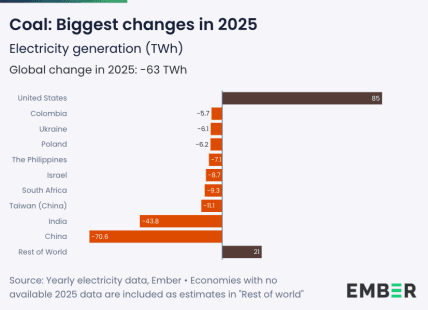
Biggest changes in coal-fired electricity generation in 2025, Global Electricity Review 2026 - Ember, page 77
Despite coal's continued prominent role, Ember expects growing demand to be met increasingly by renewables. One argument is that India, where demand growth will occur, will have better technological options than China, and its growth is less energy-intensive. Last year, for example, India added nearly 38 GW of solar and 6.3 GW of wind capacity, with around 101 GW of solar and 24 GW of wind capacity under construction.
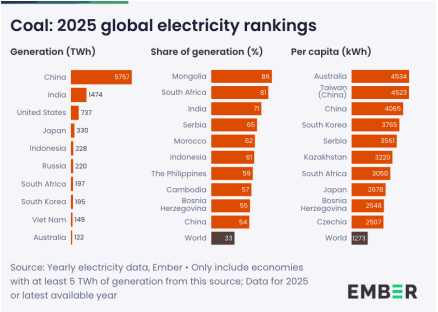
Generation, coal's share of the energy mix and per-capita consumption. Global Electricity Review 2026 - Ember, page 77
Highlights and conclusion
Total growth in electricity demand was 849 TWh, of which 503 TWh was in China and 131 TWh in the US.
The report analyzes last year's results across several regions and countries. They vary, showing, for example, that electricity demand in the EU was below its pre-pandemic 2019 level; that Russia is probably the only major country where the uptake of renewables has been minimal and total demand has fallen, partly due to a warm winter; and that Brazil maintains one of the “cleanest” energy mixes in the world.
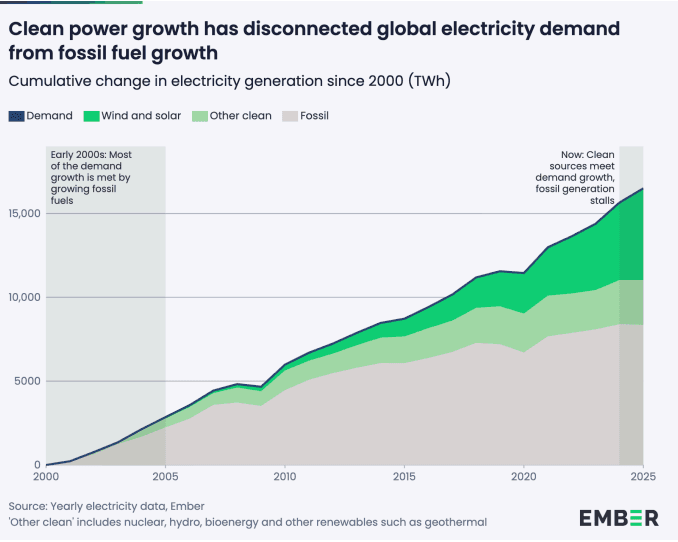
Growth in renewables' share of electricity demand growth, Global Electricity Review 2026 - Ember, page 28
The authors say, however, that a longer-term trend is emerging, pointing to a decoupling of growth in electricity demand from fossil fuel consumption. As they write in their conclusion:
“The year 2025 marked a turning point in the global power sector. For the first time outside periods of major global economic contraction, such as the 2009 financial crisis or the 2020 Covid-19 pandemic, growth in fossil fuel-based electricity generation came to a halt. Solar power and other clean sources, particularly wind power, proved to be key technologies in this structural shift, growing fast enough to meet all global growth in electricity demand.”
Translation disclaimer
This article is a machine translation of the Czech original and has not yet been fully reviewed. In case of any doubt, please refer to the Czech version.
Sdílejte článek prostřednictvím:
You might also like

12 October 2026, 10:27

12 October 2026, 07:40

11 October 2026, 20:09

11 October 2026, 08:24