OKD starts backfilling ventilation shaft at ČSM-South mine

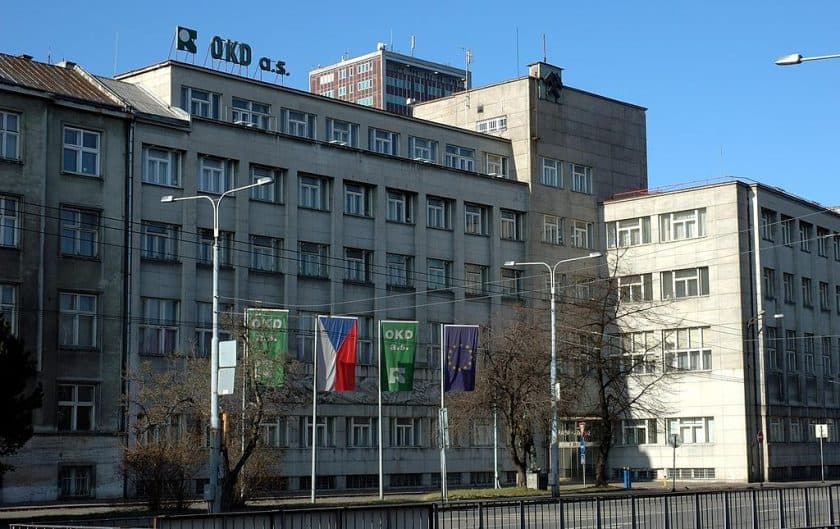
OKD today began backfilling the ventilation shaft at the southern section of the ČSM Mine in Stonava, in the Karviná region. This followed the completion of 87 explosion-proof seals used to close off mine workings. David Hájek, the mine’s closure director and mine manager, told reporters that backfilling the shaft will take around 11 days.
"We will decommission the shaft, which is approximately 900 metres deep, by backfilling it with material we produced while we were still mining coal, as a by-product of the processing plant. It is certified stone and has the right parameters," Hájek said.
The material passes through a screen, with the maximum specified particle size being 100 millimetres. "It must be placed gradually so that no arches form beneath which voids could remain, potentially causing unplanned settlement of the backfill," the mine manager explained. OKD workers will monitor the backfilled shaft using a so-called topping-up pipe.
"Calculations show that we will need 45,000 cubic metres of material. We have almost 60,000 in stock, so we have a reserve," Hájek said.
Before the shaft could be backfilled, legislative requirements had to be completed, sealing barriers constructed and mining equipment removed. "We had to build a shaft plug at the level of the first horizon. It had to be concreted and achieve explosion resistance, which took 28 days from the time it was poured. That happened on Monday, which is why we are starting to backfill today," Hájek said. OKD will also close the barriers in the shaft plug and in the two workings connecting the South section with the North section, separating the two parts of the ČSM Mine. Work to prepare for closure will continue at the North section independently of the South.
The company, which is state-owned through Prisko, has set aside a CZK 3.3 billion provision for the closure of the ČSM Mine. "We are slightly ahead of schedule and saving significantly compared with the financial assumptions, so things are good so far," Hájek said.
Ventilation will be shut down in September and the ventilation shaft in the northern part of the mine will be backfilled. "In December, filling of the intake shaft with a cement-fly ash mixture will begin in the South section, followed by the North section at the turn of January and February 2027. Once the closure of all four shafts is completed, the entire mine will be closed. Work ensuring the safe closure of the mine while preserving the possibility of methane extraction will continue until the fourth quarter of 2028," said OKD spokesperson Barbora Černá Dvořáková.
Degasification piping has been installed in the mine and in the intake shafts for future methane extraction. "At the North section, installation is currently under way of a cogeneration unit to generate electricity and heat from mine gas, which will enter trial operation in October. Once the mine’s technical closure is completed, this energy will cover most of OKD’s energy needs, significantly reducing our costs of buying electricity from external sources," said OKD chief executive Martin Džanaj.
At the beginning of February this year, OKD ended hard coal mining at the ČSM Mine, the last operating coal mine in the Czech Republic. Over recent decades, it had gradually closed all of its mines as extraction had ceased to be economically viable.
Following the end of mining, OKD is carrying out the technical closure of the ČSM Mine and transforming its business. In addition to capturing and using mine gas, the company is starting to operate, for example, in property development. OKD currently has around 550 permanent employees. Some will gradually leave by the end of the year as work on the technical closure of the ČSM Mine is completed.
"OKD’s main priority is to backfill the mines and remediate mining activity," the director said.
Even after underground mining has ended, the ground continues to subside and OKD must maintain key infrastructure networks. "There is a railway corridor here, as well as roads, major gas pipelines and drinking water mains, and we ensure that all of them continue to operate despite the ongoing ground subsidence. Ground subsidence will continue for five years after mining ends; that has already been calculated," Džanaj said.