10 August 2026, 15:50
Waste-to-energy in Czechia: record incineration, new capacity and future challenges

Jakub Malý
23 June 2026, 15:02
This article is a machine translation of the Czech original and has not yet been fully reviewed. In case of any doubt, please refer to the Czech version.
The Czech debate on waste incineration has in recent years shifted from a purely waste-management issue to an energy and system-level one. Waste-to-energy facilities, abbreviated as ZEVO, are no longer seen solely as an end-of-line solution for mixed municipal waste, but also as a source of heat for district heating systems, a replacement for part of coal-fired generation, and a potential element of greater local energy resilience. The new Czech Waste Management Plan for 2025–2035, approved by the government on 23 July 2025, is based on the waste management hierarchy: waste prevention, maximum recycling and waste recovery, followed only then by energy recovery or disposal.
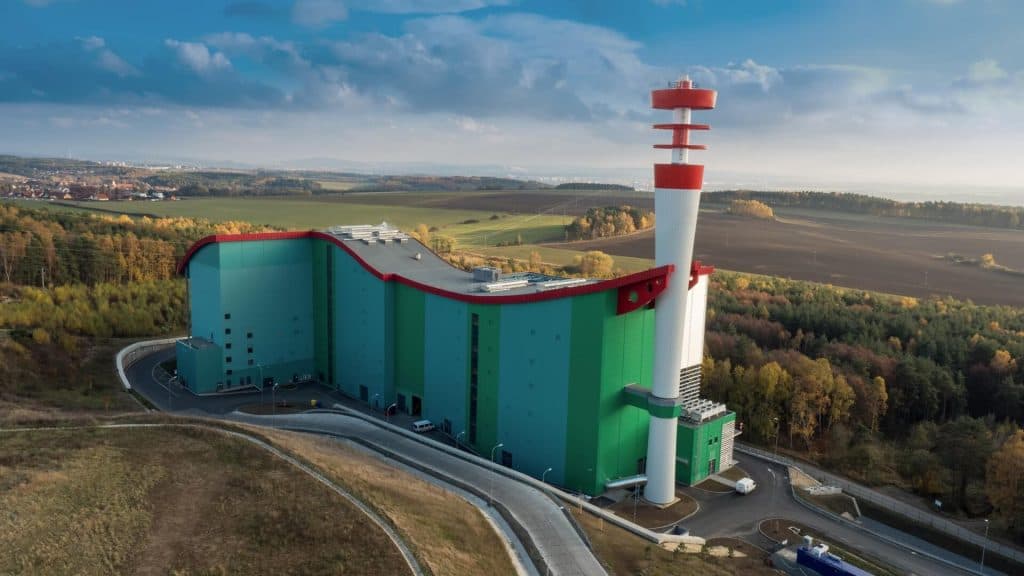
In the Czech Republic, four large municipal-waste ZEVO facilities are currently in operation: Prague-Malešice, SAKO Brno, Termizo Liberec and Chotíkov near Plzeň. According to available information, a record 830 thousand tonnes of municipal solid waste underwent energy recovery in 2024. The facilities generated 261 GWh of electricity and supplied 2,8 PJ of heat. Malešice became the largest source, with its waste treatment capacity increased, according to this source, from the original 330 thousand tonnes to 480 thousand tonnes per year, which is the permitted ceiling, although actual utilisation may be lower. Brno has a capacity of 248 thousand tonnes, Liberec 96 thousand tonnes and Chotíkov 120 thousand tonnes per year.
Construction of new capacity is already moving from the planning stage into implementation. The most visible project is the EVO Komořany facility near Most, construction of which began in August 2024 and which is expected to recover energy from up to 150 thousand tonnes of municipal waste annually. In Mělník, ČEZ has obtained a construction permit for a ZEVO facility with a thermal input of approximately 110 MWt and capacity of around 320 thousand tonnes of waste per year; trial operation is expected at the turn of 2027 and 2028. Other projects are being prepared or discussed in Planá nad Lužnicí, Písek, Vráto near České Budějovice, Opatovice and Brno, where a third boiler is being considered that would raise SAKO Brno's capacity to as much as 370 thousand tonnes per year.
Environmental organisation Arnika warns that the investment costs of Czech ZEVO facilities are among the highest internationally: according to its analysis, one installed tonne of annual capacity costs approximately 1 000 euros, while a range of 600 to 1 000 euros is commonly cited in advanced Western countries. For a facility with a capacity of 100 thousand tonnes per year, this would mean an investment of approximately 2,5 billion Kč. Arnika also states that incinerating one tonne of municipal waste costs roughly 800 to 1 500 Kč and that many projects depend on subsidies from the Modernisation Fund.
Will there be enough waste in the future?
However, the key risk lies in the quality and volume of input waste. ČAOH warns that around 85 % of municipal waste will need to be sorted and treated in order to meet recycling targets. More intensive sorting also changes the composition of mixed municipal waste: both recyclable and combustible fractions decline, and in some systems with advanced collection, the calorific value of residual waste may fall significantly. This is a fundamental problem for large-capacity ZEVO facilities, which require a stable stream of waste with an adequate calorific value and volume.
This is precisely why solid alternative fuels, abbreviated as TAP, are becoming increasingly important. They are produced mainly from non-recyclable reject fractions from sorting lines and can be used in cement plants, lime kilns or heating plants. According to ČAOH, using TAP in district heating may be economically more rational than building a separate large ZEVO facility – capital costs are lower, operations are more flexible, and heating plants can combine TAP with other fuels. The problem, however, is a regulatory restriction under which TAP complying with the relevant decree may only be burned by sources above 20 MW, complicating its use at smaller municipal heating plants.
Alongside municipal waste, a second area is often overlooked, and may be even more urgent from an industrial perspective: the incineration of hazardous waste. ČAOH states that 21 hazardous-waste incineration facilities operate in the Czech Republic, with total capacity of around 104 thousand tonnes per year, while the new Waste Management Plan indicates that approximately 45 thousand tonnes of capacity for combustible hazardous waste is lacking. For this reason, a proposal to build a hazardous-waste incinerator near Litvínov with capacity of 50 thousand tonnes per year may currently be under assessment.
Sdílejte článek prostřednictvím:
You might also like
10 August 2026, 09:33
9 August 2026, 14:38