Renewables now cover more than a quarter of EU energy consumption, with electricity share rising to 50%


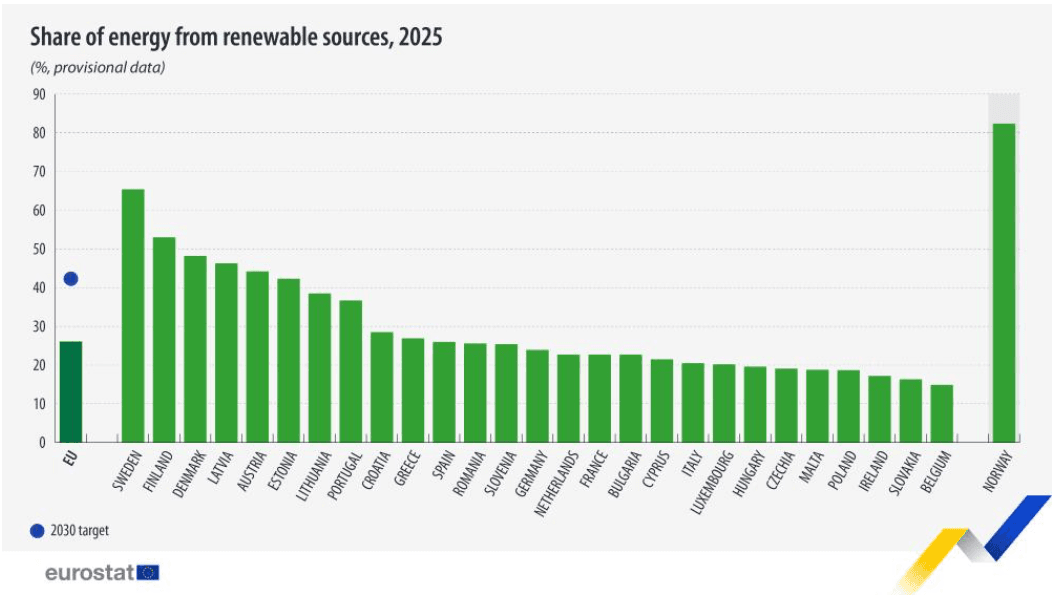
The share of renewable energy sources (RES) in gross final energy consumption in the European Union rose by one percentage point (pp) between 2024 and 2025, reaching 26.2%. Since 2004, when this indicator began to be tracked, it has nearly tripled. However, achieving the 2030 target of 42.5% would require average annual growth of 3.3 pp in the coming years. This follows from data published by the EU statistical office Eurostat.
The countries with the highest shares of renewables in gross final energy consumption have traditionally included the Nordic states, led by Sweden, which recorded a share of more than 65% last year, chiefly thanks to the use of solid biomass, hydropower and wind power. Finland was the only other country with a share above 50%, while Denmark remained just below this threshold at 48.2%.
Conversely, the lowest shares were reported by Belgium (14.9%), Slovakia (16.3%) and Ireland (17.2%). The Czech Republic has traditionally been among the countries with the lowest shares and even recorded a year-on-year decline from 19.2% to 19.1%.
Half of electricity from renewables
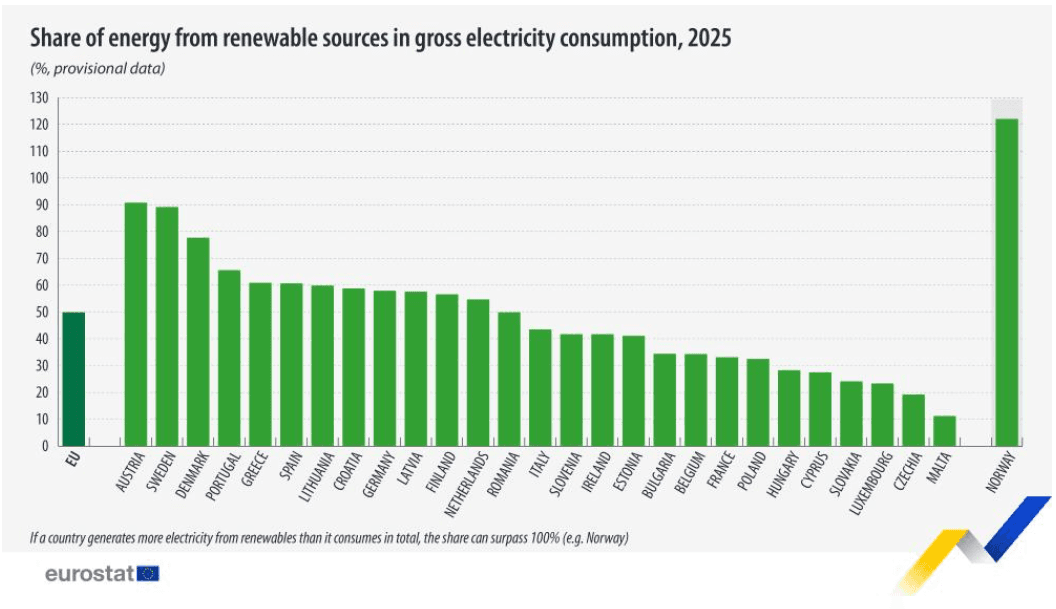
The sector in which the share of renewables is growing the most is the electricity sector. According to the published data, renewables accounted for 49.9% of gross electricity consumption last year, up 2.4 pp year on year. By comparison, this share was just under 16% in 2004.
The countries with the highest shares of renewables in gross electricity consumption last year were Austria (90.8%), Sweden (89.2%), Denmark (77.7%) and Portugal (65.6%). Conversely, the lowest shares were recorded in Malta (11.2%), the Czech Republic (19.2%) and Luxembourg (23.3%).
According to Eurostat, renewable energy deployment in the other sector monitored, heating and cooling, is considerably slower. Between 2004 and 2025, the share rose from 11.7% to 27.4%. Between 2024 and 2025, it increased by 0.7 pp, slightly below the average annual growth rate of 0.75 pp recorded over the 2004-2025 period.