
1 November 2026, 21:20
Loading...
Top 10 energy events from the past week
oEnergetice.cz
17 December 2023, 18:00
1. Germany begins construction of key SuedOstLink transmission line in Bavaria
Construction of a key backbone transmission line has begun in the German state of Bavaria, after several years of delay. With a transmission capacity of 2 GW, the line will connect windy northern Germany with the industrial south.
Growing demand for electricity transmission in Germany, driven by the continued expansion of renewable energy, the politically accelerated phase-out of nuclear and coal-fired power plants, and new EU electricity market regulations, presents new challenges for managing the German transmission system. The construction of additional transmission lines is an important part of addressing these challenges.
2. Chernobyl sarcophagus structure is unstable; partial dismantling expected by 2029

The dismantling of parts of the original shelter over the damaged reactor at the Chernobyl nuclear power plant will take longer. A plan to secure them is expected to be drawn up by 2025, with the work itself scheduled to continue until 2029. Some parts of the shelter are highly unstable and are likely to collapse without technical intervention. Chernobyl is therefore facing another phase in the process of stabilising the reactor, which cannot be completed even after almost 40 years. Some 200 tonnes of highly radioactive material remain beneath the “sarcophagus”.
The dismantling is being carried out by Ukrbudmontazh, which won the tender in 2019. The licence extension for the work was granted because of delayed funding and the ongoing Russian-Ukrainian conflict. The work will include dismantling, reinforcement and the final processing of contaminated fragments.
3. Czech gas storage sites begin to empty as temperatures fall, but supplies remain ample
Gas storage sites in the Czech Republic are currently about 90% full. Since the start of the heating season, storage levels have fallen by a tenth. The sharp drop in temperatures at the end of November led to a significant increase in withdrawals from storage, as demand for gas for heating rose.
Colder weather in the Czech Republic shows how significantly gas consumption for district heating affects overall gas demand. The first 10% of the natural gas stored in Czech facilities has now been withdrawn. Even so, storage levels are above average; only in 2011 and 2019 were Czech gas storage sites fuller at the same time of year.
4. Bulgaria suspends tax on Russian gas transit after Russian exporters fail to pay

The Bulgarian government suspended the tax on the transit of Russian natural gas at the beginning of this week. The government had only introduced the new tax at the beginning of October. However, collecting it has proved difficult and, according to available information, Russian exporters are not paying it. Hungary’s threat to veto Bulgaria’s accession to the Schengen Area may also have contributed to the suspension.
On Monday, the Bulgarian government announced the suspension of the tax levied on the transit of Russian natural gas through the country’s pipelines. The government had introduced the tax of 20 leva (around 10 euros) per megawatt-hour on imports and transit of Russian-origin gas only in mid-October.
5. Akkuyu 1 nuclear power plant receives permission to start up reactor unit

Turkey’s Nuclear Regulatory Authority (NDK) has issued a permit for the Akkuyu nuclear power plant to start up its first reactor unit. The permit allows the project to move on to the next stages of commissioning: starting up the unit, configuring its systems and conducting pre-operational tests. Together, these stages represent the final phase of the power plant’s construction and lay the foundation for safe future operations.
Anastasia Zoteeva, CEO of Akkuyu Nuclear JSC, said: “Licensing is an extremely important process that runs through every stage of a nuclear power plant’s life cycle: site selection, design, construction, operation and decommissioning. In the case of Akkuyu NPP, Turkey’s first nuclear power plant, we are going through every stage of licensing for the first time. At the same time, the national regulator is drawing on its experience of issuing licences and other permits in Russia, where four similar VVER-1200 reactors are already operating successfully.”
6. GasNet deploys tanker-based backup gas supply

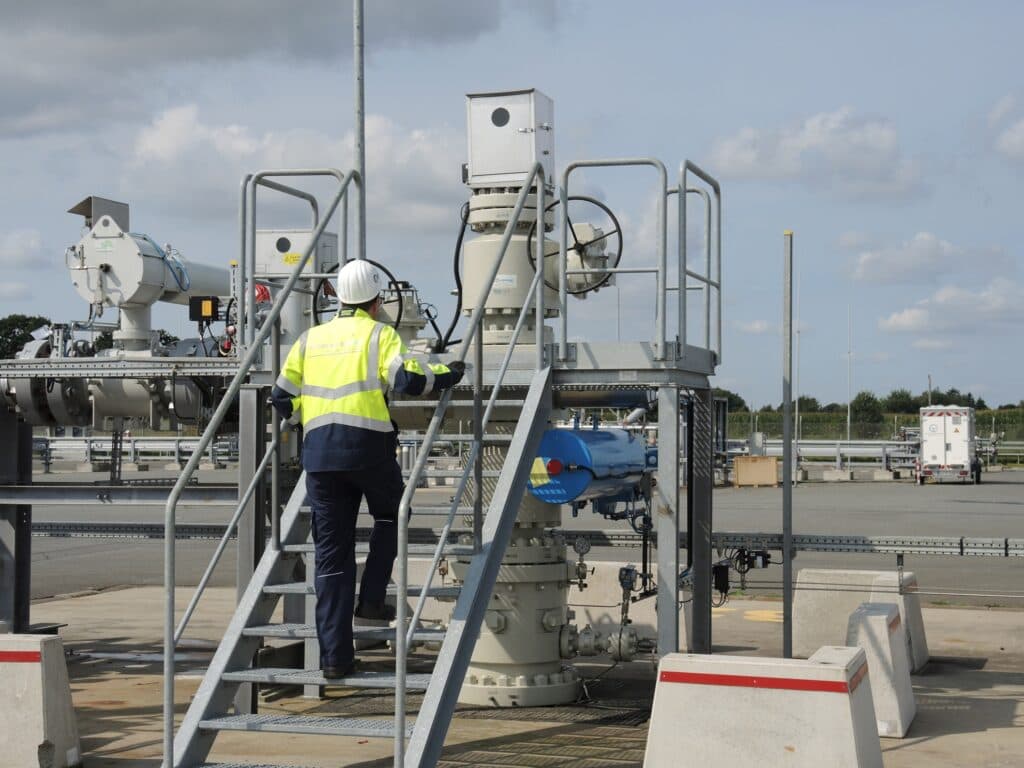
Consumers in the Lovosice area received emergency assistance at the start of the heating season. Because of a fault in the transmission system, GasNet gas engineers supplied five villages with liquefied natural gas from a tanker at the beginning of winter. This technology is not yet widely used in distribution. For the Czech Republic’s largest gas distributor, it is another modern technology its engineers have mastered, helping them improve the safety and, above all, reliability of the distribution network in unforeseen circumstances.
As a leader in natural gas distribution, GasNet is bringing a range of technological innovations to the gas sector. Connecting a liquefied natural gas (LNG) tanker directly to a transfer station is one of them. It provides another way to ensure reliable supplies when necessary, including at times when they are critically needed—such as during the period of peak gas demand in winter.
7. ČEZ receives CZK 7.5 billion grant to convert Mělník coal-fired power plant

Energy company ČEZ will use a grant of 308 million euros (around CZK 7.53 billion) to convert the coal-fired power plant in Mělník to a new gas-fired facility. The company received the funding from the Modernisation Fund. The plant’s existing coal-fired units are to be replaced by a new combined-cycle gas plant with hot-water heat storage. Ekonomický deník reported the news today. It is the largest grant awarded from the Modernisation Fund to date.
Energotrans in Mělník is the largest district heating plant in the Czech Republic, providing heat to the eastern half of Prague, Mělník and Neratovice. The plant has used lignite since 1960. As part of its planned move away from coal, ČEZ is planning to switch to other fuels. In Mělník, it is planning a combined-cycle gas plant.
8. New target on the horizon: boost renewable capacity to 11 TW
More than 100 countries agreed at the COP28 climate summit in Dubai to triple installed renewable energy capacity by 2030, one of the least controversial commitments made at the conference. However, they provided few details on how they could ensure the sector expands much faster, Reuters reports.
Renewable energy is key to meeting the 2015 Paris Agreement goal of limiting global warming. And although renewable energy is already expanding rapidly, this latest target would require a significant acceleration in the deployment of solar and wind power.
9. Fiala wants to build and develop small modular reactors in Czechia, meets Rolls-Royce chief
Prime Minister Petr Fiala (ODS) discussed opportunities to develop and manufacture small modular reactors in Czechia with Tufan Erginbilgic, CEO of Rolls-Royce Holdings. According to the prime minister, the country could not only build modular reactors in the future, but also develop them, with cooperation with the British company potentially helping to achieve this. Fiala said this on social media platform X. Under the government’s current plans, small modular reactors are expected to replace existing coal-fired power plants.
Fiala said he spoke with Erginbilgic today mainly about building closer cooperation in the energy sector. “Rolls-Royce currently has one of the most advanced small modular reactor technologies. As part of the Restart of Czechia initiative, we want to make our country a centre of nuclear energy. We want not only to build new power sources, but above all to develop and manufacture small modular reactors here. Rolls-Royce could help us do that in the future,” the prime minister said.
10. Floating solar plant in Indonesia to become the world’s largest
The floating solar plant in Indonesia, which began operating last month, will be expanded to become the world’s largest floating photovoltaic plant. The existing 145-megawatt solar farm on the Ciatra reservoir in western Jakarta is set to be expanded by a further 355 megawatts.
The plant already generates enough renewable energy to meet the electricity demand of around 50 000 households, while saving 214 000 tonnes of carbon emissions each year.
Topic
Germany’s strategic reserve: lignite power plants shut down early
In addition to supporting renewable energy, Germany also provides out-of-market support to conventional power plants through several reserves that keep the required capacity on standby for various purposes. These include reserves that provide capacity to stabilise the transmission system, as well as reserves used to meet electricity demand when generating capacity is insufficient.
Germany currently keeps conventional power plants on standby in the following reserves:
Energostat: electricity generation in the Czech Republic
Energostat: electricity generation in Germany
Translation disclaimer
This article is a machine translation of the Czech original and has not yet been fully reviewed. In case of any doubt, please refer to the Czech version.
Sdílejte článek prostřednictvím:
Topics:Energy Weekly
You might also like

1 November 2026, 16:09
1 November 2026, 07:59

31 October 2026, 12:55

31 October 2026, 08:21