The "duck curve" has eased slightly this year. The biggest extremes on the day-ahead electricity market may have passed


The so-called duck curve on the Czech day-ahead electricity market remains pronounced in 2026, but so far it has not surpassed the extremes seen in 2025. Midday prices again frequently fell into negative territory in April and May, although the overall profile has so far been somewhat milder. The rapid rollout of battery storage could bring further change, gradually reducing price differences between midday and evening hours, depending on the pace of deployment.
Data from this year confirm that the so-called duck curve has become a common phenomenon on the Czech market. The average daily price profile in April, May and June remains divided between periods of low-priced midday quarter-hours and significantly more expensive quarter-hours during the evening peak. Compared with 2025, however, the curve does not yet appear to be deepening dramatically further, as it did in previous years.
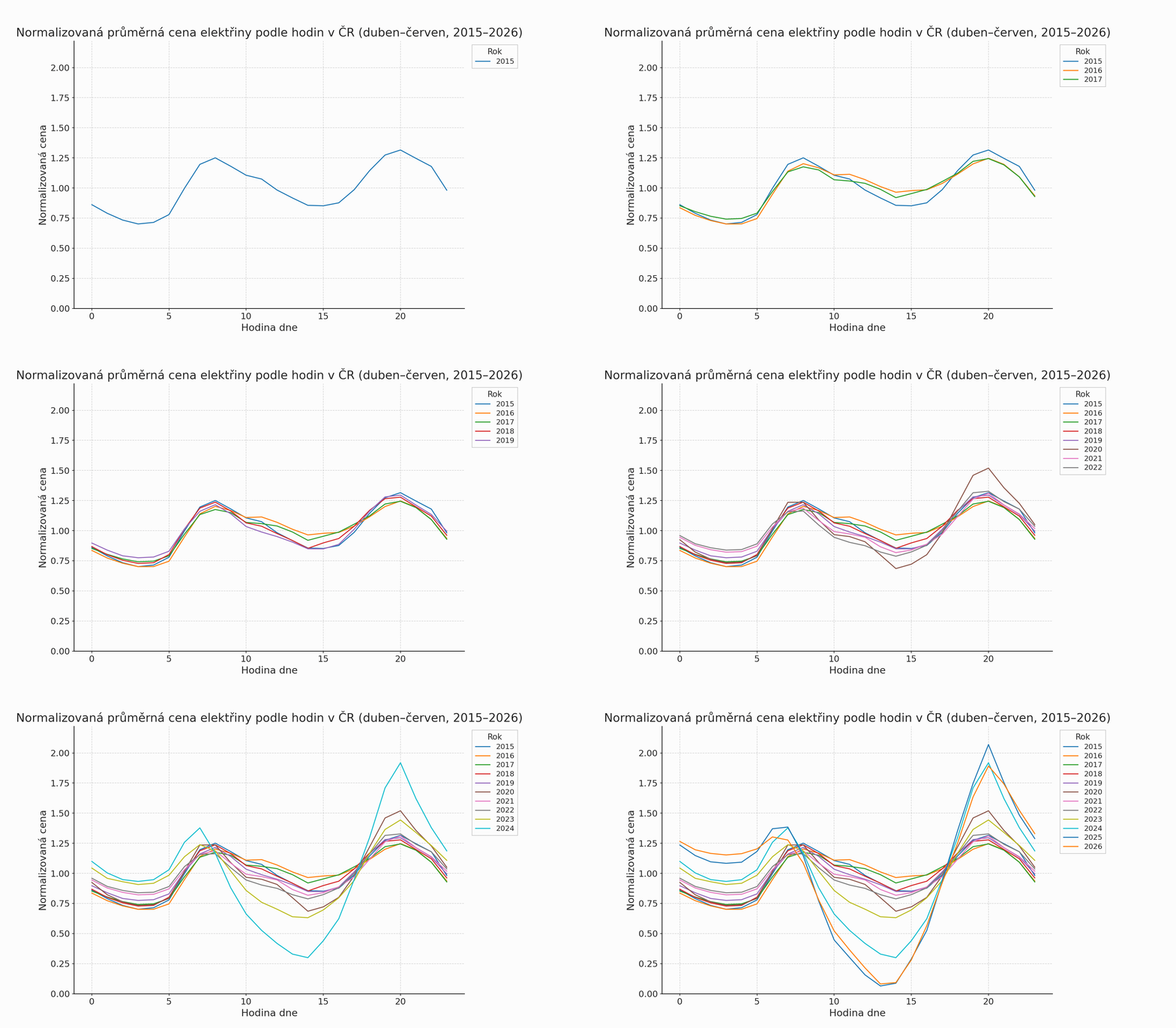
According to Energostat data for April to June, in 2025 the normalised price during the evening peak at around 20:00 exceeded twice the average, specifically reaching approximately 2.07 times the average. This year, the value at the same hour is slightly lower so far, at roughly 1.89 times the average. The evening peak around 19:00 is similarly milder, with this year's value not yet reaching last year's maximum.
This does not mean the problem has disappeared. The difference between midday and evening prices remains one of the key market signals for operators of Czech power plants and storage facilities. It merely appears that, following the marked shift in 2024 and 2025, there has not been another equally significant leap this year.
April and May shifted the entire curve lower
A somewhat different picture of conditions on the day-ahead market is provided by data for April and May alone, the period when the combination of high photovoltaic generation, lower consumption on weekends and public holidays, and limited system flexibility is most visible. In these months, this year's duck curve was similar in shape to last year's, but shifted slightly lower.
The most pronounced decline is apparent around 13:00 and 14:00. In data for April and May, the normalised price at these hours is actually negative this year. This corresponds to the frequent negative prices that occurred considerably more often during this year's late spring. The evening peak remained high, but the very fact that the midday trough shifted into negative territory shows that solar power generation in spring months continues to reduce the market value of electricity during its own generation hours.
For solar power plants and electricity storage alike, this is an important signal. Their realised price is diverging ever further from the average price on the day-ahead market. If high prices only arrive after sunset, photovoltaics benefit from them only to a very limited extent. Conversely, each additional installation without corresponding flexibility increases pressure on midday prices.
The European battery market continues to develop rapidly
It is precisely the difference between midday and evening that is the main reason why battery storage is developing rapidly in Europe. In recent days alone, according to Energy Storage News, nearly 700 MWh of new BESS projects have been commissioned in Germany, Estonia, Belgium, Denmark and Bulgaria. Specifically, the projects had a combined capacity of 682 MWh.
The largest of these was the Estonian Hertz 2 project, with a capacity of 100 MW and 200 MWh. In Belgium, the DStor project with a capacity of 140 MWh was launched; Denmark commissioned two batteries with a combined 152 MWh, and Bulgaria a 126 MWh project. The German RheinEnergie and SMA Altenso project added another 64 MWh.
The rapid growth in battery storage capacity has a dual effect on the market. In the short term, it supports the business model based on arbitrage between the midday low and the evening peak. In the long term, however, greater battery deployment may reduce this opportunity. The more storage facilities buy during the same low-price hours and sell during the same peaks, the more the price differential may flatten.
For the Czech Republic, this is both an investment signal and a future revenue risk
The Czech battery market is still in its infancy, but rapid development is generally expected. The licensed capacity of storage facilities already exceeds 61 MW, with further applications under administrative review. Licensed assets, however, represent only part of the batteries that have been commissioned. According to statistics from the Solar Association and the AKU-BAT association, a total of 318 MWh of battery storage was commissioned in the first half of the year alone. The actual capacity of batteries operating in the Czech system will therefore be significantly higher.
In addition to smaller projects, plans for projects in the hundreds of MW are continuing to be prepared. The largest include Second Foundation's projects in Tušimice, Stonava and Vraňany, together exceeding 300 MW of capacity and more than 600 MWh of energy storage. Sev.en is planning further large batteries in Chvaletice and Kladno, totalling approximately 160 MW and 320 MWh. If these projects actually enter operation, the Czech market could change substantially faster within a few years, and the duck curve could flatten further under the impact of new batteries.
This is positive news for the system. For storage investors, however, the most attractive price differentials may not last forever. Just as photovoltaics face the cannibalisation of their own revenues during midday hours, a similar phenomenon may gradually emerge in battery arbitrage. This is why not only the pace of construction will be crucial, but also the ability to combine revenues from the market, balancing services and local flexibility management.