29 July 2026, 16:38
EU seeks to double electrification rate, promises relief for industry

Eduard Majling
29 July 2026, 16:38
This article is a machine translation of the Czech original and has not yet been fully reviewed. In case of any doubt, please refer to the Czech version.
The European Commission has unveiled a plan under which electricity should cover 46% of final energy consumption in the European Union by 2040. Its share currently stands at 23%, or roughly half the target level. Key elements of the plan include changes to regulated prices, the possibility of reducing them for certain consumers, and rules on the taxation of electricity and gas. The European Commission has presented another energy plan intended to help the European continent reduce energy costs. The Commission is now targeting greater use of electricity, the generation of which it has been relatively successful in decarbonising. It has therefore unveiled a new Electrification Action Plan. The Commission wants to capitalise on the fact that approximately 70% of electricity in the European Union already comes from domestic renewable and low-emission sources. However, the electrification rate of final consumption has remained at around 23% for roughly a decade. The Commission does not want to accept the slow pace of electrification and aims to catch up with certain Asian countries, where the electrification share exceeds 30%. The focus on electrification is another step towards reducing import dependence. The share of electricity generated from low-emission local sources has risen significantly in the European Union. However, this growth in low-emission electricity generation has so far been reflected only to a limited extent in the transport, heating and industrial sectors. The European Commission sees potential precisely in electrification: domestic electricity could further reduce the cost of fuel imports, especially fossil fuels. The Commission therefore proposes increasing electricity's share of final consumption to 46% by 2040. For now, the target is to be indicative rather than binding. If met, it would represent a doubling of electrification. According to the Commission, faster electrification could reduce gas imports by more than 70%, oil imports by more than 40%, and European spending on fossil fuels by up to €260 billion annually by 2040. The plan covers transport, buildings and industry. It envisages, for example, faster deployment and support for the installation of heat pumps, electric mobility, storage and flexible consumption.
According to the Commission, electricity remains too expensive compared with gas
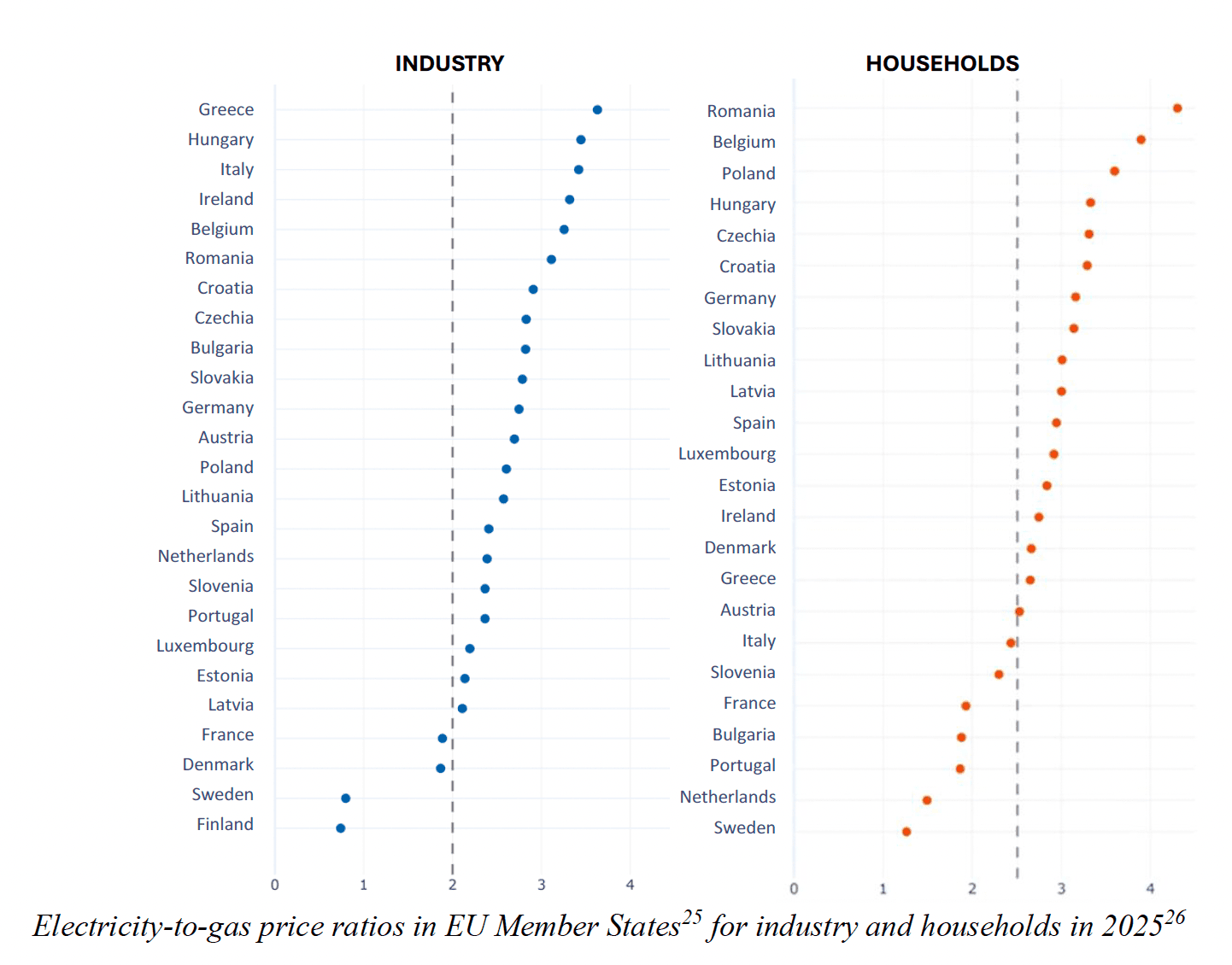
Ratio of electricity prices to natural gas prices for industry and households. Source: Electrification Action Plan
The change is to be based on a proposed amendment to Regulation 2019/943 on the internal electricity market. It is therefore not merely a non-binding action plan, but also directly applicable legislation that must still be approved by the European Parliament and the Council.
Revised rules for regulated charges for the use of grids are intended to help reduce final electricity prices. The proposal stipulates that regulated charges should take greater account of reserved capacity, the duration of grid use, and the location of consumption or generation. They should incentivise lower peaks and electricity use at times of high renewable generation.
Grid charges account on average for approximately 24 to 29% of European households' bills in the EU, and their significance is set to increase further as investment in grids grows. In the Czech Republic, the regulated component of the electricity price, including taxes, accounts for approximately half of the total electricity price.
Relief for industry will not be automatic
As regards regulated charges, national regulatory authorities will be able to introduce special tariffs for energy-intensive industry, data centres or energy communities. The condition will be demonstrating that their consumption profile has a different impact on grid costs. The proposal thus does not allow blanket preferential treatment for large consumers, but rather relief linked to flexibility, location or reducing consumption at peak times."Special tariff regimes may apply to certain categories of system users, such as energy-intensive industries, data centres or energy communities, where regulatory authorities can demonstrate that the consumption profile of the users concerned has a relatively lower or higher impact on the overall costs of the transmission or distribution system and that the principle of cost reflectivity is complied with," states the proposed wording of Article 18 of Regulation 2019/943 on the internal electricity market.Member States will also be able to finance part of the costs of modernising and developing grids from the state budget. The support is to be temporary, non-discriminatory and limited to additional costs associated with decarbonisation, the electrification of production or market integration. Public funds may thus mitigate rising tariffs during extensive grid investments, but may not replace operators' standard regulated revenues over the long term.
Sdílejte článek prostřednictvím:
You might also like
28 July 2026, 16:25