11 August 2026, 13:42
Emissions in EU rose 3.4% in Q1, biggest increases in Bulgaria and Czechia

Jan Budín
22 August 2025, 11:33

This article is a machine translation of the Czech original and has not yet been fully reviewed. In case of any doubt, please refer to the Czech version.
Greenhouse gas emissions in European Union countries rose year-on-year by 3.4% to 900 million tonnes in the first quarter of this year. An increase was recorded in 20 Member States, while the remaining 7 Member States reported a decline. This was reported by the European statistical office Eurostat.
Eurostat said that the increase in EU greenhouse gas emissions in the first quarter of 2025 was driven by two sectors: energy supply (year-on-year +13.6%) and households (year-on-year +5.6%). By contrast, emissions declined in three sectors: manufacturing (year-on-year -0.2%), transport (year-on-year -2.9%), and agriculture, forestry and fishing (year-on-year -1.4%).
Overall, greenhouse gas emissions rose year-on-year in 20 Member States, with 6 countries (Bulgaria, Czechia, Cyprus, Poland, Hungary and Greece) recording an increase of more than 5%. Conversely, the largest emissions declines were recorded in Malta (year-on-year -6.2%), Finland (year-on-year -4.4%) and Denmark (year-on-year -4.3%).
"Of the 7 countries that recorded a decline in greenhouse gas emissions, 3 also recorded a fall in GDP (Estonia, Latvia and Luxembourg). The remaining 4 EU countries (Denmark, Finland, Malta and Sweden) reduced emissions while GDP grew," Eurostat added.
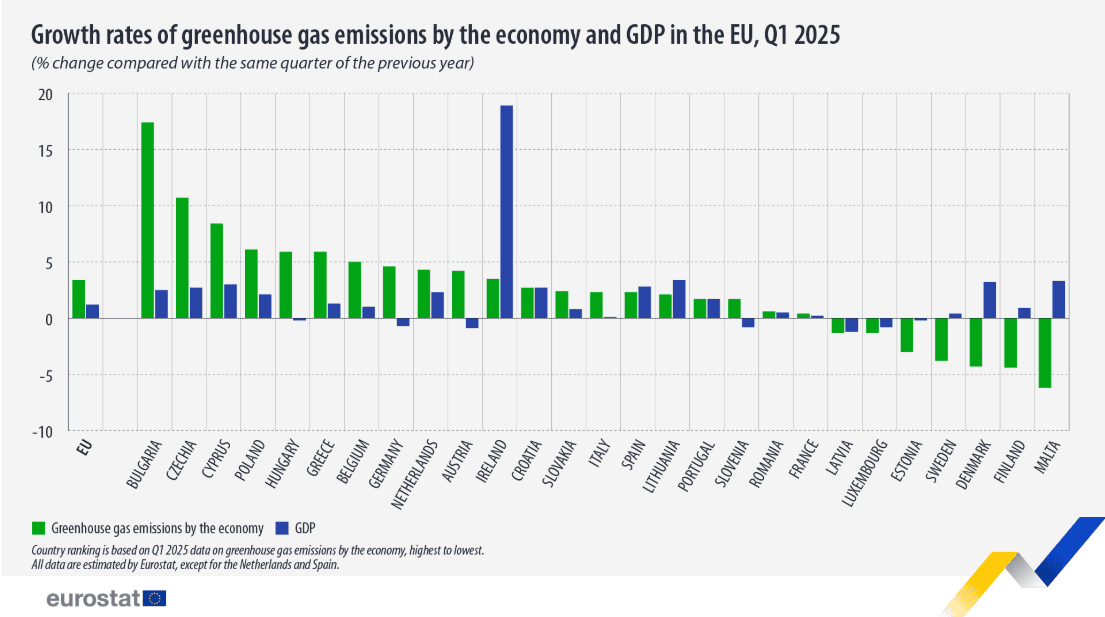
Year-on-year development of greenhouse gas emissions and GDP in the first quarter of 2025 in the EU and individual Member States. Source: Eurostat
Low wind power generation
The increase in CO2 emissions from electricity generation in Europe in the first quarter of this year was mainly driven by lower output from wind power plants. For example, German wind farms generated a quarter less electricity year-on-year in the first quarter of this year.
The significant drop in generation was caused by unfavourable weather conditions, particularly unusually weak winds in February and March. This had a very strong impact on output from both onshore and offshore wind turbines in the first quarter.
While generation from German onshore turbines fell by 22%, offshore output was down by as much as 31%. Total output from Germany's large wind turbine fleet reached 33.3 TWh, 14 TWh less than in the first quarter of 2024. Nevertheless, wind turbines covered 25% of electricity consumption.
The decline in wind power generation had to be replaced by fossil-fuel power plants. Generation from natural gas-fired power plants in Europe therefore rose by 8%, while coal-fired generation increased by 6%.
Sdílejte článek prostřednictvím:
You might also like

10 August 2026, 15:50


10 August 2026, 09:33