23 October 2026, 14:38
Loading...
Fewer bidders, more money. Third EU hydrogen auction to distribute €1.1 billion
Barbora Zimová
22 May 2026, 06:04
The number of applicants for European hydrogen support is declining, but the amount of money allocated is rising. The third auction of the European Hydrogen Bank produced the lowest bid in its history, submitted by Finland. Projects from Greece and Austria have made it among the winners for the first time; countries on the Iberian Peninsula and in Scandinavia had previously dominated. One of the new features of the third auction is stricter resilience criteria targeting Chinese electrolyser equipment and components.
The third auction of the European Hydrogen Bank (EHB) ran from early December last year until mid-February 2026. At the deadline, the list of applicants comprised 58 bids from 11 countries, and the support requested exceeded the available €1.3 billion budget more than sixfold. In May, the European Commission announced that it would ultimately distribute €1.1 billion among nine successful projects focused on renewable hydrogen production. The winning projects from seven European Economic Area countries now also include Greece and Austria.
Together, they represent approximately 1.1 GW of installed capacity and, according to information published on the Commission's website, are expected to produce more than 1.3 million tonnes of hydrogen during their first decade of operation. Aggregate production over one year of the ten-year support period thus represents approximately 1.3% of annual domestic production projected for 2030. The estimated greenhouse gas emissions reduction amounts to a total of 9 million tonnes of CO₂ equivalent. The projected savings correspond to emissions comparable to one day in 2024, when EU emissions reached 3.3 billion tonnes of CO₂ equivalent.
Support mechanism
One of the required criteria is a minimum installed electrolyser capacity of 5 MWe. The third auction also tightened the resilience criterion, which aims to strengthen the EU's strategic autonomy. It follows the Net-Zero Industry Act, which seeks to ensure that European manufacturing capacity covers at least 40% of annual EU demand for electrolysers by 2030. Specifically, at least 75% of the electrolysers included in a project must originate from a country other than the People's Republic of China. In addition, the so-called stacks, which form the core of an electrolyser, must not be of Chinese origin at all. No more than two other main components may originate from China.
The rules were still less stringent in the second auction.
“Projects must limit the procurement of electrolyser stacks for which surface treatment, the production of individual cells, or assembly is carried out in China to a maximum of 25% (in MWe),”stated the European Commission's 2024 terms.
As for the maximum amount of support per bid, the Commission reduced it from the previous €250 million to €200 million. Financial support comes from the Innovation Fund, whose revenues are generated through emissions allowance trading. The auction model is based on a fixed premium per kilogram of hydrogen produced, which project applicants submit in their bids. In this case, the specific premium awarded to individual projects ranges from €0.44 to €3.49/kg and will be paid for a maximum of ten years from the start of commercial production.
Unlike standard Innovation Fund grants, support is paid solely for a certified and verified volume of hydrogen actually produced, with no possibility of pre-financing or payments before commissioning. The instrument targets projects approaching commercial deployment, where technological risk is limited but which still face a barrier to economic viability. According to the European Commission, competition among bidders also puts downward pressure on prices, reducing the scope for excessive support.
In addition to Innovation Fund financing, Spain and Germany will contribute a further €1.7 billion to national funds. The Auctions-as-a-Service instrument enables member states to use national resources to support projects on their own territory that applied to the auction.
Winning projects
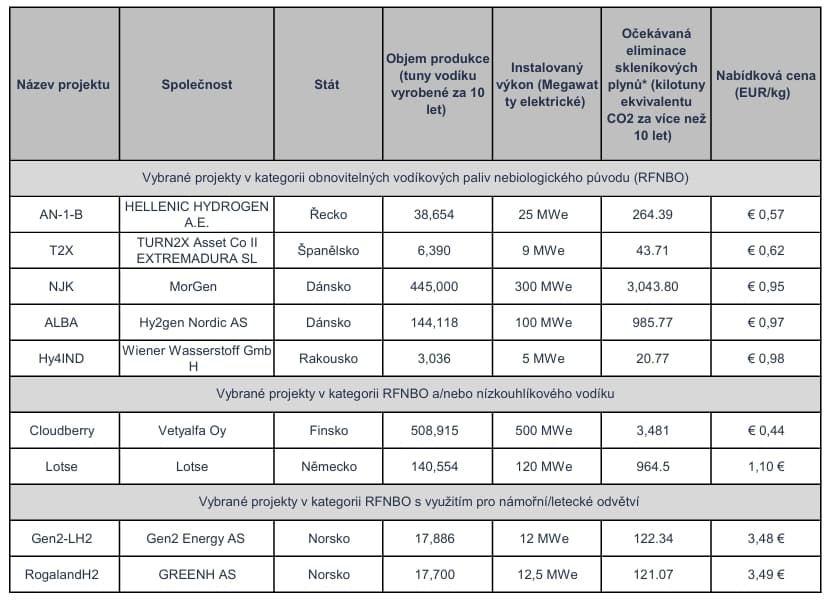
Selected projects under the third hydrogen auction, author's own compilation. Source: European Commission
Auction allocated funds across three categories
The largest share of funding is going to five projects producing renewable fuels of non-biological origin (RFNBOs).
In the second category, focused not only on RFNBOs but this time also on low-carbon hydrogen, Finnish company Vetyalfa is the notional record-holder. It submitted the lowest bid in this and all previous auctions, at €0.44/kg, for the Cloudberry project. At 500 MWe, it is also the largest project by installed capacity.
The third category focused on offtakers in the maritime and aviation sectors and, unlike the first category, where none of the bids exceeded €1/kg, both Norwegian maritime projects are an order of magnitude higher. GREENH AS has succeeded in obtaining EHB support for the second time; this time, it has a vision for use in both maritime transport and industry. Gen2 Energy AS plans to build a facility integrating electrolysis and liquefaction, thereby ensuring supplies of liquefied hydrogen (LH₂) as fuel, from production to distribution.
“Europe has an opportunity to become a leader in zero-emission shipping and broader industrial decarbonisation. Industrial-scale LH₂ production is a crucial step in this direction,”commented Lena Halvari, CEO of Gen2 Energy, on the auction results.
It is therefore no surprise that, as in the previous auction, these are exclusively Norwegian initiatives. Norway is one of the countries for which maritime transport decarbonisation is a priority under its Hydrogen Strategy. Domestic shipping and fisheries account for approximately 8.6% of total emissions. The government has set a target to halve these emissions by 2030.
All selected initiatives will now begin preparing their grant agreements and, according to the timetable, agreements with winning bidders are to be signed in the 4th quarter of this year. From then, they must reach financial close within two and a half years and be commissioned within five years, as stipulated by the auction terms.
The number of auction bidders is falling, but allocated support is rising
In the first hydrogen auction in April 2024, 132 entities expressed interest, with their support requests exceeding the available budget by more than fifteenfold. Total support for the individual installations amounted to nearly €700 million at the time. The six winning projects came either from the Iberian Peninsula or Scandinavia. Their total production potential was up to 1.5 million tonnes of renewable hydrogen during their first ten years of operation.
In the second auction a year later, there were only 61 applicants for support, but the allocated amount had already reached nearly €1 billion. Requested support for the projects was four times the available budget. It ultimately produced 15 winners, with Germany and the Netherlands newly joining the target countries. They anticipated producing 2.2 million tonnes of green hydrogen over 10 years. However, around half of them withdrew their projects six months later. The reason was the inability to complete projects under the stipulated conditions, particularly due to the requirement for commissioning by 2030.
Barriers to renewable hydrogen development
The time required is one of many obstacles facing the development of hydrogen projects. Also frequently cited are transport difficulties, high investment costs and uncertainty over future availability compared with fossil alternatives. The International Energy Agency therefore recommends implementing measures aimed at reducing this gap between them.
WindEurope has previously warned that the planned €3 billion budget for two auctions would not be sufficient either to kick-start renewable hydrogen production or to meet EU targets. Achieving the domestic production target set for 2030 requires adding an average of 20 GW of new installed capacity each year. The reality, however, is that only 3 GW had been deployed by the end of 2023.
Translation disclaimer
This article is a machine translation of the Czech original and has not yet been fully reviewed. In case of any doubt, please refer to the Czech version.
Sdílejte článek prostřednictvím:
You might also like
23 October 2026, 11:01
23 October 2026, 06:34