Repository authority begins exploratory drilling for deep radioactive waste repository
The Radioactive Waste Repository Authority (SÚRAO) announced the start of monitoring borehole drilling at sites being investigated as potential future locations for a deep geological repository for nuclear waste. Hydrogeological boreholes are first in line, while the tender for the subsequent deep boreholes had to be cancelled. The EU taxonomy is putting pressure on the timetable for commissioning the deep repository.
At the end of 2020, the government approved the selection of four recommended sites for a deep geological repository for radioactive waste. These are Březový potok in the Klatovy region, Horka between Třebíč and Velké Meziříčí, Hrádek near Jihlava, and Janoch near Temelín. Municipalities have long opposed the repository plans and last year decided to continue their opposition through the courts. The Municipal Court dismissed the lawsuits, most recently in March this year. SÚRAO has now taken another step towards building the deep geological repository for radioactive waste.
“This is an important milestone in the process of selecting the final and backup sites. For the first time, we will look directly underground through boreholes and refine the knowledge obtained so far from the surface. We will describe the geological environment in greater detail and gain a better understanding of it, providing high-quality data for selecting the final and backup sites,” SÚRAO Director Lukáš Vondrovic commented on this stage.
Vondrovic further stated that several boreholes will be drilled at each site. Their number will depend on the specific natural conditions of the area. They will focus both on the rock massif and water in deeper parts of the subsoil, as well as on monitoring water quality and quantity close to the surface.
The first boreholes will be drilled at the Janoch site. Drilling a 100-metre borehole itself will take around two weeks, followed by measurements and hydrodynamic tests. During these, experts will observe how quickly the water level returns to its original level after pumping. Experts will then collect water samples quarterly for laboratory analysis.
The drilling campaign follows a hydrogeological, hydrological and hydrochemical monitoring project. SÚRAO launched it at all four sites two years ago. The contractor is GEOtest-GeoTec. Monitoring work ideally takes place over several years in order to capture all factors that may affect water status and quality.
For example, the development of the total volume of water and its chemical composition are monitored. Installed weather stations monitor local weather 24 hours a day throughout the year. This has already enabled overflows on watercourses and all water springs to be mapped at the sites.
Radioactive waste and EU taxonomy requirements
Radioactive waste is currently generated in the Czech Republic from several sectors that differ in both the nature and composition of the material produced. One group comprises waste from industry, research and healthcare. This includes primarily used radioactive sources, decontamination and scintillation solutions, contaminated rubble, metal, plastics, laboratory glass and cellulose. It also includes low-level waste such as contaminated paper, metals, sludge or ventilation filters, generated by the operation of nuclear reactors at power plants.
According to SÚRAO, the Czech Republic produces 450 tonnes of low- and intermediate-level waste annually. It stores this waste at the complex of the former Richard limestone mine near Litoměřice, the former Bratrství uranium mine near Jáchymov, and directly at the Dukovany Nuclear Power Plant site.
As for spent nuclear fuel, the Repository Authority states that around 100 tonnes are generated annually in the Czech Republic. It is temporarily placed in special containers at interim storage facilities on the Dukovany and Temelín power plant sites.
The European Commission’s supplementary delegated act makes the inclusion of nuclear energy in the taxonomy conditional on a number of criteria. These include a requirement for Member States to have, by no later than 2050, a detailed plan for commissioning a facility for the disposal of high-level radioactive waste.
“The scientific consensus today considers deep geological repositories (DGR – Deep Geological Repositories) to be a safe and effective means of permanently disposing of spent nuclear fuel and high-level radioactive waste. These repositories are designed to be inherently safe and permanent. Their safety does not depend on human maintenance or any future human intervention,” states the introduction to the 2020 document titled Management and Disposal of High-Level Radioactive Waste: Global Progress and Solutions , published by the Nuclear Energy Agency (OECD).
The deep geological repository option has therefore also become an issue in, for example, France, Finland and Germany.
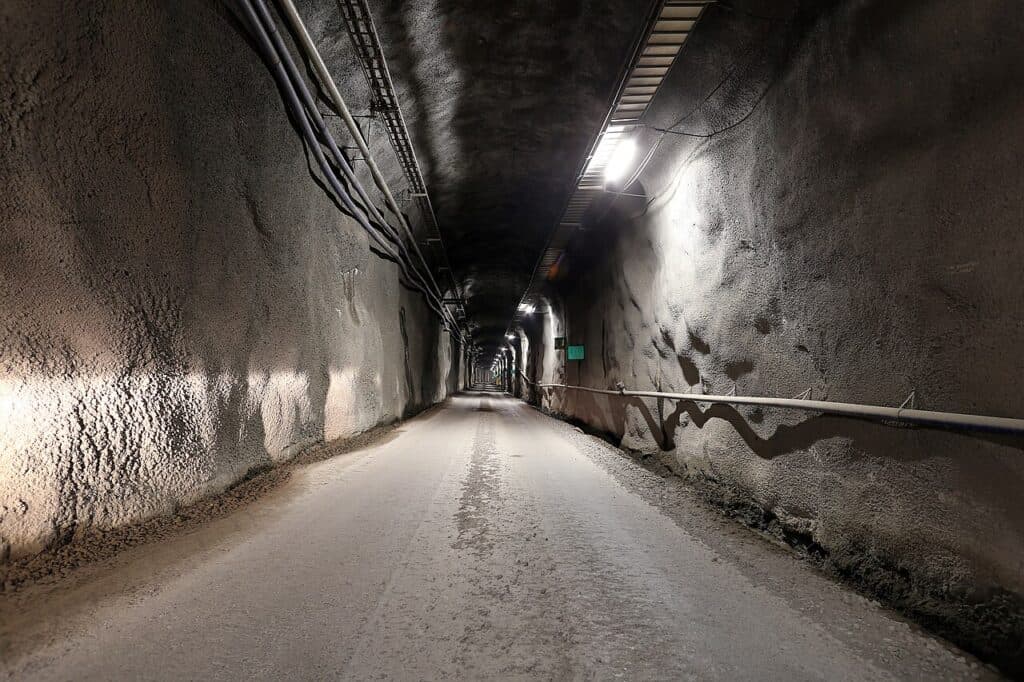
SÚRAO plans to use disposal canisters placed at a depth of around 500 metres below ground level. In addition to spent nuclear fuel and high-level radioactive waste from other generators, it will also dispose of intermediate-level waste there.
Subsequent stages of investigation and 2050 as the target
However, hydrogeological boreholes are only one of the planned stages. They will be followed by extensive geophysical measurements and deep boreholes. The combined data obtained in this way are intended to provide the basis for a decision on the final and backup sites. SÚRAO has already moved to implementation of the first of these. At the beginning of February this year, it signed a contract with KANOPY, represented by lead company INSET, to conduct the geophysical survey.
Conversely, it had to cancel the tender for a contractor to carry out the deep boreholes. TSSAP, the only company to submit a bid, exceeded the original price set in the public tender specifications by almost threefold. SÚRAO subsequently stated that it had decided to procure contractors in stages. According to the authority, these changes should not affect the project timetable.
The plan remains to announce the recommended final and backup sites by 2030. The Czech Republic’s National Report envisages commissioning the deep geological repository from 2050. SÚRAO expects it to operate for around 100 years.
The total cost of the project is expected to reach approximately CZK 273 billion (at 2024 prices). This figure was published by the Ministry of Industry and Trade in February this year in its draft Radioactive Waste and Spent Nuclear Fuel Management Strategy. Most of this amount, nearly CZK 198 billion, will be consumed by the 100-year operation itself. Around CZK 33 billion is allocated to construction of the repository.
The deep geological repository represents just under half of the costs of the entire radioactive waste management programme. The programme is estimated at CZK 559 billion for the period through to 2200 and also includes the operation of existing repositories and the decommissioning of nuclear power plants.