The "duck curve" has arrived in Czechia. It has acquired its typical shape only in the past two years


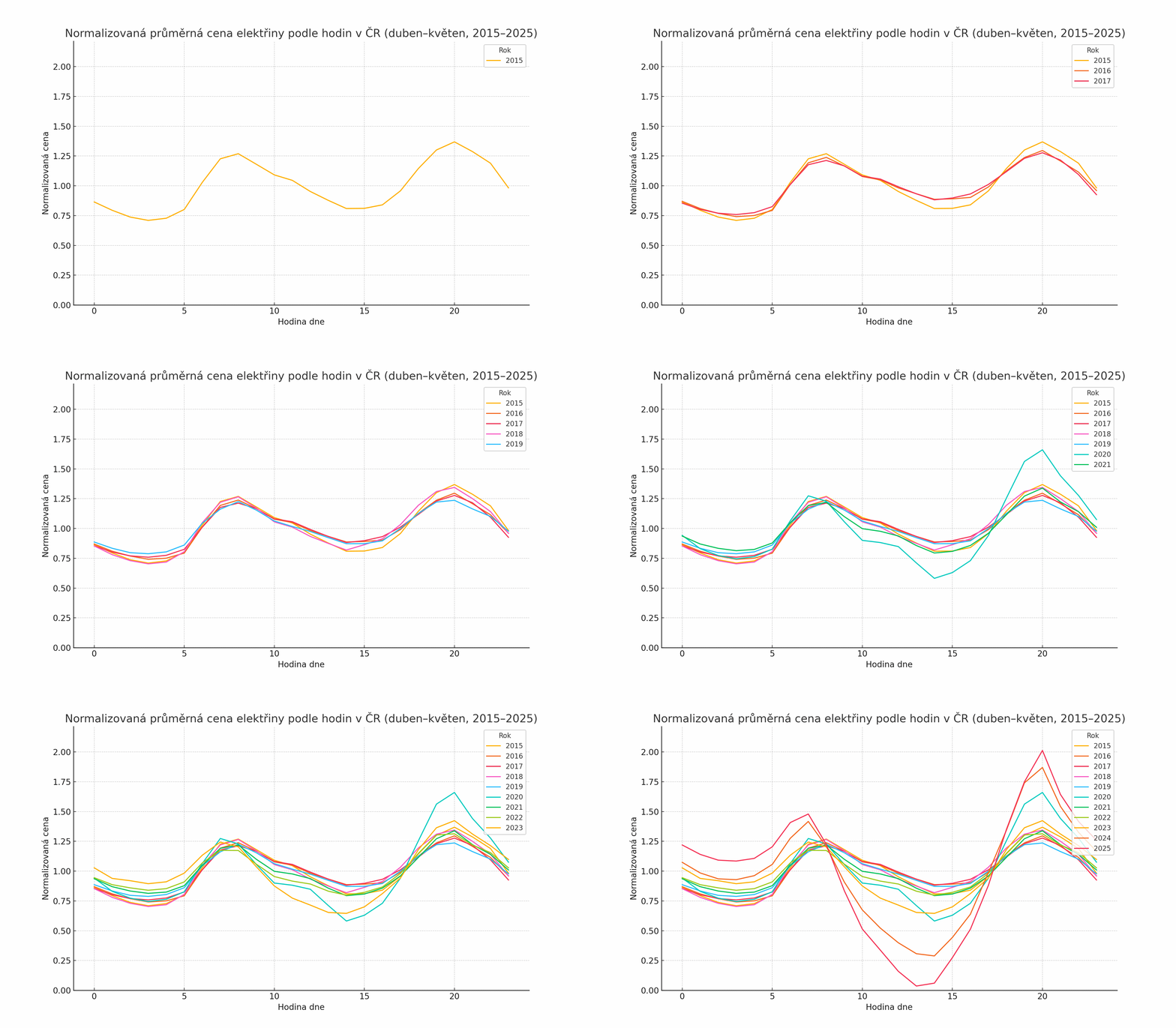
The so-called duck curve in the day-ahead electricity market is also clearly observable in Czechia. While it was minimal in 2015, its midday trough has deepened significantly over the past two years. Morning and evening price peaks are also gradually rising. The phenomenon is clearly evident in data from April and May, when solar power plants typically generate the most electricity. Their output pushes electricity prices at midday down to negative values.
The rapid expansion of renewable energy sources in recent years has had a fundamental impact on the energy system, including wholesale markets. One such impact is the formation of the so-called duck curve in the day-ahead electricity market. This is a shape created by the curve of average daily electricity prices for each hour of the day (note: the term "duck curve" is also often used to refer to the decline in system load around midday). Its characteristic shape, which vaguely resembles a duck in outline, has given rise to the term “duck curve”.
The duck curve in the day-ahead market is important for the energy sector for at least two reasons. First and foremost, it shows at which hour of the day electricity has the highest value and at which it has the lowest. The curve thus shows that at midday, when conditions are favourable for solar power generation, electricity is least in demand.
Second, it shows how flexible the system is and how well it can respond to changes in electricity generation and consumption during the day. Low prices at midday are driven not only by high solar generation, but also by output from power plants for which it is not worthwhile to reduce and subsequently increase generation due to a short-term fall in electricity prices, whether for operational or economic reasons.
As can be seen in the previous chart showing spot electricity prices in April and May, the duck curve is also clearly visible in Czechia. Most of its characteristic shape has emerged over the past two years.
The curve reaches its deepest trough at 13:00 and 14:00, when spot prices average only a few percent of the average price in April and May. Conversely, it peaks at 20:00, during the evening peak, when the price is up to double the average electricity price over this period.
The duck curve is far from being a problem confined to Czechia. Since European markets are interconnected to a considerable extent, similar curves can also be observed in other European countries. However, the first more serious references to the duck curve phenomenon appeared in the United States, where it was described many years ago by the system operator in California.
The consequences of the so-called duck curve can pose a major problem for newly built solar power plants. The value of their output is significantly lower because they generate most of their electricity when power prices are low. Conversely, their generation is generally lower during hours with higher prices.
On the other hand, the duck curve is a positive signal for investors in short-duration storage facilities. It may open up an opportunity for additional revenue: in addition to providing balancing services, they can profit from short-term differences between electricity prices at midday, at the bottom of the duck curve, and during the evening peak.
Large-scale energy storage is, however, developing relatively slowly in Czechia. This is primarily due to delays in adopting appropriate legislation. Lex OZE III, which introduces the concept of energy storage into the Energy Act, was adopted only at the beginning of this year, and some of its implementing regulations are still pending.