Wind energy in the Czech Republic is facing headwinds on several fronts. Some of the acceleration zones intended to kick-start wind turbine construction will be scrapped, while no new ones will be created. The anti-wind movement is stepping up its activities, and referendums are increasingly resulting in projects being rejected.
“It is being said that they are considering dropping 26 to 30 of the original 80 wind energy zones,” says Petr Holub, former director-general of the climate protection section at the Ministry of the Environment.
The Ministry for Regional Development (MMR), which is responsible for designating acceleration areas, does not want to provide a specific number of zones that could potentially be removed. It is currently inundated with comments. It has registered more than 13,000 submissions, with each submission potentially containing several comments. The process is due to be completed by the end of August, when the government is expected to approve the acceleration areas. If it fails to do so, it risks losing billions from the National Recovery Plan.
“A reduction in the number of acceleration areas is expected, but the final figure will only be clear after the government’s decision in the summer of this year,” says Veronika Lukášová, the ministry’s spokesperson.
Regions were previously constructive
One publicly known case is the Liberec Region, where the original plan envisaged five areas for accelerated wind power development. In the end, however, it will most likely have none, with only two areas for solar energy remaining. Local municipalities and the Liberec regional administration opposed the wind acceleration zones. They objected that the MMR had not consulted the designation of the zones with the leadership of the towns and municipalities where the turbines were to be built.
According to Holub, acceleration zones were discussed with the regions while he was still at the Ministry of the Environment. Consultations directly with affected municipalities were meant to take place over the first draft of the acceleration areas in the first quarter of this year.
“It was discussed with all the regions, and some regions, including the Liberec Region at the time, were constructive. Many regions said: Propose it to us; we do have to oppose it, but ultimately it will be better for us if the state designates it and we do not have to,” Holub says.
“Discussions with the affected municipalities were originally planned for the first quarter, but the first draft of the acceleration areas was delayed following the change of government,” the expert adds. “Of course, if the law had come earlier, there would have been more time buffer, but it was parked in the previous parliament for half a year because parliament was often blocked during the pre-election year,” Holub adds.
While some acceleration areas will be removed, no new ones will be created. “Amendment No. 2 to the Spatial Development Plan will not propose any new acceleration areas of nationwide importance beyond the draft for the joint meeting and public consultation,” says spokesperson Lukášová. “We expect that, even after reductions made on the basis of the joint meeting and public consultation, the requirements of the National Recovery Plan will be met. Regions and municipalities may designate additional acceleration areas of regional and local importance in their spatial planning documentation,” Lukášová notes.
More turbines, but fewer modern ones
Under the National Recovery Plan, areas for accelerated wind and solar development must make it possible to build facilities with a capacity of at least three gigawatts. In the original draft of acceleration zones presented by the Ministry for Regional Development in mid-April, the total capacity of wind power plants was estimated at 4.5 gigawatts, while solar power plants accounted for 1.5 gigawatts. At first glance, it might therefore appear that the state has a sufficient buffer and can remove zones.
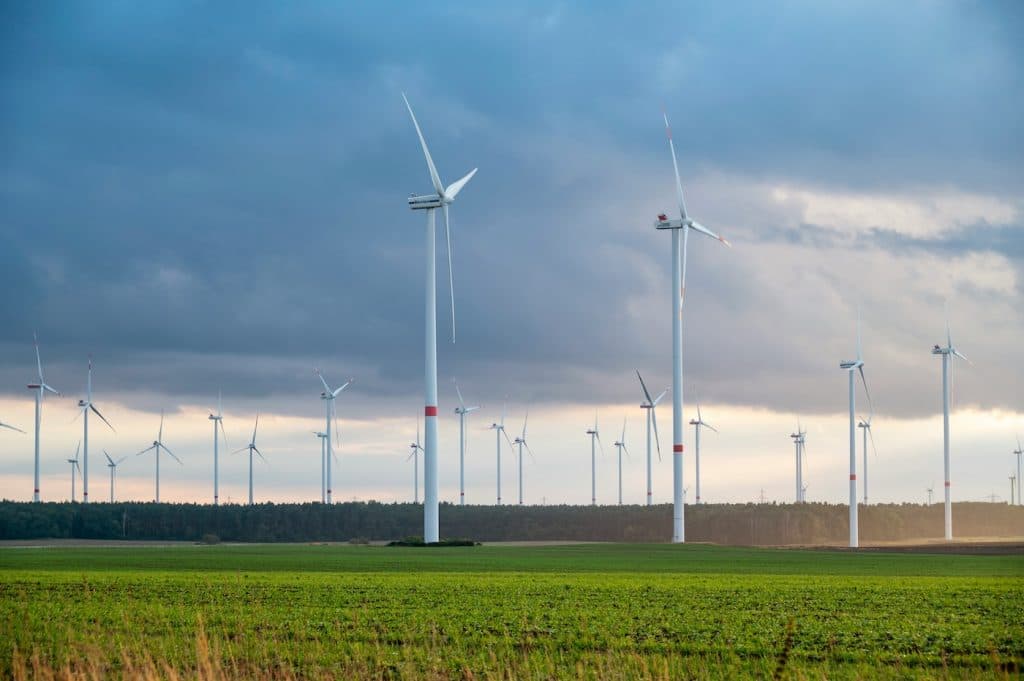
However, experts have long pointed to the problem of height limits for wind turbines. In a substantial part of the zones, the ministry sets a maximum turbine height that will make it impossible to install the most modern equipment. And if the state wants to achieve the required gigawatts, paradoxically it will have to build more power plants. Smaller turbines generally generate less electricity, so a larger number of units is needed to reach the same capacity.
When fields are ploughed, turbines must not turn
According to Holub, another problem in the proposed acceleration zones is the regime following ploughing and harvesting. “The conditions for acceleration areas state that after ploughing and harvesting, the power plant must be shut down for a certain period. This is for bird protection,” the expert explains. “When a field is ploughed or harvested, voles, insects and roots emerge. Birds have more food there, so more of them typically fly in. It therefore makes sense to curtail or stop the plant for a period. But when we spoke with conservationists, there was agreement that one day, or three days at most, was sufficient; after that, the food has been eaten. Nevertheless, the proposed acceleration zones stipulate five days, which is a maximalist and unnecessary requirement,” Holub says.
“Reducing the number of acceleration areas or making them smaller is a natural outcome of the consultation process; I do not see a problem with that. But imposing restrictive conditions that would effectively prevent the construction of modern technologies in those acceleration areas ultimately designated by the government is completely nonsensical. Hopefully it will not happen,” Holub says.
In addition to the Liberec Region, the MMR’s draft response to comments envisages removing two of the four proposed wind areas in the Pardubice Region as well. Some areas will be removed due to military interests. “There are at least three that we know we can remove, at the request of the military and affiliated bodies, because they could interfere with radar and other matters,” Environment Minister Igor Červený said less than two weeks ago on the programme Five Minutes to Twelve.
Two areas are to be removed because of military interests: Pomezí, located in the aforementioned Pardubice Region, and Kryštofovy Hamry in the Ore Mountains. It should be noted that turbines are already operating in Kryštofovy Hamry; it is one of the largest wind farms in the Czech Republic.
“A total of sixteen existing wind turbines fall within the planned area – specifically, thirteen from the Kryštofovy Hamry project and all three turbines from the Rusová project,” says Magdalena Hynčíková, spokesperson for the Ministry of Defence. “Both projects were approved by the Ministry of Defence as early as 2004, with their permits valid for 20 years. The turbines were subsequently built – in Kryštofovy Hamry in 2007 and in Rusová in 2006,” the spokesperson says.
New wind turbines could pose an obstacle to the nearby Hrušovany radar. And according to the ministry, even the existing turbines are not without issues in the future. “It is important to take into account that the Ministry of Defence only began designating the area around the Hrušovany radar at the turn of 2007 and 2008, after these wind turbines had already been built. For this reason, the Ministry of Defence must respect them in this area, but only for the period for which they were originally permitted – namely 20 years,” Hynčíková notes.
Anti-wind movement toughens its stance
The Ministry for Regional Development says that most comments came directly from citizens. This is no coincidence. In recent months, a large-scale anti-wind campaign has gathered pace in connection with the consultation process. Discussions were held in cultural centres and municipal pubs where, alongside misinformation about the health impacts of wind turbines, attendees were given specific instructions on how to oppose turbines and acceleration zones. The ZastavVTE website, backed by the Svobodní political party, offered downloadable template documents for comments on acceleration zones.
These activities are documented in detail by the Association for International Affairs (AMO). Its latest analysis shows that the number of anti-wind meetings has been growing since last autumn. “The most were held in May, most likely in connection with the consultation process on acceleration zones,” says Petr Vidomus, co-author of the analysis. It tracked 37 meetings outside Prague held between August last year and May this year, with seventeen of them taking place in May alone. Vidomus notes, however, that some debates may have been missing from the data because the research team may not have captured them.
According to AMO’s analysis, the meetings are not an expression of spontaneous local opposition to wind power development, but a strategically managed campaign. The same figures often appear at discussions with local residents, especially Hynek Beran and Ivan Noveský, who present themselves as independent experts despite their links to the PRO political party.
Direct contact with residents of villages and municipalities is beginning to pay off for the anti-wind movement. In October, eighteen referendums were held in connection with parliamentary elections. In eight cases, municipalities voted in favour of construction; in ten cases, they rejected wind turbines in their territory. This year, seven referendums were held from January to May, and six municipalities voted against construction, with only one in favour. “The meetings definitely have an influence. They are often held where citizens want to initiate a referendum, or where a referendum is already planned,” Vidomus adds.
This text was produced thanks to a grant from the Independent Journalism Foundation.