10 August 2026, 15:50
First wind farms from Czech auctions enter operation. Their capacity is set to double thanks to the auctions

Martin Voříšek
18 May 2026, 06:14
This article is a machine translation of the Czech original and has not yet been fully reviewed. In case of any doubt, please refer to the Czech version.
Auctions for operating support for renewable energy sources are beginning to deliver their first tangible results in Czech wind power. According to data from the Ministry of Industry and Trade, 26,94 MW of wind power capacity awarded operating support in auctions had entered operation as of 30 April 2026. A further roughly 378 MW of capacity is expected to follow in the coming years, provided these projects secure permits and financing and complete construction.
The first three wind power projects that received support in auctions have already begun operation. This follows from the Ministry of Industry and Trade's response to a request under the Freedom of Information Act. They are projects by SYNERGION Jívová s.r.o., with installed capacity of 11,3 MW; LHOTA BRNO s.r.o., with 9,04 MW; and VTE Maletín s.r.o., with 6,6 MW. All three projects succeeded with a reference price of 3 500 Kč/MWh.
In total, the auction system has thus added 26,94 MW of installed wind power capacity in Czechia. This is not an entirely negligible figure in the Czech context, as total installed wind power capacity in the Czech Republic stood at approximately 377 MW at the end of 2025, according to data from the Energy Regulatory Office. At the same time, however, it is clear that the capacity added through auctions so far still represents only a small share of what will be needed to meet national targets.
Hundreds of megawatts remain in development
Since 2022, wind projects with a total installed capacity of approximately 405 MW have succeeded in auctions. After deducting the projects already commissioned, roughly 378 MW remains in the development phase. The largest volume comes from the second auction for 2025, in which 23 wind bids with a capacity of 242,5 MW succeeded.
Based on the commissioning dates stated in the auction results, the largest volume of new projects should come online in 2027 and 2029. By the end of 2027, 140,15 MW of installed wind power capacity should be built in the Czech Republic, followed by another 64,78 MW in 2028 and 173,50 MW by the end of 2029.
Although the volume of projects awarded in auctions is gradually increasing, it still represents only part of the target set in the National Energy and Climate Plan (NECP), under which the Czech Republic should have 1 500 MW of wind power installed by 2030.
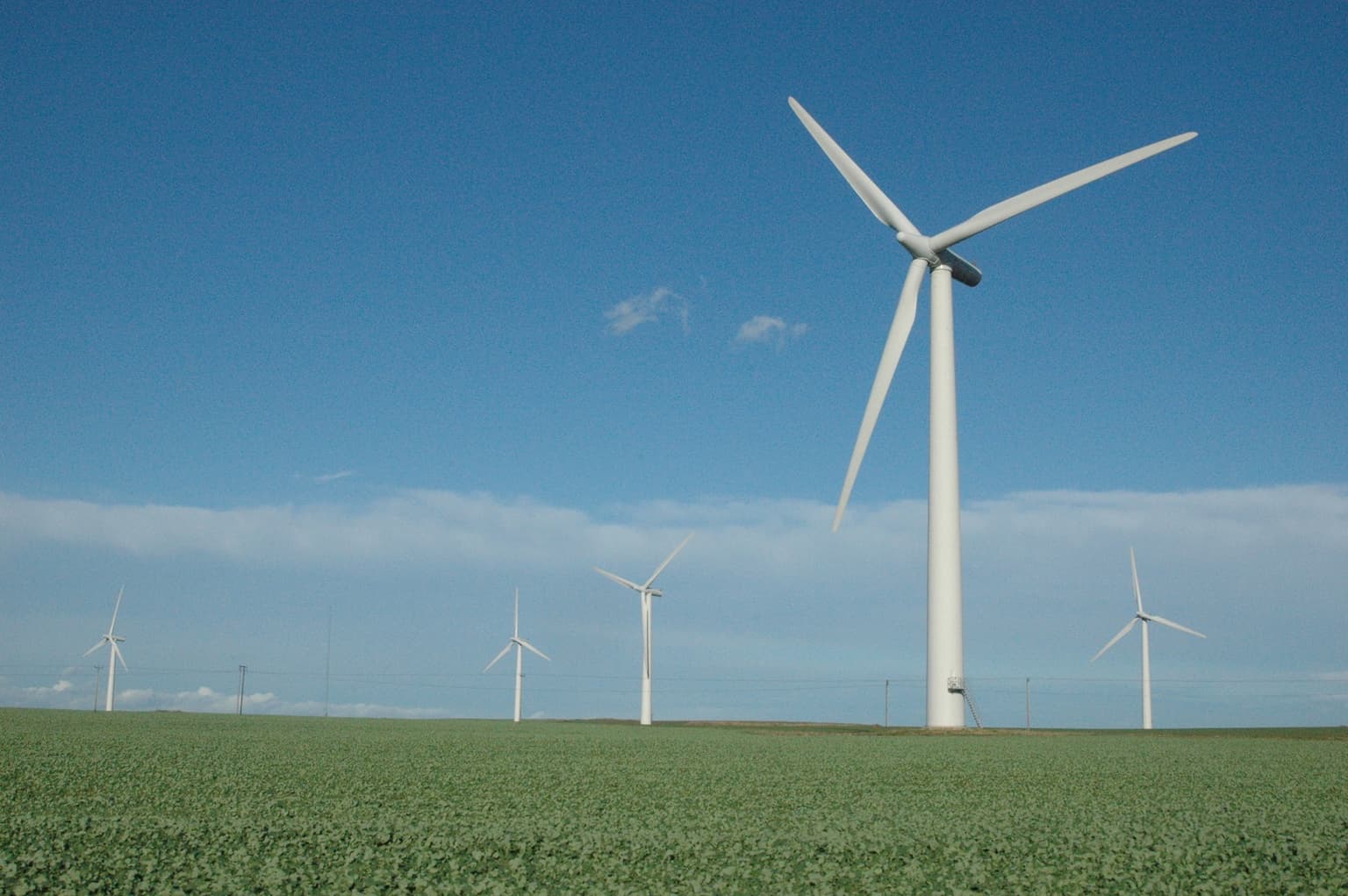
Wind turbine. Source: Tom Corser / Wikimedia Commons / CC-BY-SA-3.0
Being awarded support in an auction does not necessarily mean that construction will actually take place. According to ministry data, one company in the second 2025 auction did not demonstrate the second part of the financial guarantee, and therefore did not acquire the right to operating support.
The ministry also stated that no decision to withdraw the right to auction support has yet been issued to any company.
Auctions show both the potential and weaknesses of the market
Developments in recent years confirm that there is investor interest in wind auctions in the Czech Republic, although it is fairly sensitive to the conditions set. While some calls were fully subscribed, the first auction of 2025 ended in failure. With an allocation of 180 MW, only one project with a capacity of 4,2 MW applied. One reason was the condition that projects had to already have construction permits.
After this requirement was eased, interest rose significantly. The second 2025 call offered 360,8 MW for wind power plants, and 23 bids met the auction conditions and succeeded. Reference prices were just below 3 200 Kč/MWh, with the lowest winning bid at 3 149,50 Kč/MWh.
Even if all auction projects successful to date were completed, installed wind power capacity would reach only approximately half of the 1,5 GW target for 2030. The remainder would have to be delivered through further auctions or purely commercial projects.
Sdílejte článek prostřednictvím:
You might also like

10 August 2026, 09:33
9 August 2026, 14:38