Which sources cover demand in the Czech Republic and how will the situation change after coal is phased out?

Events at the beginning of this year (in particular the Czech power system reaching record demand and the short-term split of the European synchronous transmission grid) and increasing pressure to accelerate the phase-out of coal-fired capacity are prompting debate over options for ensuring future security of electricity supply in the Czech Republic. According to the Czech transmission system operator, the Czech Republic will not be able to ensure generation adequacy in the coming years without fairly extensive development of power plants and heating plants burning natural gas. In its simulations, ČEPS also assumes operation of a new nuclear unit with installed capacity of 1200 MWe from the second half of the 2030s and operation of the remaining units at the Dukovany nuclear power plant up to 60 years of service, i.e. until 2045 to 2047.
Extreme frosts that hit the Czech Republic in the second week of February resulted in the highest power system demand since 1990, the first year for which relevant data are available. The value of 12 292 MW was recorded on 15 February before 9 a.m. This was 200 MW higher than the previous record at the turn of February and March 2018, when Europe was likewise hit by a spell of freezing weather.
Looking at electricity generation on the day in question, it is clear that a large share of demand during the 9 a.m. hour was covered by nuclear (around 3.5 GW) and coal-fired power plants (around 5.1 GW). Natural gas-fired power plants, which supplied around 1.5 GW to the grid during the 9 a.m. hour, also made a substantial contribution to covering demand. Hydropower and pumped-storage hydropower plants supplied around 1.1 GW. Solar, wind, biomass and other renewable sources together supplied around 900 MW.
A similar situation is typical of most winter days. The third week of January in 2019 and 2020 can serve as an example. During these weeks, the most significant Czech baseload sources (coal-fired and nuclear power plants) typically supply 7 to 9 GW to the grid. Flexible gas-fired, hydro and pumped-storage plants typically supply 0.5 to 2.5 GW, depending on conditions in the grid and electricity market. Solar power plants supply up to 500 MW and wind power plants up to 300 MW.
A different situation occurs during typical summer days. For comparison, the third week of July in 2019 and 2020 can be used as an example. The charts below show that on these days, coal-fired and nuclear power plants typically supply 5 to 6 GW. Flexible gas-fired, hydro and pumped-storage plants usually supply around 0.5 to 2.0 GW. Generation from solar power plants reaches up to 1200 MW under favourable conditions. Wind power generation generally does not exceed 100 MW.
From the charts and figures above, it is possible to estimate, with a certain degree of accuracy, the size of the power system's baseload, i.e. the minimum demand reached in the period under review, on typical winter and summer days. In winter, this is 7.5 to 8.5 GW, while on summer days it is around 6 GW.
Similar figures also emerge from a recent analysis of electricity consumption in the Czech Republic using 2018 data. According to the analysis, annual baseload is determined chiefly by electricity offtake at the high-voltage (or extra-high-voltage) level, which is primarily attributable to industrial consumers. Except for the Christmas holidays and New Year, these consumers' share of total system demand is always above 50 %, including at weekends. In summer, the share of large consumers is even more pronounced due to lower household consumption.
During 2018, the year in question, large consumers' offtake only rarely fell below 5000 MW. Conversely, peak demand was 6500 to 7000 MW for most of the year, rising to 7000 to 7500 MW in the winter months. As with households and small consumers, consumption increased during the February frosts, when large consumers' demand exceeded 8000 MW.
The minimum demand in the household segment is also noteworthy: it does not fall below 750 MW in the summer months or below 1600 MW during a cold February. In this segment in particular, these figures can be expected to rise in the future with the anticipated expansion of electric heating and cooling.
How can security of electricity supply in the Czech Republic be ensured after coal capacity is phased out?
Looking at the charts and figures above, it is clear that coal-fired power plants remain absolutely crucial for covering both system baseload and mid-merit, and sometimes even peak, demand. In 2019, these sources accounted for nearly 42 % of total gross electricity generation in the Czech Republic.
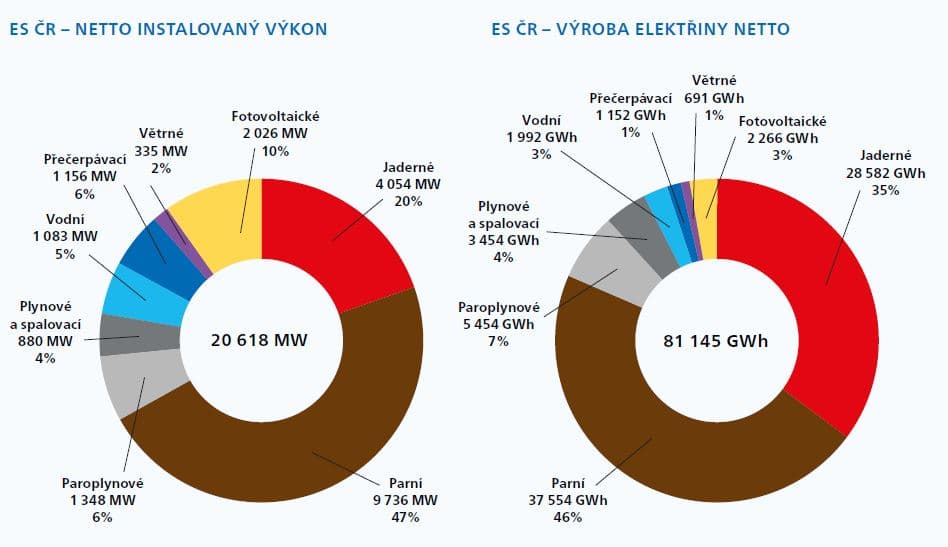
source: ERÚ, ČEPS calculations
Given mounting pressure to accelerate the move away from coal, the question of how to ensure security of electricity supply in the Czech Republic in the coming years is being increasingly discussed.
The Czech transmission system operator, ČEPS, a.s., sought to answer this question in its Generation adequacy assessment of the Czech power system to 2040 (MAF CZ). Given the complexity and scope of the issue, ČEPS prepared the assessment under several scenarios, focusing on four key aspects:
- Reliability – maintaining electricity supply reliability standards (particularly an LOLE indicator of up to 6–8 hours/year)
- Self-sufficiency – maintaining electricity generation in the Czech Republic at no less than 90 % of electricity demand (an ASEK requirement)
- Economic justification – considering economically justifiable development of the generation fleet, especially the development of peaking and mid-merit sources necessary to maintain secure and reliable supply
- Emissions footprint – reducing greenhouse gas emissions
In the report mentioned above, ČEPS sets out a number of input assumptions for the individual types of generation sources used in its simulations. Regarding coal-fired capacity, it notes, among other things, that these sources contribute not only to meeting electricity demand but above all to providing ancillary services.
“Coal-fired sources almost entirely provide frequency containment reserve (FCR), account for approximately 80 % of available capacity for downward balancing reserves (aFRR-, mFRR-) and approximately ½ of available capacity for upward balancing reserves (aFRR+, mFRR+). Coal-fired power generation also extends into the heating sector, as most of these plants also supply heat to district heating systems,” ČEPS states in MAF CZ.
ČEPS also notes that, given these sources' high dependence on the price of emissions allowances, a decline in their generation may occur regardless of a decision on their mandated closure.
One of the basic assumptions of the simulations is the expected transformation of the district heating and industrial energy segments, which should lead to the construction of gas-fired combined heat and power (CHP) sources with total installed capacity exceeding 1000 MW. However, ČEPS does not include a number of large coal-fired sources that supply heat in this category, such as facilities in Mělník, Opatovice, Dětmarovice and Kladno. These large coal-fired sources can also be expected to be gradually replaced by gas-fired cogeneration sources.
For nuclear power plants, ČEPS assumes that the nuclear units at Temelín will operate until 2060/2062. According to ČEPS assumptions, the existing units at the Dukovany nuclear power plant should operate until 2045 to 2047.
“From the second half of the 2030s, the simulations and calculations assume operation of a new nuclear unit with gross installed capacity of 1200 MWe. For a certain period, all existing nuclear power plant units are therefore assumed to operate concurrently with the new unit. This assumption is a necessary condition for reducing coal-fired electricity generation,” ČEPS states.
As noted above, ČEPS models the development of generation adequacy under several scenarios, which differ, among other things, in the pace of coal capacity phase-out and renewable energy development. To ensure compliance with the security and reliability parameters of Czech power system operation under the individual scenarios, ČEPS supplements capacity with modern combined-cycle gas turbine units.
The only scenario that does not require such capacity additions is the Reference Scenario, which assumes coal-fired sources will continue operating after 2040.
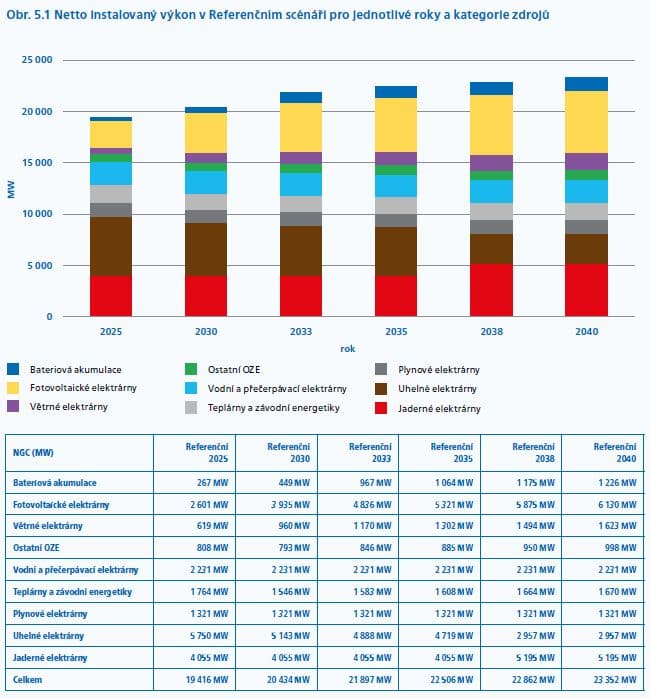
The Conceptual Scenario, which assumes a more significant move away from coal-fired sources after 2030 and a complete coal exit by 2038, already indicates a need to build 2.4 GW of new combined-cycle gas capacity.
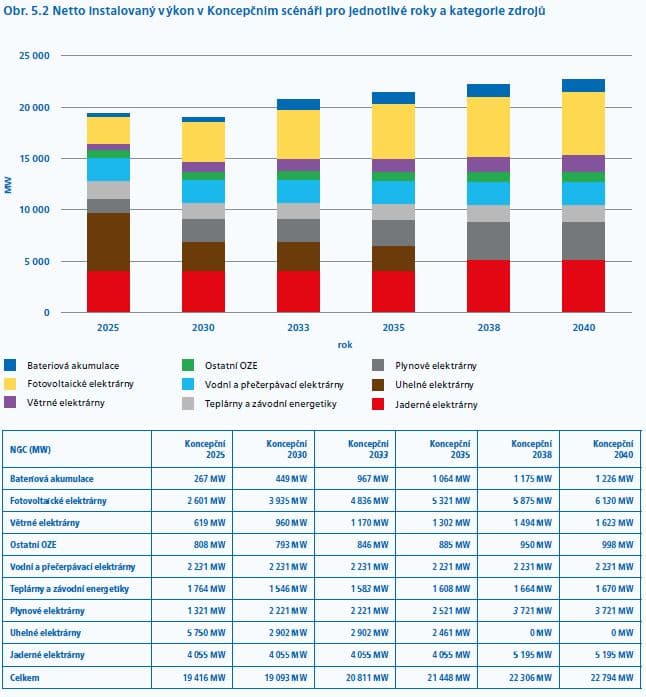
The simulation outputs for the Progressive Scenario, which assumes the end of coal in 2033 and higher penetration of renewable energy sources, are also of interest. Among other things, this scenario requires 3600 MW of additional capacity by 2033.
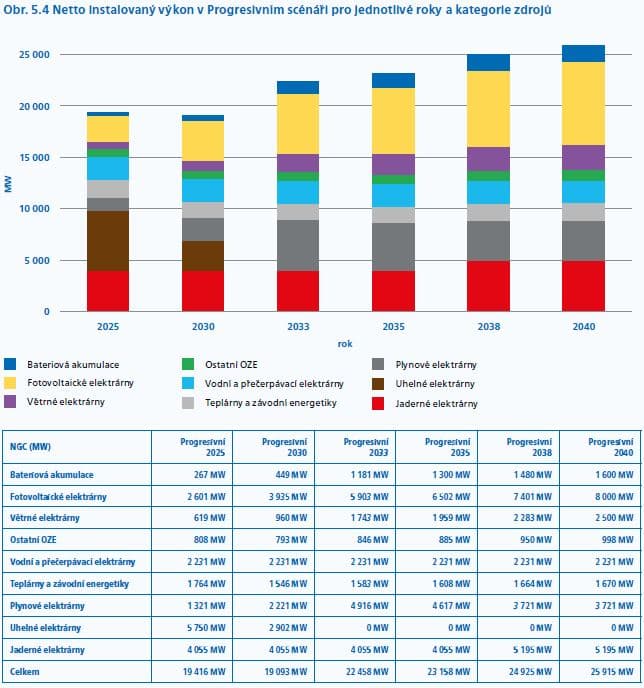
The figures above make it clear that the phase-out of coal-fired power plants and heating plants will very likely lead to construction of several gigawatts of combined-cycle gas capacity. If the Progressive Scenario is implemented, the development of battery energy storage will also need to be accelerated.
Finally, it should be recalled that all of the scenarios above assume operation of all six currently operating nuclear units, which should continue to provide more than 4 GW of baseload capacity and supply around 30 TWh of electricity to the grid annually, as well as commissioning of a new nuclear unit at Dukovany in the second half of the 2030s. In light of events in recent days, the future of the new nuclear source in the Czech Republic is at the very least highly uncertain. If the new nuclear source were removed from the available capacity and annual generation balance, a further increase in additional capacity beyond the stated 2.4 to 3.6 GW could be expected.
Translation disclaimer
This article is a machine translation of the Czech original and has not yet been fully reviewed. In case of any doubt, please refer to the Czech version.