EU renewable energy share nearly triples in 20 years, Czechia lags behind


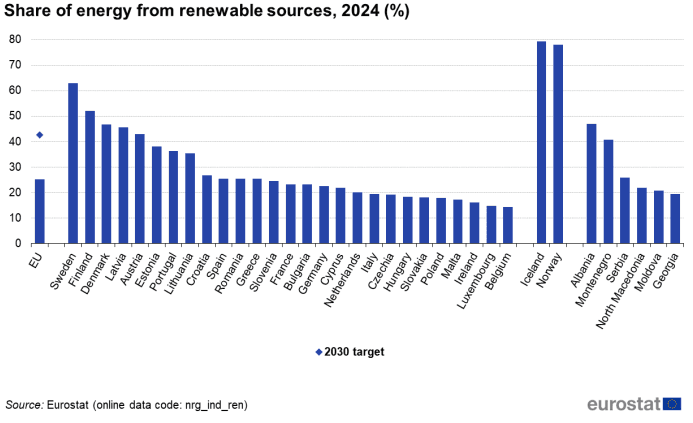
The share of renewable energy sources (RES) in gross final energy consumption in the EU nearly tripled between 2004 and 2024, reaching 25.2% in 2024. In electricity, the EU is already approaching the 50% mark, while in transport it remains around 10%. This follows from data published by the EU statistical office Eurostat.
The share of RES in gross final energy consumption rose by 0.7 percentage points (p.p.) year-on-year in 2024 to 25.2%. Sweden traditionally recorded the highest share, at 62.8% (down 3.6 p.p. year-on-year). Belgium, by contrast, had the lowest share, at 14.3% (down 0.3 p.p. year-on-year). The Czech Republic had a 19.2% share of RES in gross final consumption in 2024, traditionally placing it among countries with lower shares.
"The use of renewable energy sources has many potential benefits, including reducing greenhouse gas emissions, diversifying energy supplies and reducing dependence on fossil fuel markets (particularly oil and gas). The growth of renewables can also stimulate employment in the EU by creating jobs in new ‘green’ technologies, which are one of the pillars of the Energy Union and the Clean Industrial Deal," Eurostat said.
EU approaches 50% share in electricity
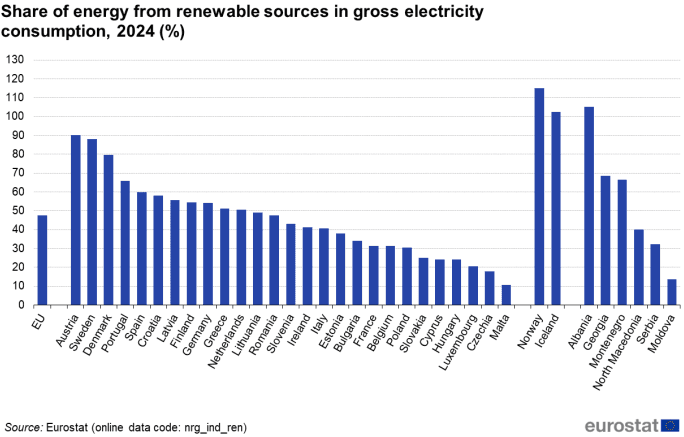
The share of RES in gross electricity consumption reached 47.5% in 2024, representing a year-on-year increase of more than 2 p.p. and a threefold increase compared with 2004.
Austria (90.1%), Sweden (88.1%) and Denmark (79.7%) reported shares above 75%. By contrast, the lowest shares were recorded in Malta (10.7%), the Czech Republic (17.9%) and Luxembourg (20.5%).
"Electricity from wind and hydropower plants accounted for nearly two-thirds of total renewable electricity generation (38.0% and 26.4%, respectively). The remaining third came from solar power plants (23.4%), solid biofuels (5.8%) and other renewable energy sources (6.1%)," Eurostat said, adding that solar power plants are the fastest-growing source. They generated just 7.4 TWh in 2008, compared with 304 TWh in 2024.
More than a quarter of heating and cooling from RES
In heating and cooling, renewables had a share of nearly 27% in the EU in 2024, an increase of 15 p.p. compared with 2004. The Nordic countries traditionally reported the highest shares, led by Sweden (67.8%). Ireland (7.9%), the Netherlands (11.3%) and Belgium (also 11.3%) were traditionally among the lowest performers.
"Growth was supported by developments in industry, services and households. The statistics also include ambient heat used in heat pumps," Eurostat added.

Transport still around 10%
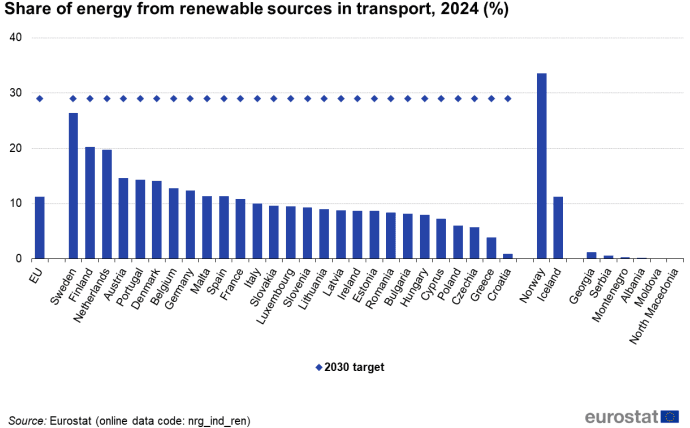
The average RES share in transport in EU countries increased from just 1.4% in 2004 to 11.2% last year. While this represents an eightfold increase, it remains far from the 2030 target of 29%. However, as Eurostat noted, EU member states may choose an alternative to meeting the 29% target: reducing the greenhouse gas emission intensity of fuels used in transport by 14.5% by 2030.
Sweden (26.4%) and Finland (20.3%) have traditionally been among the countries with the highest RES shares in transport. In 2024, the Netherlands began catching up with these countries, reporting a 19.8% share, an increase of more than 6 p.p. year-on-year.
With a share of 5.7%, the Czech Republic is among the three worst-performing countries in the EU.